
2026-10-06
Park Bench Procurement Guide: How to Specify, Compare and Buy Public Benches
A procurement guide for public park benches: specification checklist, material comparison, quotation review, total cost of ownership and the mistakes that inflate municipal bench budgets.
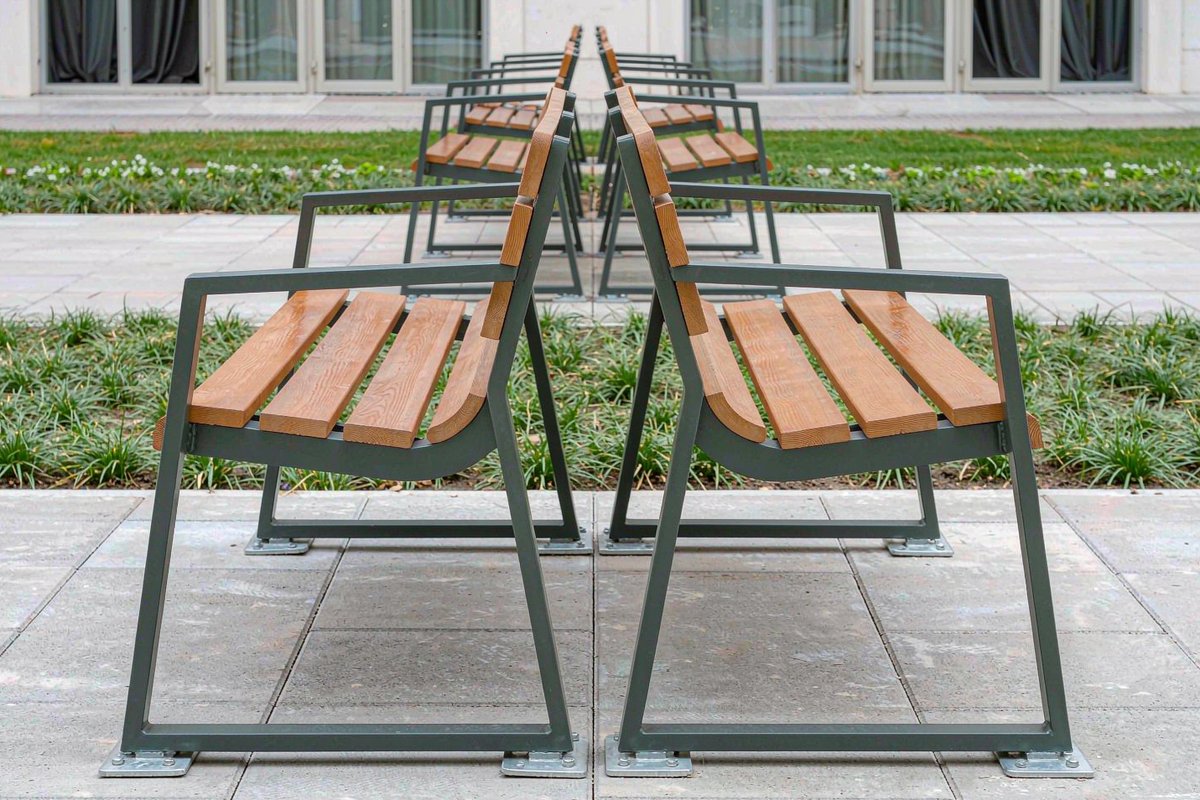
Most municipal bench purchases do not fail because the product was bad. They fail because the tender described a style instead of a specification, the lowest bid was accepted on unit price alone, and the first winter exposed fixings that were never rated for the substrate. Park bench procurement sits at the intersection of design intent, public liability and hard budget cycles — and the gap between a good and a bad process is usually decided before a single quote is opened. This guide walks through how to define, specify, compare and award a public bench package so that the benches you buy are still on site a decade later.
Start With Function, Not With a Photograph
The single most common procurement error is issuing a mood board as a specification. A rendering tells a supplier what the bench should look like; it says almost nothing about what the bench must survive. Before writing the tender, fix these four decisions:
- Use pattern — waiting, resting, social seating, picnic, or amenity-only. Social and picnic benches need different seat depth, back angles and load cases than waiting benches.
- Mounting method — surface-mount, in-ground, or free-standing. This determines the substrate requirements, the fixing hardware and, later, the installation labour line in the contract.
- Expected abuse level — a memorial garden and a transit forecourt should not receive the same frame thickness or the same fixing kit.
- Maintenance capability — who will clean, repaint and replace slats, and with what equipment. A design that needs a specialist repaint every three years is an operational cost, not just a capital one.
Getting these four answers on paper before design sign-off removes most of the ambiguity that suppliers exploit when they "value-engineer" a bid.
The Park Bench Specification Checklist
A tender that pushes suppliers to respond to the same measurable requirements is a tender you can actually compare. Include at least the following in the technical schedule:
| Specification item | What to state | Why it matters |
|---|---|---|
| Frame material and wall thickness | e.g. steel tube 60 × 40 × 3.0 mm, in millimetres | Weight and service life; gauge numbers vary by standard |
| Surface protection | Hot-dip galvanized / zinc primer + polyester powder coat, μm film thickness | Corrosion reserve at scratches and coastal exposure |
| Colour | RAL number, not a colour name | Reproducible touch-up and batch consistency |
| Slat material | WPC, hardwood species, aluminium or powder-coated steel | Comfort, maintenance cycle, replacement cost |
| Fixing kit | Bolt grade, anchor type, substrate assumption, tamper-resistant option | Prevents post-award "fixings excluded" variations |
| Load rating | Static load per seat position and armrest | Public liability and warranty validity |
| Mounting pattern | Hole centres and plate dimensions on a drawing | Lets the contractor pre-set foundations |
| Warranty | Years, coverage scope, exclusions in writing | The real comparator between quotes |
Where a supplier cannot answer a line, that is information in itself. A bench quote with no wall thickness, no film thickness and no anchor grade is a quote you cannot audit.
Comparing Bench Slat and Frame Options
Bench cost and bench performance are both driven by two choices: the frame and the slats. The matrix below reflects what procurement teams typically weigh up across a ten-year horizon.
| Option | Upfront cost | Maintenance over 10 years | Comfort / aesthetics | Best suited to |
|---|---|---|---|---|
| Powder-coated steel frame + WPC slats | Moderate | Low — wipe down, no annual recoating | Good; wood-like look, splinter-free | Parks, promenades, high-use public realm |
| Powder-coated steel frame + hardwood slats | Moderate–high | Medium — oiling or sealing every 1–2 years | Premium natural feel; weathers over time | Heritage and premium landscape schemes |
| Galvanized steel frame + steel slats | Moderate | Low, but hot surfaces in summer | Industrial; extremely durable | Transit, industrial estates, high-vandalism sites |
| Cast iron frame + hardwood | High | Medium–high, heavy units need plant to move | Classic municipal character | Conservation areas with budget for upkeep |
| Aluminium frame + composite slats | Moderate | Very low — no rust, light units | Contemporary, slim profiles | Coastal sites, rooftop terraces, airside |
Two conclusions follow. First, slat material drives lifecycle maintenance while frame material drives structural life — they are separate decisions and should be specified separately. Second, the cheapest row on upfront cost is rarely the cheapest on total cost of ownership once coating repair, slat replacement and fixing failures are added in.
Reading the Quotation: Unit Price Is Not the Price
When three suppliers return three unit prices, the instinct is to rank them. Resist it until each quote is normalised to the same scope. A genuinely comparable bench quotation itemises:
- Frame, slats, armrests and back as separate line items
- Fixing kit and anchor type, priced separately or explicitly included
- Coating system with film thickness and RAL colour
- Packaging method and container loading quantity
- Lead time, incoterm (FOB, CIF, DDP) and port of loading
- Warranty terms and spare-parts availability, including slat-only reorders
A quote that is 20% cheaper because armrests, anchors or the galvanizing step were excluded is not a cheaper bench — it is a different product that will reappear as a variation order. Normalising scope before ranking price is the single highest-value hour in the whole procurement cycle.
Common Park Bench Procurement Mistakes
- Specifying by photograph or by brand name. Invites substitutions you cannot measure, and in many jurisdictions narrows competition unnecessarily.
- Ignoring the substrate. Surface-mount plates specified for a paving build-up that cannot take anchors leads to poorly fixed benches and early failures.
- Buying a single SKU for a whole city. High-traffic nodes and quiet greenways need different duty ratings; a single spec either overspends in low-use areas or underspends where abuse is highest.
- Forgetting spares and slat reorders. A bench line is only maintainable if individual slats and fixings remain available years after the original order.
- No sample or prototype clause. For large fleets, a pre-production sample is cheap insurance against a container of benches that do not match the drawing.
Sourcing Park Benches Factory-Direct
AOTUDE manufactures park benches, litter bins, planters and supporting site furniture at its Foshan factory in China and supplies municipalities, landscape architects and contractors across 40+ countries factory-direct — which means the price you compare is a manufacturer's price, not a trading margin stacked on a catalogue. Our bench range covers steel, galvanized and WPC-slat constructions with specified RAL powder coating, hot-dip galvanizing for coastal and de-icing environments, and the full fixing-kit and mounting-plate detail your contractor needs to set foundations correctly. As an OEM/ODM manufacturer we produce to your drawings and specifications from MOQ 50 pcs per SKU, support sample approval before bulk production, and back every frame with a 5–10 year structural warranty plus spare slats and fittings for the life of the fleet. Send us your tender schedule and we will return an itemised, scope-normalised factory quotation at https://aotude.com.