Stainless Steel Grades for Outdoor Furniture: 304 vs 316 and How to Specify
2026-09-28 · 6 min read · By AOTUDE Furniture Team
Stainless steel sells itself as "rust-free", yet any maintenance team that has cleaned tea-staining off a seaside bench knows the truth: not all stainless is equal. Choosing between the two most common stainless steel grades for outdoor furniture — 304 and 316 — is one of the most consequential line items in a site furniture specification, and it is also one of the easiest to get wrong, because the difference is invisible on delivery day. This guide explains what separates these grades chemically, where each one belongs, and how municipal buyers, landscape architects and contractors should match grade to environment before signing a procurement contract.
Why the Grade Matters More Than the Price Tag
Stainless steel resists corrosion because its chromium content (at least 10.5%) reacts with oxygen to form a self-repairing chromium oxide film only a few nanometres thick. That passive layer is what keeps a bench frame bright after years of rain, salt spray and de-icing chemicals. The catch is that chlorides — from sea air, road salt, pool water and even some cleaning products — attack this film locally and cause pitting corrosion.
Grade 304 and grade 316 differ by roughly 2% molybdenum. That sounds trivial, but molybdenum is what stabilises the passive film against chloride attack, and it can double or triple the service life of stainless furniture in coastal conditions. At the same time, 316 typically costs 15–30% more than 304. Specifying 316 everywhere inflates budgets unnecessarily; specifying 304 at the shoreline invites pitting, rust streaking and warranty disputes within two or three years. The specification decision is therefore about matching grade to exposure, not buying the "best" grade blindly.
Grade 304: The Workhorse for Inland Sites
Grade 304 (18% chromium, 8% nickel, often marked 18/8) is the most widely used stainless steel in the world, and for good reason. In inland urban environments — city plazas, office parks, university campuses, inland parks more than roughly 10–15 km from the coast — 304 performs reliably for decades with only routine cleaning.
Where 304 works well:
- City-centre plazas and pedestrian streets away from the coast
- Corporate campuses and institutional grounds
- Inland parks and playgrounds with normal rain exposure
- Indoor-outdoor transition zones such as covered terraces
Where 304 struggles:
- Within a few hundred metres of breaking surf
- Areas heavily treated with winter de-icing salt, where salt residue stays wet on surfaces
- Around swimming pools, where chlorine compounds concentrate
- Sites where the furniture is never cleaned and grime holds moisture against the surface
Grade 316: When Chlorides Demand More
Grade 316 adds 2–3% molybdenum (and slightly more nickel) to the 304 recipe. The molybdenum dramatically raises the resistance of the passive film to pitting and crevice corrosion, which is exactly the failure mode that chlorides trigger. This is why 316 is often called "marine grade" — it is the default choice for beach promenades, harbourfront developments, seaside resorts and coastal boardwalks.
Three practical notes for specifiers:
- 316 is not maintenance-free. Even 316 needs periodic freshwater washing in marine zones to remove salt deposits; neglect it and tea-staining will eventually appear on any grade.
- The 10–15 km rule of thumb. Corrosivity falls off quickly inland, but the exact transition depends on prevailing winds and topography. A common conservative practice is to specify 316 within roughly 10–15 km of the coast and 304 beyond it.
- De-icing zones deserve 316 too. Municipal crews that spread rock salt every winter create artificial coastal conditions on sidewalks and plaza edges. Salt-splash zones on bollards, bin bodies and bench legs see chloride concentrations comparable to sea spray.
304 vs 316 at a Glance
| Property | Grade 304 | Grade 316 |
|---|---|---|
| Composition | 18% Cr, 8% Ni | 16–18% Cr, 10–14% Ni, 2–3% Mo |
| Chloride / pitting resistance | Good | Excellent |
| Typical cost index | 1.0 | 1.15–1.30 |
| Suitable distance from coast | > 10–15 km | Anywhere, incl. beachfront |
| De-icing salt exposure | Acceptable if cleaned | Strongly recommended |
| Poolside / marine structures | Not recommended | Recommended |
| Typical outdoor furniture use | Urban plazas, inland parks | Coastal promenades, marinas, winter road corridors |
Surface Finish and Passivation: The Half of Performance That Nobody Orders
Grade alone does not determine corrosion performance — surface condition does most of the remaining work. Two details belong in every stainless furniture specification:
- Brushed finish (e.g. 240 grit) as standard. A brushed, directional finish drains water evenly and makes minor staining and scratching far less visible than a mirror polish. It is also the look most architectural specifications ask for on visible frames.
- Passivation after fabrication. Welding and bending leave free iron and heat-tint on the surface — the very triggers of rust staining on a chemically perfect grade. A pickling-and-passivation bath (nitric acid treatment per ASTM A967 or equivalent) restores the chromium-rich passive layer across welds and bends. If a supplier cannot confirm passivation, the "stainless" performance of the frame is a lottery.
It is also worth distinguishing stainless furniture from other corrosion-protection strategies. For painted or galvanised carbon-steel furniture, protection comes from coatings, as covered in our guides to outdoor furniture materials and hot-dip galvanizing for outdoor furniture. Stainless steel instead builds protection into the alloy itself — the trade-off is a higher material cost in exchange for no coating that can chip or wear through.
A Specification Checklist for Stainless Site Furniture
Before approving a stainless steel bench, litter bin or bollard package, check that the offer states:
- Grade (304 or 316) for the load-bearing frame and visible fasteners — mismatched fixings are the most common rust-streak source on otherwise correct furniture.
- Surface finish (brushed grit or polished) applied consistently, including inside weld areas.
- Passivation or pickling after welding, with certificate.
- Cleaning and maintenance instructions matched to the site's corrosivity class.
- Weld quality: continuous, sealed welds without porosity, since crevices collect chlorides.
These five lines cost nothing to add to a tender document and remove nearly all of the ambiguity that leads to disputed rust claims in year two.
Sourcing Stainless Furniture at Factory Terms
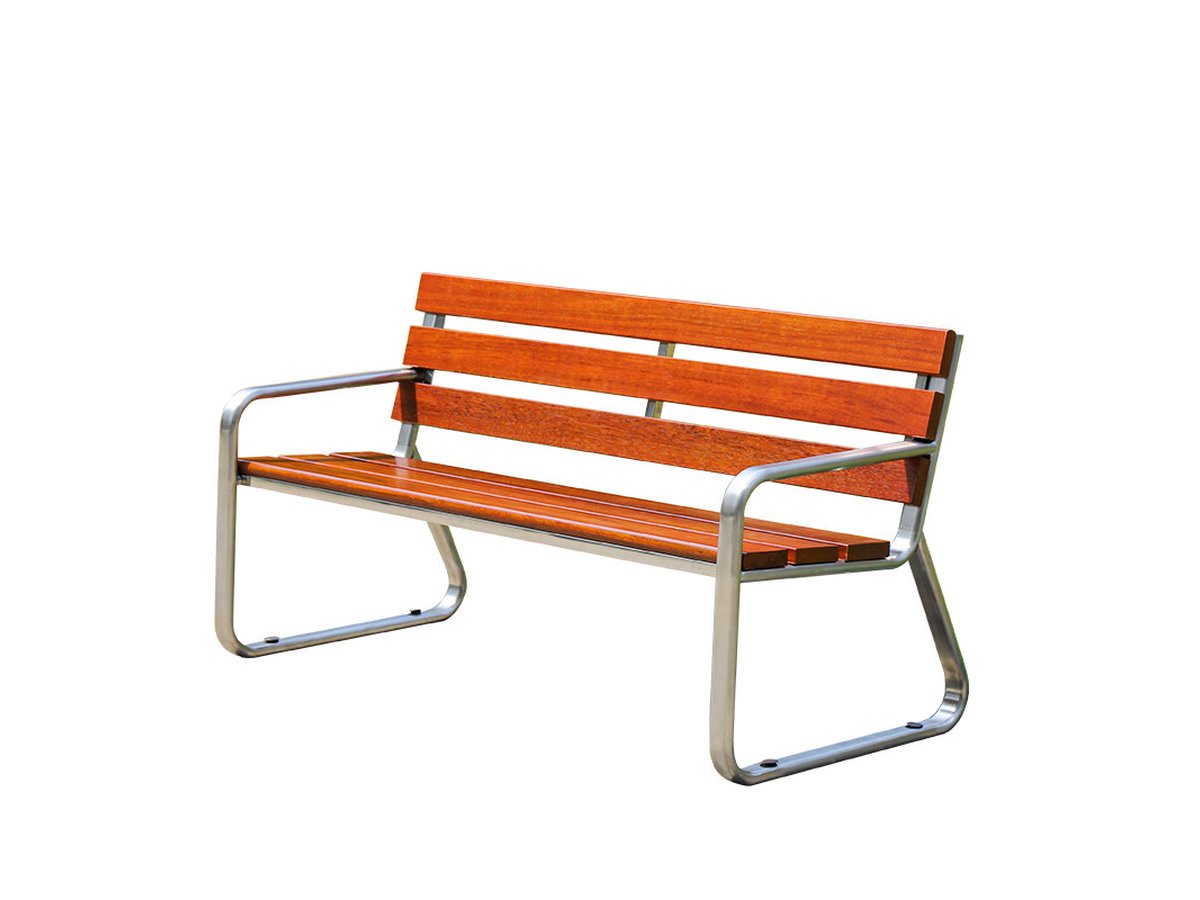
AOTUDE manufactures stainless and carbon-steel site furniture — including the Stainless Frame Park Bench and other pieces in our outdoor seating collection — at our 20,000 m² factory in Foshan, China, and ships factory-direct to municipal and commercial buyers worldwide. We produce in 304 or 316 depending on your site's exposure, passivate all stainless weldments as standard, and support OEM/ODM customisation from your drawings with a minimum order of just 50 pieces. Every stainless product is backed by a 5–10 year warranty, and our team can help you match grade and finish to your project's corrosion environment before you commit. Browse the full range at https://aotude.com or request a factory quotation for your next tender.