
MOQ
Per-model, from 5 pcs
Lead time
Confirm with sales (production + sea freight)
Quality & testing
ISO 9001 process, CMA/CNAS test reports on request
Trade terms
FOB / CIF, 30% deposit
A recycling station only works if people get it right at the point of throw. That is a design problem, not an education problem: the apertures, colours and icons have to make the correct stream obvious in under two seconds, in the rain, from a metre away.
AOTUDE builds two- and three-stream stations around a shared steel frame with independent removable liners, so each stream can be emptied without touching the others. Aperture shapes, icon panels and body colours are specified per stream, and the panel artwork can follow your city or campus signage system rather than a generic set.
The range covers the Duotone two-stream classified bin for parks and playgrounds, the Triovista three-stream station with bold graphic panels for streets and malls, and the Trisort triple sorting bin for campuses and transport interchanges. Custom stream counts, RAL colours and panel artwork are available on custom runs from 50 pcs per model.
Multi-stream stations fail on capacity per stream, not on total volume: see capacity per collection stream before you fix the split between compartments.
Key features
- ✓Two- and three-stream configurations on a shared frame
- ✓Independent removable liners — one stream emptied at a time
- ✓Icon panels, aperture shapes and body colours per stream
- ✓Panel artwork can follow your existing signage system
- ✓Powder-coated galvanized steel, anti-vandal fixings
3 Recycling Stations models
Every model below is manufactured in our Foshan plant. Open a model for dimensions, finish options and tiered FOB pricing, or send a drawing for a custom length.
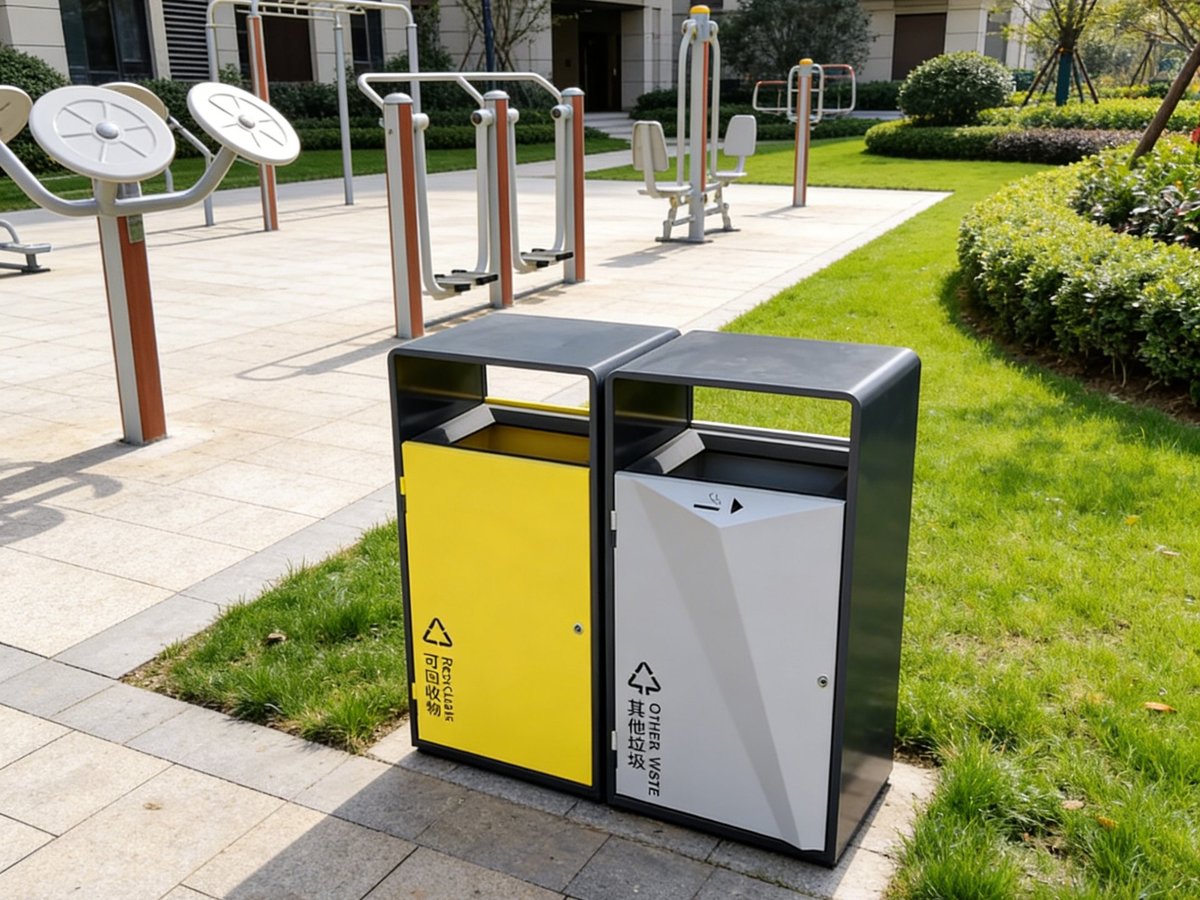
Duotone Classified Litter Bin
Two-stream classified litter bin pairing a bright recyclable-yellow body with a light grey residual compartment — high visibility for parks and playgrounds.
Request a quote · MOQ 20 pcs
View specifications →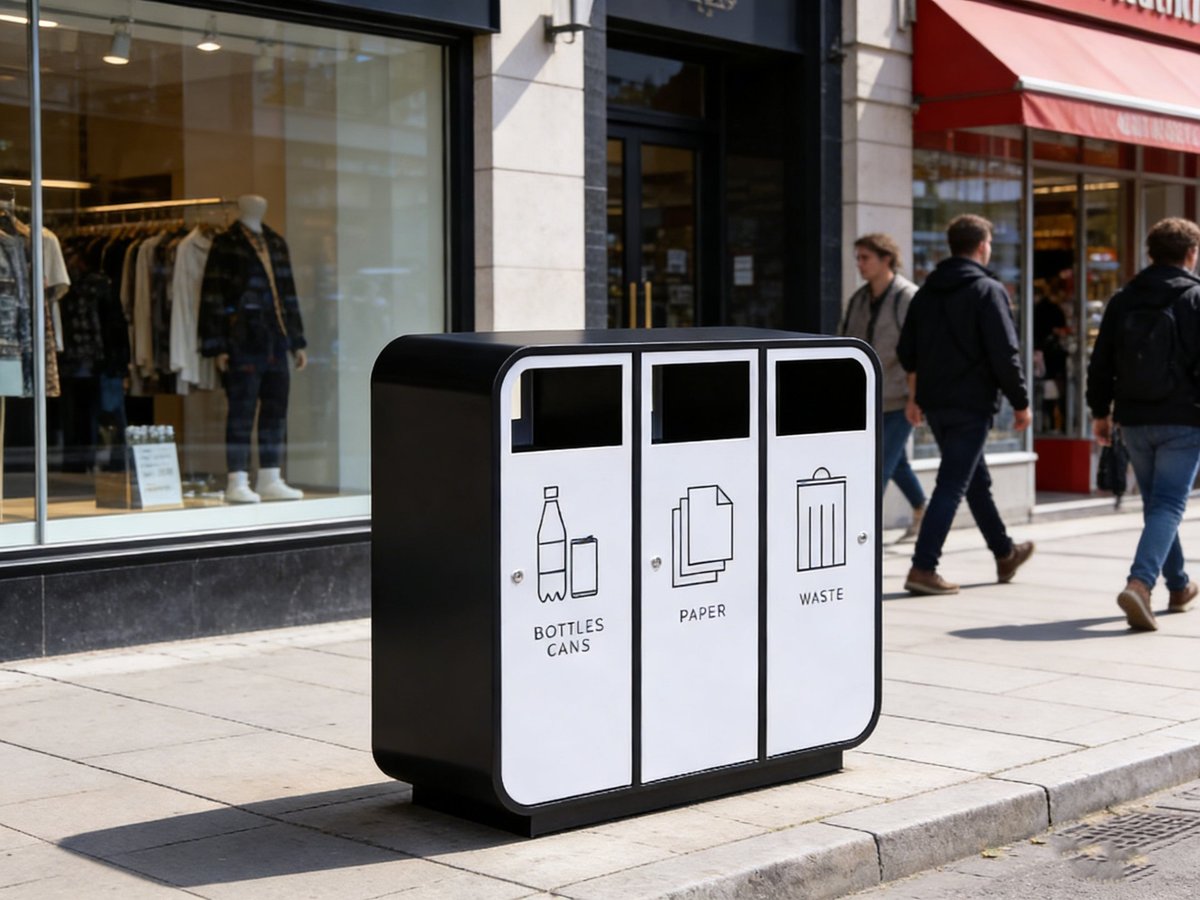
Triovista Triple Recycling Station
Three-stream recycling station with bold icon panels for bottles & cans, paper and waste — a clean, wayfinding-friendly statement piece for streets and malls.
Request a quote · MOQ 20 pcs
View specifications →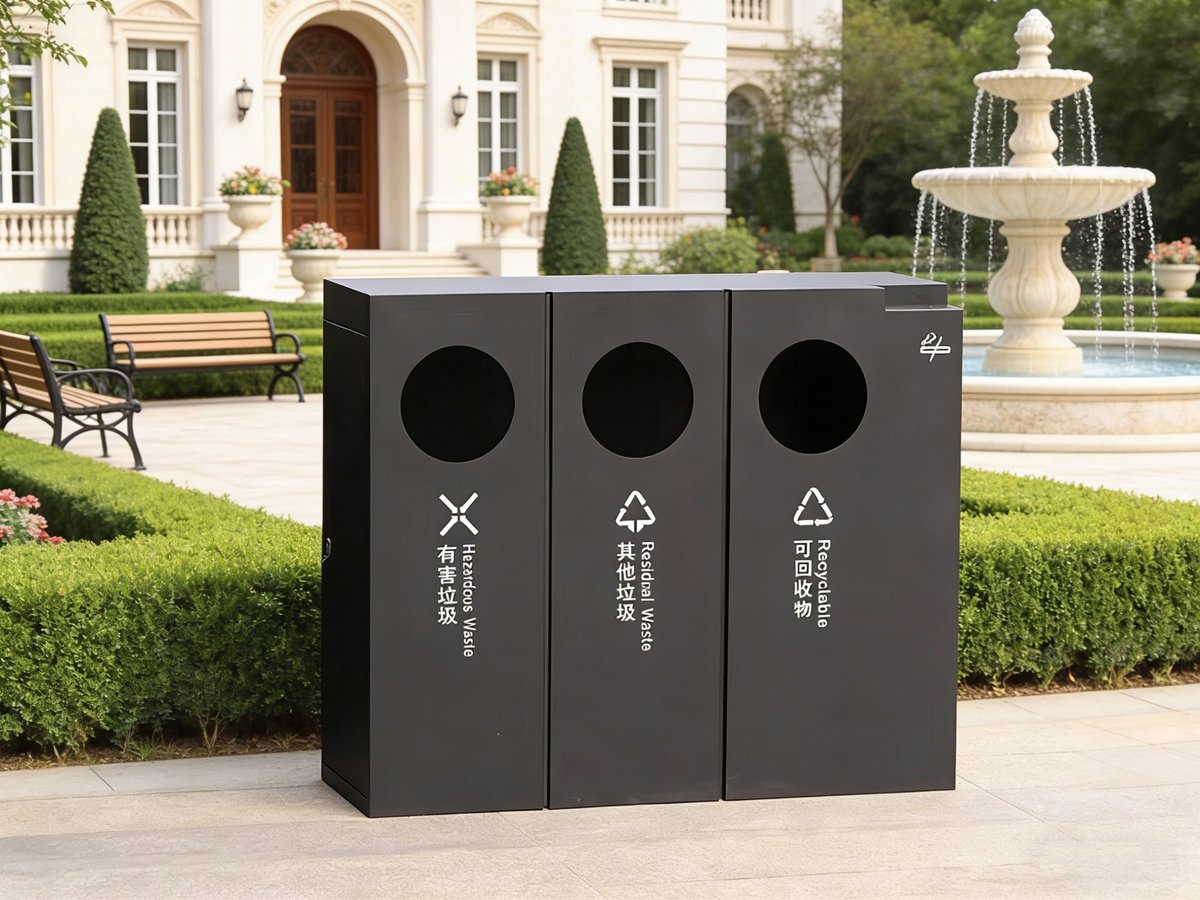
Trisort Triple Sorting Bin
Slim three-compartment sorting bin with circular apertures for recyclable, residual and hazardous waste — ideal for parks, estates and public gardens.
Request a quote · MOQ 20 pcs
View specifications →Model specifications
| Model | Dimensions (mm) | Streams | Body material |
|---|---|---|---|
| Duotone Classified Litter Bin | 800 x 420 x 950 mm | 2 | Powder-coated galvanized steel |
| Triovista Triple Recycling Station | 1500 x 450 x 1000 mm | 3 | Powder-coated steel frame, steel graphic panels |
| Trisort Triple Sorting Bin | 1290 x 400 x 1050 mm | 3 | Powder-coated galvanized steel |
Stream count and panel artwork are project-specific. We do not claim compliance with any national recycling-labelling regulation — the station is built to your specification and your local scheme remains the authority on colours, icons and stream names.
Which build fits which site
A short decision table for specifiers — the same logic our engineers apply when reviewing a project drawing.
| Setting | Recommended configuration | Why |
|---|---|---|
| Park, playground, small plaza | Two-stream (recyclables / residual) | Two streams is the most people get right without supervision |
| Street, mall, high-footfall frontage | Three-stream with graphic panels | Bigger visual target, clearer icons, wayfinding benefit |
| Campus, transport interchange | Three-stream with labelled apertures | Captive audience, consistent stream names across the estate |
| Site with no collection for one stream | Two-stream, or single-stream plus residual | Never add a stream that the collection contract cannot empty |
| Heritage or landscape setting | Two-stream in timber-clad body | Keeps the material palette consistent with benches and bins |
2-Stream vs 3-Stream: Choosing by Collection Contract
Start from the collection contract, not the waste audit. The station only works when every aperture on it is emptied separately by someone paid to do it — a compartment with no collection route becomes a contamination bin within weeks.
| 2-stream station | 3-stream station | |
|---|---|---|
| Must be true before you specify it | Two separate collection routes exist on site (typically recyclables / residual) | Three separate routes exist, and the stream names match the rest of the estate |
| Typical failure mode | Both streams go to one truck, so the separation at the aperture was theatre | The third stream has no collection contract, so it fills with whatever fits |
| Suited to | Parks, playgrounds and small plazas — two streams is what most people get right unsupervised | Campuses, transport interchanges and high-footfall frontages with dedicated servicing |
If in doubt, specify two streams that get emptied correctly over three that might not.
Recycling Bins for Parks, Streets and Campus Plazas
Siting decides whether a station is used correctly long before the graphics do. The same three-stream unit that works on a campus plaza underperforms on a park path, and the differences are practical rather than aesthetic: walking speed, who empties it, and whether the aperture is visible from the direction people actually approach.
Parks. People arrive slowly and often with a bag already in one hand, so the station belongs on the main circulation route rather than at the boundary, and it is read against the litter bin standing next to it. Two streams is usually enough here; what matters is that both apertures stay legible from a short distance in low light, which is a panel-contrast decision rather than a reason to specify a larger body. A station tucked behind planting or a shelter wall reads as a maintenance object and collects contamination instead of sorting.
Streets. Footfall is fast and the throw is made in motion, so the aperture faces the oncoming pedestrian and the colour coding sits at eye height rather than at knee height. A three-stream station with graphic panels — the Triovista is the model built for this — suits a high-footfall frontage, but only where the third stream has a collection route of its own. On a street the failure is almost always contractual, not behavioural.
Campus plazas. The constraint is consistency across the whole estate rather than any single installation. Stream names, colours and icons have to match the bins inside the buildings, because a student who sorts correctly in the entrance hall will not re-learn a different scheme outdoors. Service access changes too: a grounds crew working from a utility vehicle needs the door to open clear of the parking bay and the hinge side away from passing traffic.
Across all three settings the design question for recycling bins for public spaces is the same one: how many streams the collection contract can genuinely service, and how fast a crew can empty one without disturbing the others. That is why we ask for the collection schedule before the artwork — the stream count follows from it, not from the waste audit on its own.
Materials, coating and quality control
The same four stages apply to every model in this range, whether it is a catalogue item or a bespoke project — which is why a bench, a bin and a planter from one order will still match after five years outdoors.
Steel
Mild steel sheet and tube, laser-cut and MIG-welded; gauge selected per load path rather than a single house gauge.
Corrosion protection
Hot-dip galvanizing to ISO 1461 on request, or a zinc-rich primer where hollow sections make dipping impractical.
Powder coating
Outdoor-grade polyester powder coat over a conversion coating, cured to the coating supplier's schedule; any RAL colour.
Quality control
Incoming material check, weld inspection, coating thickness and adhesion, pre-shipment inspection with photo record.
Test reports (salt spray, coating thickness, material certificates) are issued with the shipment when requested and can be supplied at tender stage. We do not publish test figures for a product until the report for that specific build exists.
Frequently asked questions
How do the apertures and colours reduce contamination? +
Contamination drops when the aperture shape physically excludes the wrong item (a round hole for bottles and cans, a slot for paper) and the body colour matches the local scheme. We build apertures and panels to your specification rather than a fixed set, so the station reads as part of the site.
How is each stream emptied? +
Each compartment has its own removable liner with a separate door or lift-out top, so a crew can empty one stream without disturbing the others. That matters where recyclables fill faster than residual waste.
Will the station survive outdoor exposure and heavy use? +
Bodies are powder-coated galvanized steel with stainless fasteners, and doors are hinged and latched rather than lift-off. For exposed coastal sites we recommend stainless or a heavier coating build-up; tell us the location and we will specify the finish.
Can the station follow our city or campus recycling scheme? +
Yes — send the scheme document (stream names, colours, icon set) and we will produce an artwork proof for approval before production. We will not claim that the result is "compliant" with a regulation; acceptance remains with your waste authority.
Selection guides and technical notes
Deeper reading for specifiers and procurement teams working on this product line.
2026-10-08
Green Public Procurement for Street Furniture: How Tender Evaluation Criteria Are Shifting
2026-10-04
Litter Bin Capacity Planning: How to Size Public Waste Bins for Parks, Streets and Plazas
2026-09-27
Sensor-Based Litter Bin Collection ROI: What Cities Should Calculate Before Buying
2026-10-04
Smart Bin Trends: How Solar-Compacting and IoT Litter Bins Are Changing Public Waste Management
2026-09-21
How to Choose Outdoor Trash Bins for Parks: A Municipal Buyer's Checklist
2026-09-26
Anti-Vandal Street Furniture Design: How to Specify Site Furnishings That Survive Public Spaces
See also the site furniture specifications hub for material comparison, coating build-up and dimensional conversions.
Send your drawing, get a costed BOM
Tell us the site, the quantity and any dimensional constraint. Our engineers reply with a specification and price within one working day.
Request a Quote