Perforated Metal in Outdoor Furniture: Patterns, Open Area and Specs
2026-11-01 · 7 min read · By AOTUDE Furniture Team
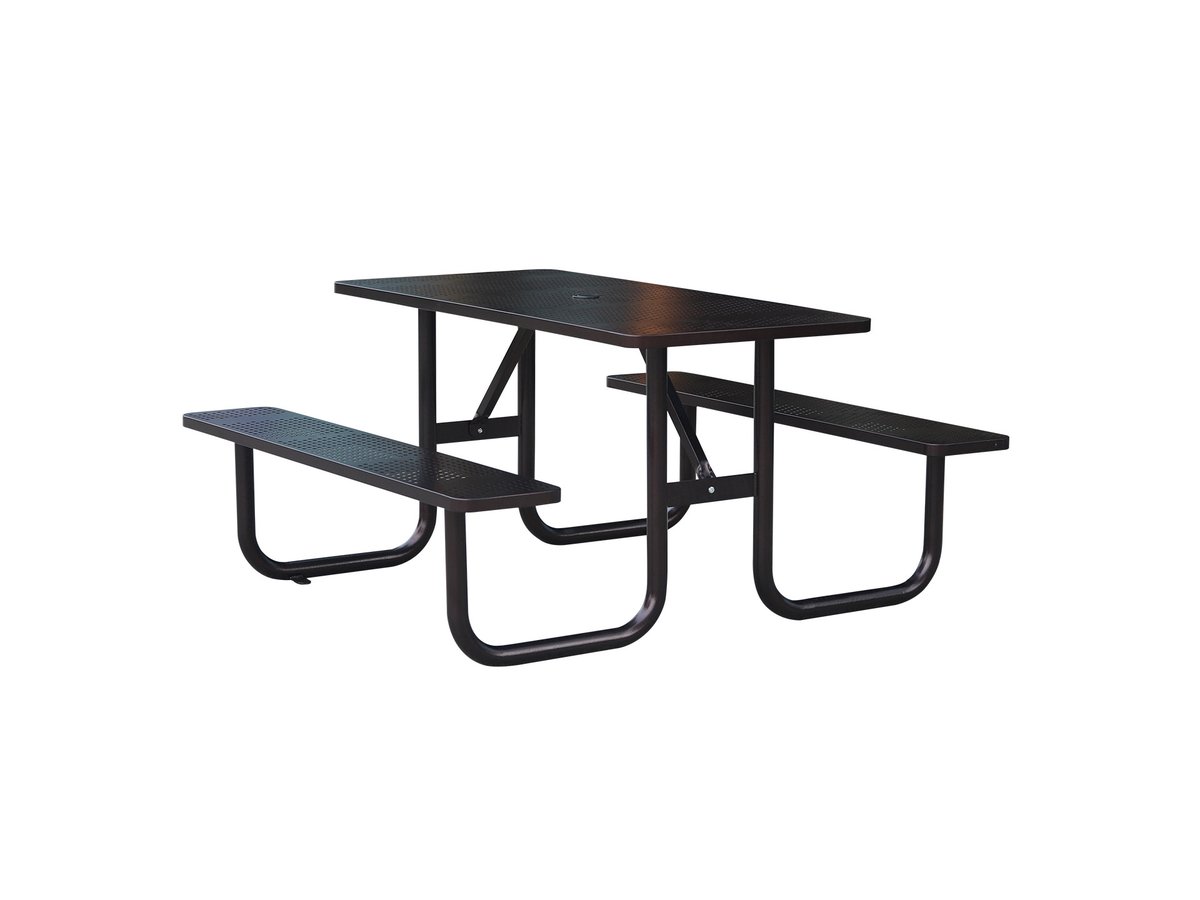
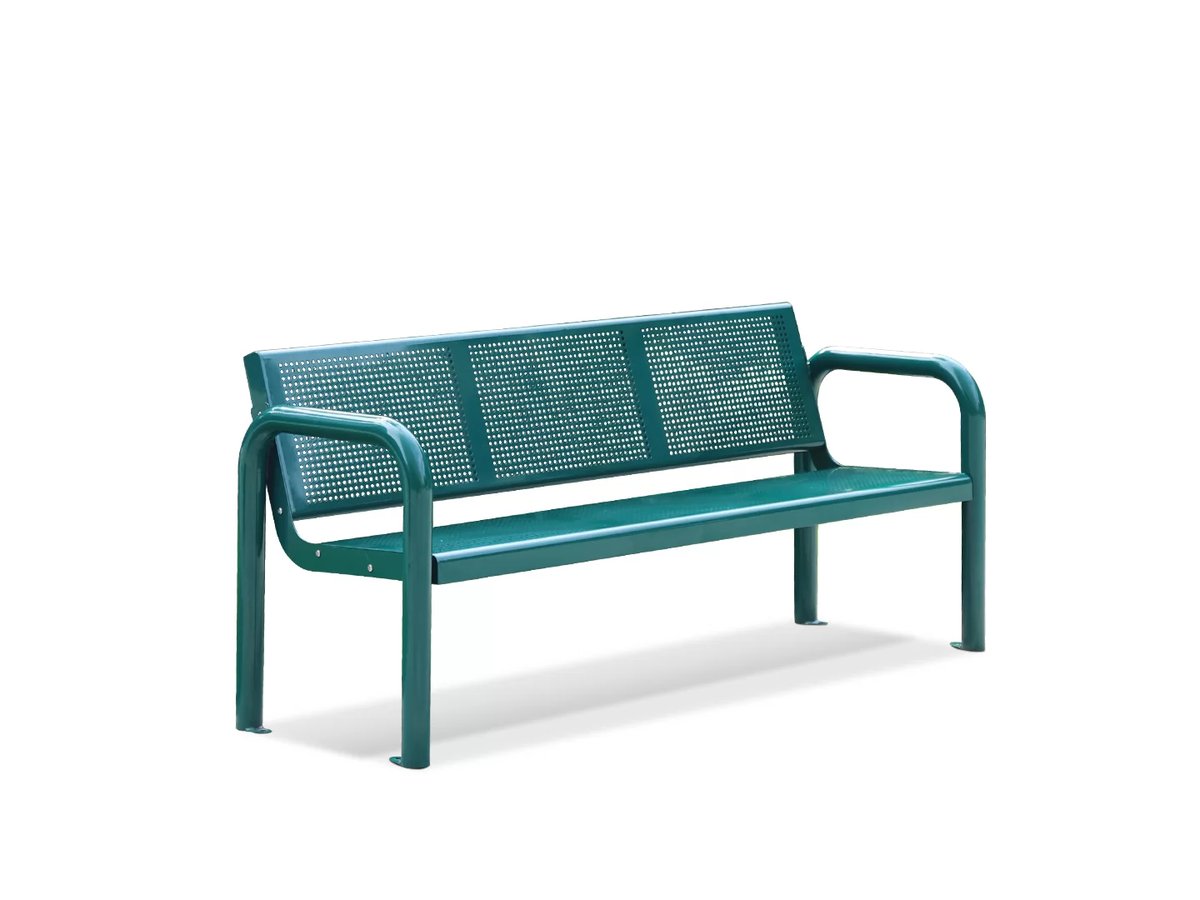
Perforated metal panels are everywhere in public space furniture — on the seats and backs of the modern perforated steel park bench, on litter bin hoods, on picnic table tops and on planter screens. Yet perforation is one of the least specified aspects of site furniture tenders. Buyers routinely lock in the material and the powder coat colour, then leave the hole pattern to the factory, and only discover the consequences later: surfaces that hold water, panels that dent, seats that feel cold and hard, or waste bins that let litter blow straight back out.
This guide explains how perforated metal works in outdoor furniture, which numbers actually belong in a specification, and how to match the pattern to the function — whether you are evaluating a landscape architect's rendering or writing a procurement sheet from scratch.
Quick answer: For most public furniture, a round-hole pattern between 3 mm and 10 mm diameter, punched from 2–3 mm sheet steel, with 20–40% open area, and finished with a galvanized-plus-powder duplex coating, delivers the best balance of drainage, strength, vandal resistance and seat comfort.
Why Perforated Panels Beat Solid Sheet in Outdoor Use
Solid metal panels look clean on day one, and then quietly collect problems. Rain pools on flat seats, leaves paste themselves to surfaces, and graffiti sits on a continuous canvas. Perforation changes the physics rather than just the look:
- Drainage. Water and melted snow pass straight through seats and tabletops, so surfaces dry in minutes instead of hours. Less standing water means fewer corrosion starting points and fewer icy patches.
- Litter and debris behaviour. On a perforated litter bin, rain drains to the liner instead of brewing a soup bag, while the pattern lets ground staff see fill levels from a distance. On tabletops, small holes shed crumbs and bottle-cap puddles.
- Wind loading. Open area reduces wind uplift and pressure on large panels — relevant for anything cantilevered or mounted where gusts funnel along a waterfront.
- Grip and comfort. Micro-texture from the holes reduces the wet-glass sliding effect on seats; in winter, perforated surfaces hold less film of ice.
- Vandal resistance. A dimpled, perforated surface gives spray paint less continuous area and makes scratching less rewarding, which is one reason perforated faces are common on furniture specified for transit hubs and nightlife districts.
Common Hole Patterns and Where Each One Belongs
Pattern choice is a mix of engineering and visual identity. The main families used in site furniture:
| Pattern | Typical size in furniture | Best suited for | Notes |
|---|---|---|---|
| Round hole, staggered (60°) | Ø3–10 mm, pitch 5–12 mm | Bench seats/backs, bin hoods, tabletops | The default for good reason: highest strength per open area, most comfortable to sit on, most graffiti-friendly to clean |
| Round hole, straight grid | Ø5–15 mm | Recycling stations, decorative screens | Cleaner geometric look; slightly less stiff than staggered layout at equal open area |
| Square hole | 10–25 mm | Industrial-style plazas, bin bodies | Bold look; more edge length to deburr; catches heels of shoes if used on walking surfaces |
| Slot / elongated | 3×20 mm to 5×40 mm | Planter screens, shelter cladding, skewers-resistant bin openings | Directional privacy and airflow; slots resist pencil-poking and litter drop-through better than big rounds |
| Decorative / custom (logo, leaf, wave) | Project-specific | Brand plazas, campus identity projects | Costs more in tooling; require laser or custom die — viable for larger OEM runs |
For most municipal work, the staggered round hole is the workhorse. It maximises strength for a given weight, sheds water in any orientation, and its slight visual "texture" hides wear far better than a solid panel.
Open Area Percentage: The Number That Actually Matters
The single most useful spec value in perforation is open area — the percentage of the panel surface that is hole rather than metal. It links directly to drainage speed, wind load, visibility and comfort:
| Open area | Behaviour in the field | Typical applications |
|---|---|---|
| 10–20% | Slow drainage, mostly decorative; surfaces stay damp longer | Decorative screens, privacy panels |
| 20–40% | Fast drainage, visible fill level in bins, comfortable seating | Bench seats, litter bin bodies, picnic tabletops |
| 40–60% | Very fast drainage, but panel stiffness drops and edges feel coarser | Bins in heavy rain zones, non-seat surfaces |
| 60%+ | Structural bracing needed; not suitable for seats or tabletops | Cladding, mesh-style architecture |
Open area is calculated from hole diameter and pitch — a staggered Ø8 mm hole on a 12 mm pitch, for example, gives roughly 40% open area. You do not need to do the maths yourself, but you should require the supplier to state the open area and the punch specification on drawings. A vague "perforated steel" line item is how two factories quote wildly different products against the same tender.
Pairing Perforation with Sheet Thickness
Perforation removes material, so the panel must be thicker than an equivalent solid sheet — this is where perforation and gauge specification meet. Our earlier guide to steel gauge for outdoor furniture covers the general thickness logic; for perforated panels the practical pairings are:
- 2.0–2.5 mm sheet with holes up to Ø6 mm — light-duty seats, tabletops in low-vandalism parks.
- 2.5–3.0 mm sheet with holes up to Ø10 mm — the standard for public bench seats, bin hoods and picnic tops; the workhorse range.
- 3.0–4.0 mm sheet for larger holes (Ø12 mm and up), slots, or high-vandalism locations such as transit stops.
Two failure modes to design out: oil-canning (a large thin panel that flexes with a hollow "clack" under load — solved by edge returns, stiffener folds or closer pitch) and hole-edge crack propagation at punched edges under repeated impact (solved by adequate thickness and full powder-coat coverage of the punched edge).
Function Check: Drainage, Cleaning and Coating the Punched Edges
Punched holes create raw, sharp steel edges — thousands of them per panel. Coating strategy matters more here than on any solid sheet:
- Deburr and edge-round before coating. Powder will not wrap a burr; uncoated burrs rust first and shed oxide stains onto paving.
- Pre-galvanize, then powder. A duplex system — hot-dip galvanizing under a UV-stable polyester powder — protects both the faces and the internal hole walls. This is the same synergy described in our galvanizing guide, and it matters doubly on perforated panels where hole walls add coated surface area.
- Specify powder film thickness on perforated parts explicitly (typically 60–80 µm), since electrostatic wrap into holes is weaker than on flat faces; a reputable line compensates with gun positioning and a second pass.
- Cleaning compatibility. Perforated seats tolerate pressure washing well because water exits through the pattern. For graffiti response on textured perforated surfaces, the pattern's discontinuity usually reduces required solvent contact time — see our guide to graffiti removal methods for solvent selection and anti-graffiti coating considerations.
If your portfolio includes waste infrastructure, the same logic applies to a perforated litter bin: open area shows fill level, drains rain, and allows air movement that reduces odour — but holes must be small enough (or slotted) to stop cans and bottles being pushed through into the liner.
Pre-Tender Specification Checklist
Copy this block into your drawing notes or tender annex:
- Pattern: staggered round, Ø8 mm on 12 mm pitch (or project-specific)
- Open area: 20–40% stated on drawing, calculated, not estimated
- Sheet: 2.5–3.0 mm steel (or 3 mm+ for holes over Ø10 mm)
- Edge treatment: all punched edges deburred; panel edges returned or folded
- Coating: hot-dip galvanized to ISO 1461 + polyester powder 60–80 µm, RAL ___
- Fixings: tamper-resistant, isolated from panel with washers/gaskets
- Sample: one production-finish sample panel approved before batch coating
One last ergonomic note: holes above roughly Ø12 mm start to transmit the "waffle" feel through clothing and can catch heels of narrow shoes on tabletop edges; below roughly Ø3 mm they lose drainage benefit and cost more in tooling time. The 3–10 mm band is where outdoor furniture lives.
How AOTUDE Manufactures Perforated Site Furniture
AOTUDE is a factory-direct manufacturer of outdoor site furniture in Foshan, China, operating a 20,000 m² production facility where CNC punching, laser cutting, press-brake forming, hot-dip galvanizing and powder coating sit under one roof — perforation, forming and coating are controlled in one quality loop, with all punched edges deburred before coating. We supply perforated benches, litter bins, picnic tables and planters to municipalities, landscape architects and contractors in 40+ countries, with full OEM/ODM customization including custom decorative patterns and per-model MOQ from 5 pcs (most models from 20 pcs; custom runs from 50 pcs), backed by a 5–10 year warranty on structure and coatings. Send your pattern drawings or tender documents through aotude.com and our engineering team will return a manufacturable perforation specification with matched sheet thickness and coating build-up.