GFRC Planters: A Specifier's Guide to Glass Fibre Reinforced Concrete
2026-10-28 · 7 min read · By AOTUDE Furniture Team
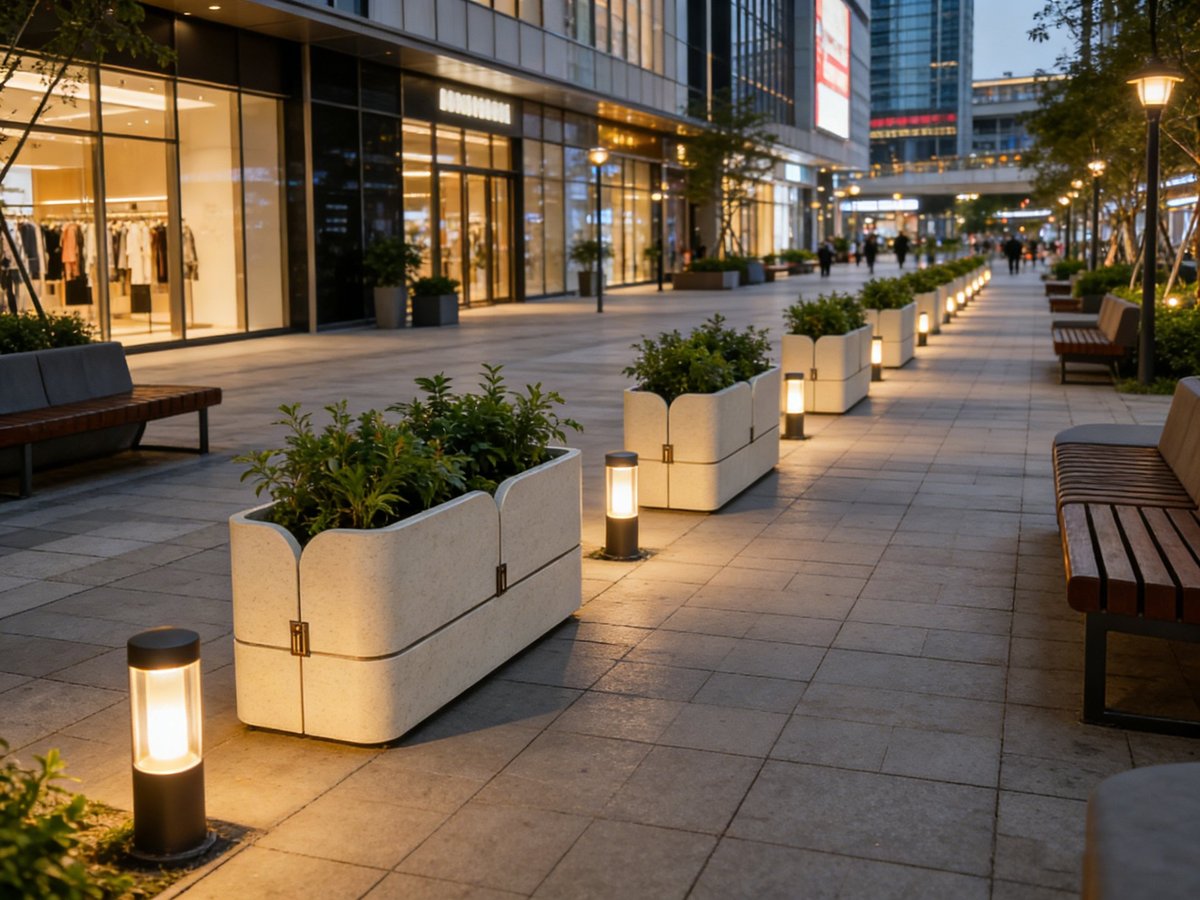
Concrete-look planters are everywhere in contemporary streetscape design — but the stone-grey body you admired on a recent plaza project is probably not solid concrete at all. Chances are it is GFRC: glass fibre reinforced concrete, a cementitious composite that delivers the mass and mineral texture of precast stone at a fraction of the weight. For municipal engineers and landscape architects, GFRC planters solve a specific set of problems — roof load limits, crane costs, frost cracking, and the gap between a rendered concept image and what can actually be installed on a constrained site. This guide explains what GFRC is, how it compares with the other planter materials you are likely to be pricing side by side, and what to check before you sign a specification.
If you are still at the sizing stage, our outdoor planter size chart covers dimension planning; here we focus on the material itself.
What GFRC Actually Is
GFRC is a composite of three things: a fine sand-and-cement matrix, alkali-resistant (AR) glass fibres, and typically a polymer admixture that improves flexural strength and reduces permeability. The fibres carry tensile loads that plain concrete cannot, which allows the wall section to be dramatically thinner — usually 12–25 mm instead of the 80–150 mm typical of precast concrete planters.
That thin section is the whole point. A GFRC planter body behaves like a shell rather than a block: it is moulded off a single form, cured under controlled conditions, and arrives on site as a finished, sealed unit. Because the mix is applied against a high-quality mould face, the as-cast surface can replicate granite, travertine, board-formed timber or any other texture without additional cladding.
Two clarifications specifiers often need:
- GFRC is not glass-fibre-reinforced plastic (GRP/fibreglass). GRP is a polymer composite with no cement content; GFRC is a cementitious composite with glass fibre reinforcement. Their failure modes, fire behaviour and weathering are entirely different.
- GFRC is not "lightweight concrete" in the aggregate sense. Lightweight concretes replace the stone aggregate with expanded clay or similar; GFRC keeps normal-density aggregates but simply needs less material because the fibres do the structural work.
GFRC vs the Alternatives: A Material Comparison
Most planter tenders arrive with two or three materials priced in parallel. Here is how GFRC stacks up against the usual candidates for public-realm work.
| Property | GFRC | Precast concrete | Powder-coated steel | Rotation-moulded polymer |
|---|---|---|---|---|
| Relative weight (same volume) | Medium-low | Very high | Low | Very low |
| Wall section | 12–25 mm shell | 80–150 mm+ | 1.5–3 mm panel | 4–8 mm wall |
| Frost resistance | Good when sealed and drained | Vulnerable to spalling at cracks | Not frost-sensitive | Not frost-sensitive |
| Impact behaviour | Chips locally, no collapse | Cracks can propagate | Dents; coating damage invites rust | Scratches, UV fade over years |
| Surface fidelity | Any cast texture or colour | Cast texture, less crisp | Any RAL colour | Limited texture range |
| Typical failure mode | Edge chip, sealant failure | Crack/spall from freeze-thaw | Coating breach → corrosion | UV degradation, brittleness |
| Crane / install cost | Low–medium | High | Low | Lowest |
| Repairability | Patch + recoat, near invisible | Patch visible, colour drift | Touch-up paint, visible | Usually not repaired |
The table simplifies, of course — a well-detailed steel planter with a hot-dip galvanized substrate is a different proposition from a budget powder-coated drum. But for the "concrete look" brief specifically, the real contest is GFRC versus precast, and the deciding factors are usually weight logistics and frost behaviour rather than unit price.
Weight, Structure and Installation Logistics
The weight advantage is where GFRC earns its premium over precast. Three scenarios where it changes the design:
- Roof terraces and podium decks. A 1200 mm precast planter can weigh 400–600 kg before soil; the GFRC equivalent with the same footprint often lands at 120–180 kg. On a structure with a live-load allowance already consumed by soil and trees, that difference decides whether the design is buildable at all.
- Cranes and closures. Anything above roughly 250 kg typically means a crane, a traffic management plan and a full road closure on a busy street. GFRC units light enough for two operatives and a pallet truck compress both the installation programme and the cost of the closure itself.
- Relocation and phased schemes. Cities increasingly buy furniture they expect to move — event overlays, pilot schemes, temporary plaza conversions. A planter that a small crew can lift empty is a planter that actually gets relocated instead of abandoned.
The counterweight to all this: GFRC is not unbreakable, and a light shell filled with wet soil is still a heavy object. Anchoring or anti-tipping details matter on slopes and in high-traffic zones, exactly as they do for steel planters. Our planter drainage and irrigation guide covers the internal detailing — geotextile, drainage layer, overflow — that applies to GFRC just as much as any other material.
Frost, Sealing and the Failure Modes That Matter
GFRC's known weaknesses are manageable, but only if they are specified rather than assumed:
- Edge chipping. The most common real-world defect is a chipped arris from snow-plough or trolley impact. Specify radiused or chamfered edges (many street schemes do — 10–15 mm radii are typical) rather than sharp arrises on ground-level units.
- Sealant ageing. A penetrating, breathable sealer is what keeps water out of the matrix and stains off the face. It is a renewable finish, not a permanent one — a five-year re-sealing cycle is a realistic maintenance line item, and anti-graffiti sealing can be combined with it.
- Drainage discipline. Standing water in a closed planter is the enemy of any cementitious shell. Confirm that the specification includes an open-bottom or drained base detail and that irrigation lines, where used, do not discharge against the inner face.
Handled this way, GFRC's typical service life in public space sits comfortably in the 15–25 year range — comparable to powder-coated steel and, unlike unsealed precast, without the mid-life spalling surprises.
Where GFRC Planters Make Sense (and Where They Don't)
A short decision list for the specification meeting:
- Choose GFRC when the concept demands a stone or concrete aesthetic, the deck or street cannot take precast weight, frost cycles are severe, or the scheme values textured mineral surfaces over painted colour.
- Prefer steel when the palette is colour-led (RAL-matched), vandal resistance is the top priority, or the units need to bolt directly into street furniture runs — as with most of the steel planter range in our catalogue.
- Be cautious with GFRC when budgets are extremely tight per unit, the design calls for large spans of sharp, thin geometric edges in vehicle-adjacent zones, or the client expects zero cosmetic change over ten years — some patina and sealant wear is normal.
A Specifier's Checklist for GFRC Planters
Before awarding, ask the manufacturer these eight questions:
- Wall thickness and fibre content — is the shell genuinely GFRC (AR-glass fibre, ≥5% by weight) or a sand-cement render?
- Surface sealing system — penetrating sealer brand, number of coats, expected re-sealing interval.
- Frost resistance evidence — freeze-thaw cycling test data or completed projects in comparable climate zones.
- Edge detailing — radiused/chamfered arrises on all publicly reachable edges.
- Internal drainage detail — base drainage or open bottom, geotextile separation, overflow position.
- Anchoring provisions — internal fixing points, anti-tipping details, wind-load statement for exposed sites.
- Colour consistency — pigment batch control across a multi-unit order, and repair-patch availability.
- Loading — empty lift weight, filled weight, and confirmation against your deck or street loading limit.
Working with a GFRC Manufacturer
AOTUDE manufactures street furniture in Foshan, China, operating a 20,000 m² factory with factory-direct pricing and OEM/ODM capability for landscape architects and municipal contractors. Our Lumen Street Planter is a GFRC composite body with a warm cream granite finish, designed for evening streetscapes with an integrated cable channel for luminous bollards. Order quantities are per-model MOQ from 5 pcs — most standard models start at 20 pcs, custom runs from 50 pcs — with documented, traceable supply chains and a 5–10 year warranty across the range. Browse the full catalogue at https://aotude.com, or send us a drawing set and we will return a material recommendation with a quotation.