Flood-Resilient Street Furniture: A Specifier's Guide
2026-11-14 · 7 min read · By AOTUDE Furniture Team
Heatwaves get the headlines, but water is quietly becoming the bigger specification problem for the public realm. River cities in Europe, coastal municipalities in Australia and the Gulf, and riverine towns across Southeast Asia are all re-mapping which parts of their parks and promenades will be under water at least once a decade — and once a bench, litter bin or planter sits inside that outline, it is no longer just street furniture. It is submerged infrastructure. Specifying flood-resilient street furniture is therefore less about buying "waterproof" products and more about planning for inundation: choosing materials and details that tolerate being underwater, can be cleaned and re-certified quickly, and do not float away or become debris. This guide sets out what flooding actually does to site furnishings, which materials survive it, and how municipal teams, landscape architects and contractors should adjust their specifications — a natural companion to our earlier piece on outdoor furniture for hot climates, which covers the other half of climate adaptation.
Why Flooding Belongs in the Specification, Not the Warranty Claim
Most street furniture on the market is designed for rain, UV and vandalism — not for standing or flowing water. When a plaza floods, three things happen at once, and each one defeats a different part of a conventional specification:
- Inundation. Water reaches joints, fixings and cavities that were never meant to be wet. Any crevice, open tube end or layered coating becomes a corrosion starting point.
- Debris and impact. Floating logs, pallets and bins strike frames with surprising force; silt and gravel scour coatings at the waterline.
- Saturation and drying. Porous materials absorb water, then dry unevenly — the classic cause of warped slats, spalling concrete and trapped moisture stains.
A flood-resilient specification accepts these facts up front and chooses products accordingly, rather than discovering them in the first warranty inspection after a flood event.
What Floodwater Does to Each Part of a Bench, Bin or Planter
Think of any piece of site furniture as three systems: the frame, the surface material, and the connections. Flood performance differs sharply between them:
- Frames. Closed steel tubes that trap water inside are the single worst detail. Water enters through a bolt hole, sits in the bottom of the tube, and rust attacks from the inside where nobody can inspect it. Open, drained or solid sections perform far better.
- Surface materials. Metal, concrete and dense hardwood tolerate submersion; laminates, low-density boards, untreated softwood and foam-filled elements usually do not.
- Connections. Standard zinc-plated bolts are the first casualty in every flood. Stainless fasteners and welded joints hold up; hidden welds under powder coating need inspection where silt scoured the coating away.
Flood-Tolerant Materials Compared
The table below summarises how common furniture materials behave after temporary submersion in fresh or slightly brackish floodwater. Saltwater or estuarine flooding is harsher again, and coastal projects should read this alongside our guide to mixed-metal corrosion in outdoor furniture.
| Material | Survives temporary submersion | Typical post-flood work | Specification notes |
|---|---|---|---|
| Hot-dip galvanized steel | Yes | Rinse, inspect coating, touch up scratches | Best all-round frame choice; ensure tube ends are capped or drained |
| 304 stainless steel | Yes | Rinse off silt; wipe tea-staining | Good for most river flooding; 316 recommended for brackish or saltwater sites |
| Aluminium | Yes | Rinse; check dissimilar-metal contact points | Light frames float less risk of corrosion, but check fixings |
| GFRC / concrete | Yes | Rinse; inspect for impact chips | Heavy units resist buoyancy; surface may need re-sealing |
| Dense tropical hardwood | Yes | Allow slow, even drying; re-oil | Slats should be individually replaceable so warped ones can be swapped |
| WPC / recycled plastic | Yes | Rinse | Check the frame inside the plastic — the frame is the weak point, not the board |
| Powder-coated steel (coating only) | Depends | Inspect waterline and scour damage | Coating must be underpinned by galvanizing, not used instead of it |
| Untreated softwood, laminates, MDF-type boards | No | Usually replacement | Do not specify in any zone with a mapped flood probability |
Two patterns stand out. First, the coating is never the strategy — the base material is. Second, drainage and replaceability matter as much as material choice, which is why the details below matter more than the brochure.
Fixings, Anchoring and the Buoyancy Question
Flood-resistant details are cheap to specify and almost impossible to retrofit:
- Stainless fixings throughout. Specify A2 stainless as a minimum and A4 for sites near saltwater; one zinc bolt in a galvanized frame guarantees a rust bleed after the first flood.
- Fully welded vs bolted frames. Welded frames leave fewer crevices, but bolted frames allow components to be replaced after debris impact. A pragmatic middle ground: welded frame, bolted slats and panels, stainless hardware.
- Drain everything. Any closed section should have capped tops, weep holes at the base, or be left open-bottom so water can exit. Ask the manufacturer explicitly how each tube drains.
- Anchor against buoyancy. Empty planters and hollow bins can float in even 300 mm of standing water. Heavy GFRC units, in-ground anchoring or through-bolted base plates keep furniture where it was installed. Surface-mounted furniture on thin paving is the first thing to move.
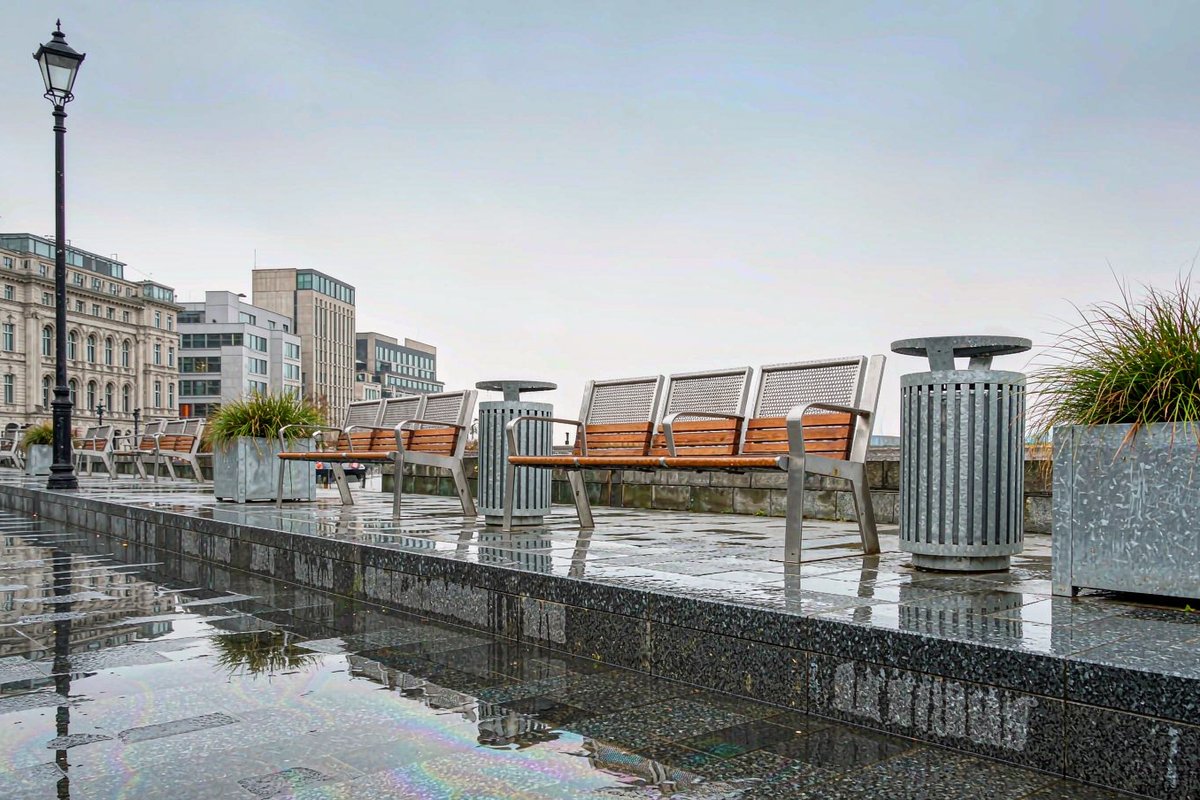
- Debris-proof the waterline. Solid or perforated panels below likely flood depth resist impact better than open slats; perforated steel seats also drain and dry quickly, which shortens downtime.
A Placement Checklist for Flood-Prone Sites
Material choice only works if placement follows the flood map, not the landscape plan alone:
- Map furniture positions against the site's flood outlines (river, coastal or pluvial), and record the expected maximum water depth at each position.
- Within the outline, tier the specification: fully flood-tolerant details at the lowest levels, conventional furniture above the design water line.
- Identify "sacrificial" positions where cheap, quickly replaceable items are acceptable, and protect high-value elements with anchoring and heavier sections.
- Keep service access in mind: after a flood, crews need to reach anchors, drains and fixings with ordinary tools.
- Agree a post-flood inspection route in advance so damage is documented for insurance while it is still visible.
After the Water Recedes: A Post-Flood Recovery Sequence
The days immediately after floodwater drops decide whether a bench costs a cleaning shift or a replacement order:
| Step | Timing | Action |
|---|---|---|
| Rinse | Within 24–48 h | Wash off silt and organic matter before it dries onto surfaces and coatings |
| Drain | Immediately | Open caps, tilt or lift units so trapped water can exit frames |
| Dry | 1–2 weeks | Let timber slats dry slowly and evenly; force-drying causes cupping |
| Inspect | Week 1–2 | Check fixings torque, coating scour at the waterline, slat condition, weld seams |
| Touch up | Week 2–4 | Recoat scratches, replace individual damaged slats, re-torque anchors |
| Document | Ongoing | Photograph all findings to support warranty and insurance claims |
Sites that follow this sequence routinely keep 90% or more of their furniture; sites that wait a fortnight often lose coatings, slats and fasteners to what was, in material terms, survivable immersion.
Working With a Manufacturer on Flood-Resilient Furniture
Flood-resilient details — drained sections, stainless hardware, reinforced anchors, replaceable slats — are all straightforward for a factory that controls its own production, which is exactly why they are best raised at specification stage rather than negotiated after delivery. AOTUDE manufactures street furniture in-house at its 20,000 m² factory in Foshan, China, selling factory-direct with OEM/ODM support: project teams can specify 304 or 316 stainless hardware, hot-dip galvanized frames, GFRC planter bodies or custom anchoring plates to match their flood map. Per-model MOQ starts from just 5 pcs (most models at 20 pcs, custom runs from 50 pcs), so even a phased upgrade of a single riverside promenade can be ordered economically, and every product is backed by a 5–10 year structural warranty. To see how these details come together on seating, browse our stainless frame park bench or the wider park bench collection, and start the conversation at https://aotude.com — the earlier the flood map reaches the factory, the cheaper the resilience.