Biophilic Street Furniture: A Specification Guide for Public Spaces
2026-11-12 · 8 min read · By AOTUDE Furniture Team
Biophilic design has moved from airport lounges and office lobbies into the ordinary street. For municipal buyers and landscape architects, the practical question is no longer whether to bring nature into the public realm but how to specify it so that it survives contact with real streets: heavy use, drying wind, vandalism, tight maintenance budgets. That is where biophilic street furniture earns its place in a tender — furniture that does not merely sit beside greenery but is designed to host, frame and protect it.
This guide translates biophilic city design principles into concrete specification decisions: how much soil a planter really needs, when seat-and-planter integration makes sense, which material choices support the biophilic experience, and what maintenance a nature-integrated scheme actually costs.
What Biophilic Design Means at the Furniture Scale
Biophilic design rests on the idea that people are measurably calmer, more sociable and more likely to linger in spaces that include living systems and natural patterns. At building scale this is delivered through green walls and courtyards. At street scale, the delivery mechanisms are far more modest — and far more frequently overlooked in specifications:
- Direct contact with vegetation: planters, tree pits, and planted buffers placed where people sit and walk, not as distant ornament.
- Natural materials and textures: timber slats, matte coatings and warm neutrals instead of uniformly glazed, cold surfaces.
- Sensory softening: vegetation that filters wind, buffers traffic noise and shades hot pavement — functions that furniture placement directly controls.
- Seasonal variation: planting that changes through the year, giving a plaza a reason to be visited repeatedly.
A bench under a tree is biophilic by accident. A seating module wrapped with planted edges, positioned to catch afternoon shade and detailed with warm materials, is biophilic by specification. The difference is what a drawing set actually instructs the contractor to build.
Four Ways to Integrate Nature Through Furniture
Most nature-integrated schemes combine several of the approaches below. Treat the table as a menu for matching furniture typology to site ambition and maintenance capacity.
| Approach | Typical furniture | Best suited to | Key specification issues |
|---|---|---|---|
| Seat-planting integration | Bench-planter modules, planter-bench islands | Plazas, campuses, retail streets | Soil volume vs. seat ergonomics; drainage; root protection |
| Furniture as planting frame | Large planters defining seating rooms | Wide sidewalks, transit waiting areas | Weight, anchoring, vehicle impact clearance |
| Under-canopy placement | Standard benches and tables sited in shade | Parks, school grounds, courtyards | Root zone clearance; drip line; maintenance access |
| Edible or sensory planting | Raised planters beside seating | Community gardens, healthcare settings | Growing depth, irrigation, harvest access |
For a deeper treatment of the first approach, see our guide to bench-planter integration in public spaces, which covers layout patterns in detail. The remainder of this article focuses on the specification details that decide whether a biophilic scheme performs or declines within two seasons.
Getting Planting Volumes and Drainage Right
The most common failure in biophilic street furniture is not aesthetic — it is hydrological. A shrub planted in 80 mm of soil over a sealed planter base will not reach the canopy mass that made the concept render look convincing.
Practical minimums used by specifiers:
- Small grasses and seasonal displays: 150–300 mm growing depth, free-draining substrate.
- Perennial and shrub palettes: 300–500 mm, with structural soil or expanded clay amendments.
- Small trees and multi-stem features: 500 mm or more, ideally a dedicated soil cell or continuous substrate below the planter.
Drainage holes, a geotextile separation layer and a 30–50 mm drainage aggregate layer at the base are standard details, and where planters sit against building lines, a reservoir or drip irrigation loop should be budgeted from day one. Our planter drainage and irrigation guide covers these details, including winter drainage for freeze-thaw climates.
Two specification habits prevent most warranty disputes:
- State the planting intent in the furniture specification. If the planter must host 400 mm of substrate for a shrub palette, say so in the drawing note — manufacturers can then confirm internal depth, freeboard and drainage detail rather than discovering the mismatch after delivery.
- Match planter material to exposure. Powder-coated steel and GFRC behave very differently on a heat-absorbing south-facing plaza; substrate in thin metal walls dries and overheats far faster than in thicker sections.
Seat-Planting Integration: Design Details That Matter
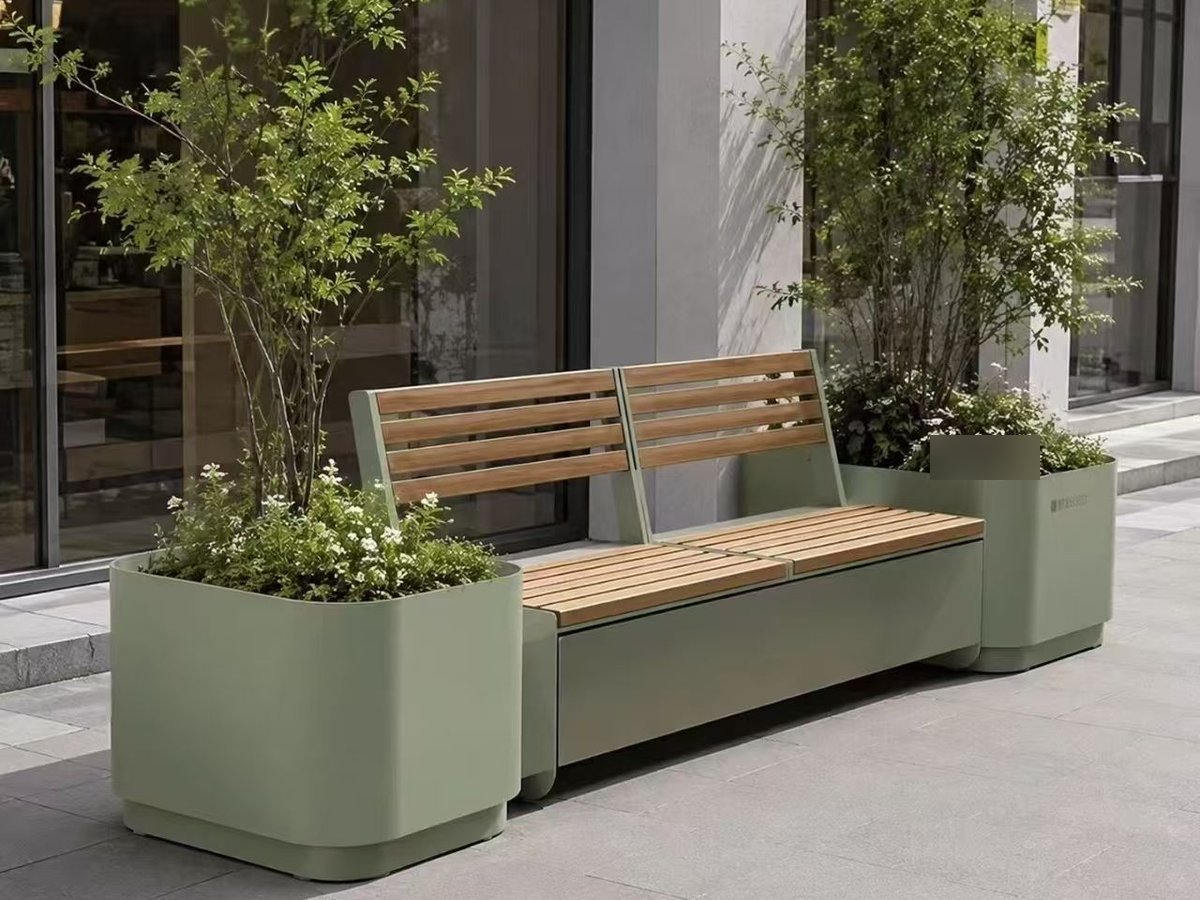
Integrated bench-planters are the signature element of biophilic street furniture, but they concentrate conflicting requirements into one object. The details below separate well-documented products from disappointments:
- Seat height and depth remain non-negotiable. Planted ends do not excuse a 380 mm seat or a 350 mm depth. Reference standard seating ergonomics and keep the planted section visually distinct so users do not treat vegetation as extra seating.
- Protect the soil from the seat. Foot traffic across planter edges compacts substrate and kills root systems; a raised edge detail of 100–150 mm above seat level, or a low rail between seat and planting, preserves the planting without reading as a barrier.
- Plan irrigation access into the module. A hose point or drip feed that reaches every planted bay without dismantling seating is worth more than any species choice.
- Keep the line of sight open. Vegetation above roughly 800 mm at corners and crossing approaches blocks visibility for both pedestrians and drivers; coordinate planting height with traffic-sightline drawings.
Where integration is not achievable — narrow sidewalks, heritage paving, tight budgets — the fallback is still valuable: place standard planters and seats within 2–3 m of each other along desire lines. Proximity delivers much of the biophilic effect at a fraction of the fabrication cost.
Materials, Texture and Microclimate
The biophilic experience is multisensory, and material choice is where furniture either supports or undermines it. Three considerations matter most:
- Warm tactility at touch points. Timber slats on seats and armrests remain the most effective way to soften metal frames; they also feel comfortable across a wider temperature range than bare steel in full sun. Powder-coated steel with a matte, stone-toned finish achieves a similar effect where timber maintenance is not wanted.
- Colour that recedes, planting that leads. Muted greens, greys and earth tones keep the furniture as a backdrop, letting vegetation carry the visual interest. High-chroma furniture competes with planting and ages badly in UV.
- Surface temperature. On exposed sites, dark powder coatings and dense stone can exceed 60°C in summer; perforated or slatted surfaces, lighter colours and canopy shade reduce contact-temperature risk. Our guide to heat-resilient streetscape furniture details these trade-offs.
Placement around existing trees deserves its own drawing set: root protection areas, installation methods that avoid root cutting, and clearances that let both the tree and the furniture be maintained; a separate guide on our blog covers that topic in full.
Budgeting the Maintenance That Biophilic Schemes Demand
Nature-integrated furniture shifts maintenance effort from "wipe down" to "garden": irrigation checks, replanting cycles, substrate topping, and pruning that must not damage furniture finishes. A realistic annual allowance for an integrated bench-planter is two to four times that of a standard bench — a figure worth stating in the tender so that low bids do not quietly strip the planting budget.
A workable split:
| Task | Typical frequency | Owner |
|---|---|---|
| Irrigation and substrate moisture check | Weekly in growing season | Grounds team |
| Deadheading, pruning, replanting | Seasonal | Grounds or landscape contractor |
| Furniture inspection (fixings, coating, timber) | Quarterly | Asset management |
| Drainage outlet clearing | Twice yearly, plus pre-winter | Grounds team |
Choosing furniture with durable coatings and replaceable timber slats keeps the furniture-side maintenance predictable, so the extra budget is spent on planting rather than repairs.
A Specification Checklist for Biophilic Street Furniture
Before signing off a nature-integrated furniture package, confirm:
- Growing depth and substrate spec stated per planter, not per project average
- Drainage detail: outlets, geotextile, aggregate layer, winter drain-down
- Irrigation access designed into furniture modules where planting is permanent
- Seat ergonomics unchanged by integration; planting protected from foot traffic
- Sightlines preserved at corners and crossings with mature planting heights
- Touch-point materials specified for tactile comfort and temperature range
- Maintenance budget line for planting separated from furniture line
- Furniture finishes compatible with fertiliser, irrigation overspray and pruning tools
Working With a Manufacturer
Biophilic schemes succeed when the furniture and planting packages are specified as one system, which is easier when the furniture manufacturer can adapt standard modules rather than force a catalogue selection. AOTUDE manufactures street furniture in a 20,000 m² factory in Foshan and supplies municipal and landscape buyers worldwide factory-direct: bench-planter modules, planters and seating with per-model MOQ from 5 pcs (most models from 20 pcs, custom runs from 50 pcs), OEM/ODM customisation for integrated seat-planting geometries, and 5–10 year warranties on structural frames. If your biophilic concept needs a bench-planting module adjusted to your substrate depth or seat layout, send the drawing — see the full range at aotude.com or browse the outdoor planters category to start from a standard base.