Specifying Site Furniture Around Existing Trees: Root Zone Clearances
2026-11-03 · 10 min read · By AOTUDE Furniture Team
Retrofitting furniture into an established streetscape is a different discipline from furnishing a new plaza. On a blank site the designer sets the tree positions. On a mature site the trees are fixed assets with decades of investment behind them, statutory protection in many jurisdictions, and a root system that extends far beyond anything visible above ground. Every bench, bin, planter and bike rack has to be negotiated around them. Get the placement right and the tree canopy becomes the reason people sit there; get it wrong and you either kill a specimen tree within three seasons or spend the maintenance budget re-leveling furniture that was set on ground it should never have been dug into. This guide sets out how to specify site furniture around existing trees — root zone clearances, root-safe footing options, ring bench detailing, and the drawing notes that keep contractors out of trouble.
Why the Tree Comes First in the Layout
Furniture is replaceable. A 40-year-old plane tree or oak is not. That asymmetry should drive the sequence of decisions on any retrofit project: the arboriculturist's root protection plan is an input to the furniture layout, not a check performed after the layout is drawn.
In practice the conflict usually surfaces late, when a contractor's setting-out drawing shows a bench footing directly over a structural root, or when a bin is positioned in the one spot where the irrigation sleeve runs. Resolving it then is expensive — redesign, variation order, sometimes a tree removal application. Resolving it at concept stage costs an hour of coordination.
There is also a design argument. Trees deliver shade, evaporative cooling, and the sense of enclosure that makes a seating area feel like a place rather than a leftover strip of paving. Furniture placed to read with the canopy — facing into the shade, tucked under the drip line but clear of the trunk — outperforms furniture set in the open. The urban heat island case for green infrastructure is essentially a seating argument: shaded benches get used in August, unshaded ones do not.
Reading the Root Zone Before You Draw
Two boundaries matter, and they are frequently confused.
The canopy drip line is where the leaves end. It is visible, easy to measure, and almost always smaller than the root system. Fine roots responsible for water and nutrient uptake commonly extend one to three times the canopy radius, and structural roots can run further still in open, uncompacted soil.
The root protection area (RPA) is the calculated zone within which excavation, compaction and level changes are restricted. The widely used basis is a circle of radius twelve times the trunk diameter measured at 1.5 m above ground for single-stem trees, subject to minimum and maximum caps and to adjustment by a project arboriculturist. On a 400 mm trunk that is a radius of 4.8 m — a 9.6 m diameter no-go circle, which in a 12 m wide pavement strip leaves very little room for anything.
Practical consequences for the furniture plan:
- Measure trunk diameters on site. Recorded dimensions on old drawings are unreliable, and multi-stem trees need a combined calculation.
- Overlay the RPA on the layout before selecting products, not after.
- Treat the RPA as a construction exclusion zone with fencing, not a line on a PDF. Most root damage happens through storage, tracking and spoil heaps, not through the footing itself.
- Where furniture must sit inside the RPA, the design has to change — raised deck, surface-mounted base, or a product that wraps the tree instead of standing beside it.
Clearance Matrix for Common Furniture Types
The figures below are starting points for concept layout on typical street and park trees. They assume no excavation inside the RPA, and they should be confirmed against the project arboriculturist's report and any local tree protection policy.
| Furniture type | Clear from trunk face | Additional constraint | Reason |
|---|---|---|---|
| Backed park bench | 1.5 m minimum, 2.0 m preferred | Footings outside RPA; back clear of low limbs | Root flare and buttress roots occupy the first metre; backrest needs headroom |
| Backless bench | 1.0 m minimum | Seat edge not over exposed roots | Prevents soil compaction at the seating line |
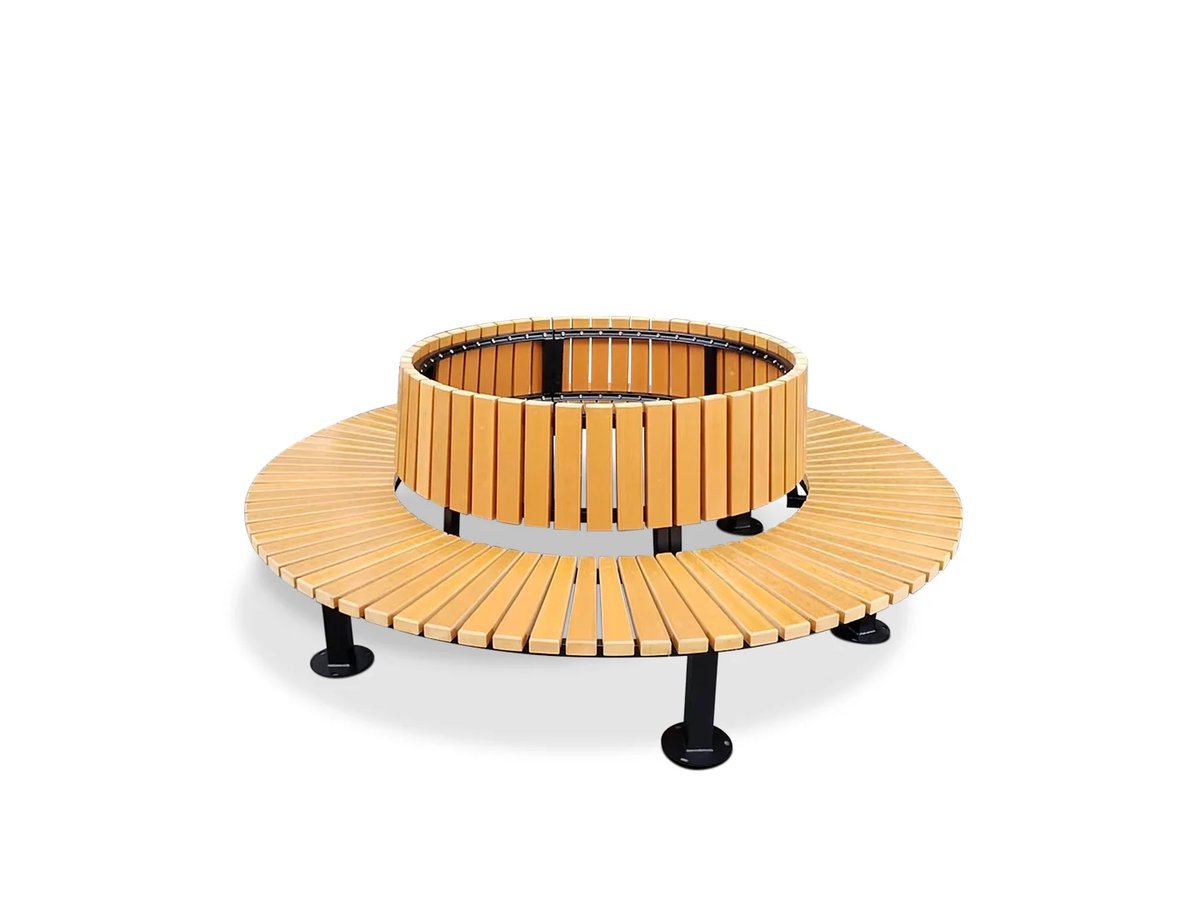
| Circular ring bench | Trunk + 150–250 mm growth gap | Segmental assembly, inner ring open to soil | Wraps the tree without bearing on the trunk |
| Litter bin | 1.0 m | 1.5 m clear servicing access on the collection side | Avoids mower and vehicle strikes; keeps openings clear of leaf drop |
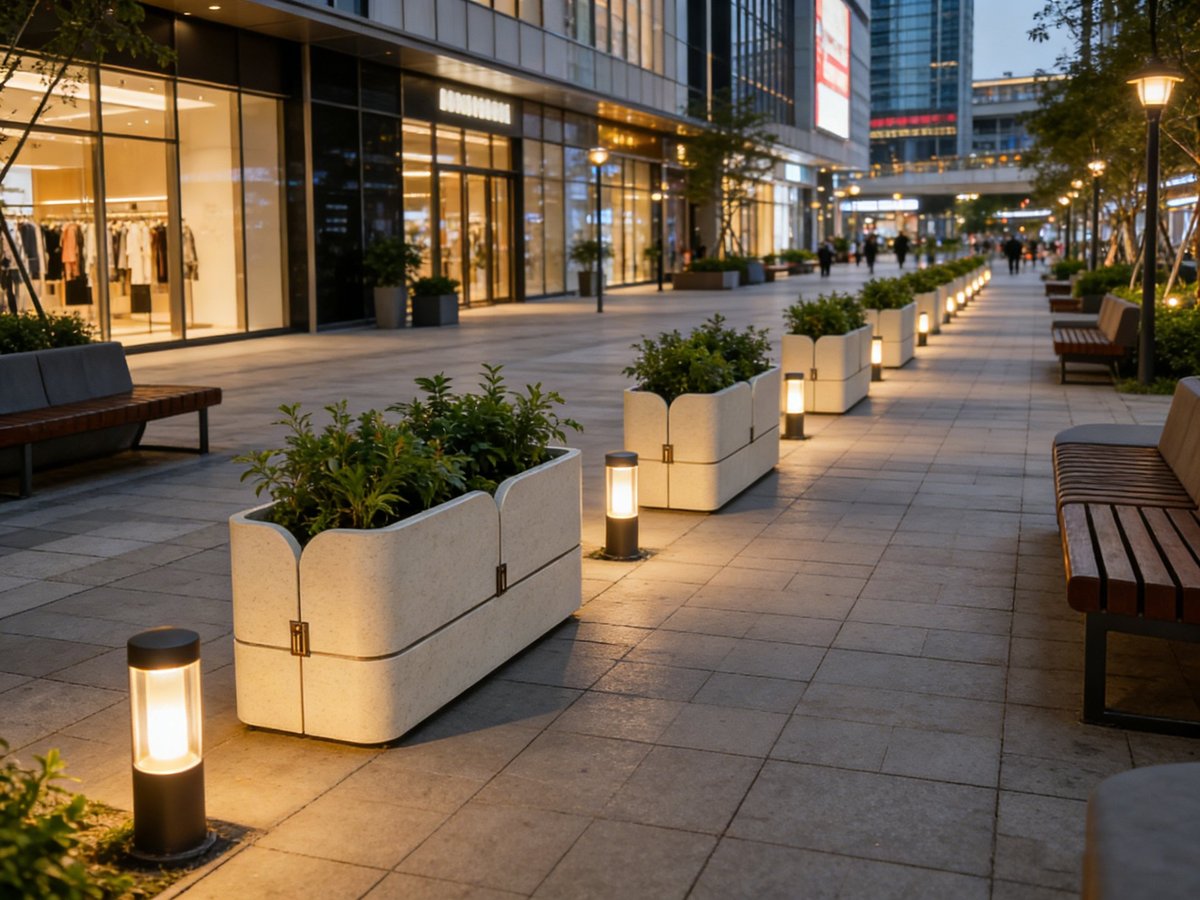
| Planter | Outside RPA; 2.0 m if inside is unavoidable | Never dump surplus soil over the RPA | Root suffocation and grade change are worse than excavation |
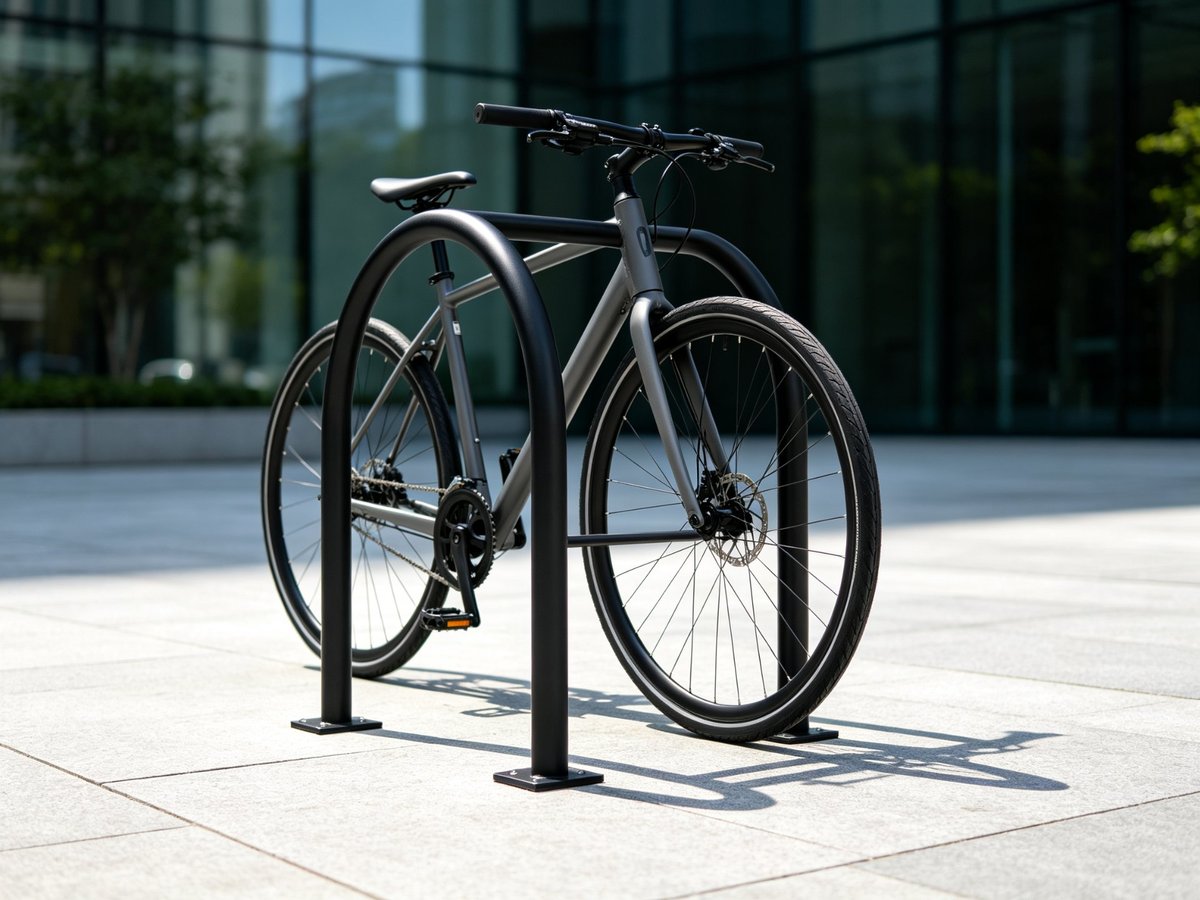
| Bike rack | 2.0 m from trunk, 1.0 m from canopy edge at 2 m height | Rack axis parallel to the tree line | Handlebars and pedals foul low branches |
| Bollard | 1.0 m | Root barrier only if the line cannot be moved | Impact loads transfer into near-surface roots |
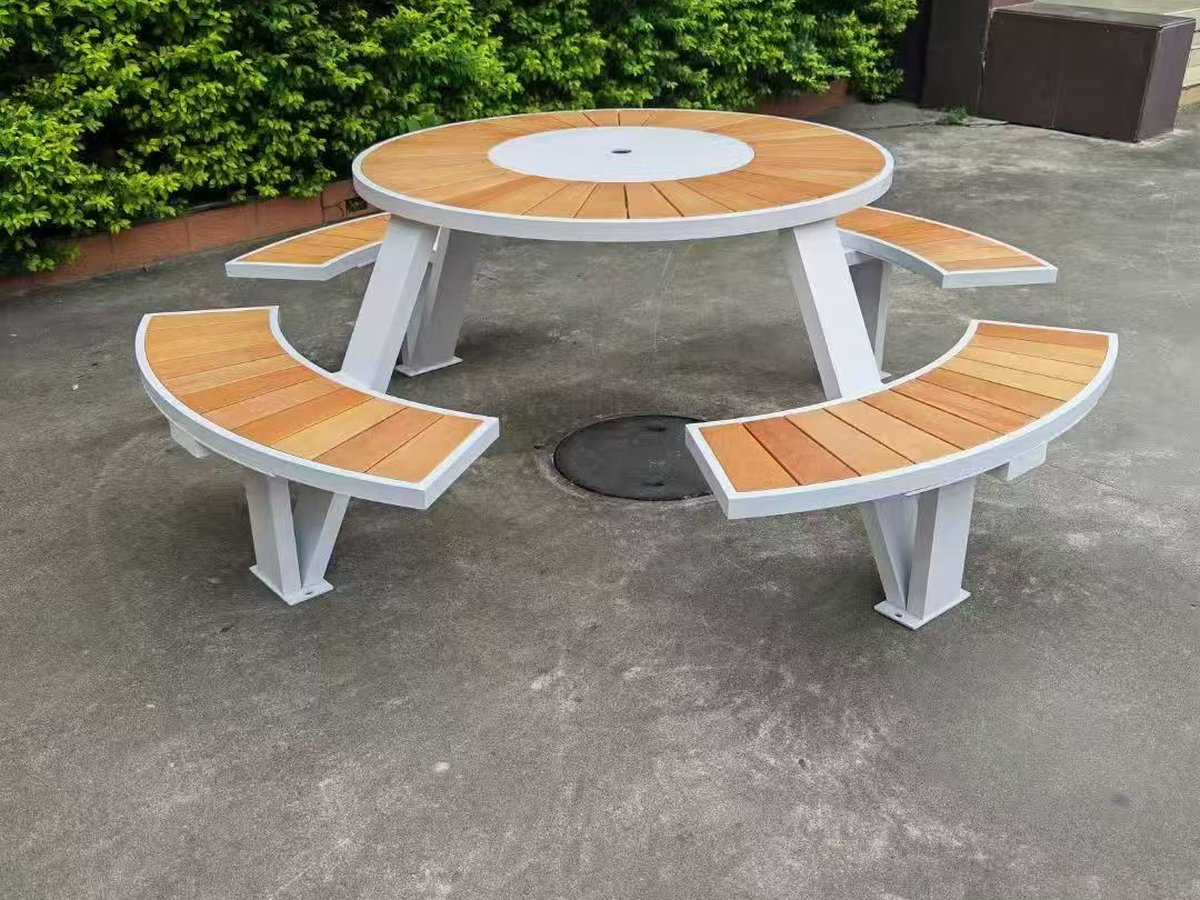
| Picnic table | 2.5 m | Accessible route on at least one long side | Benches plus seated circulation need depth |
Three Placement Strategies That Work
Push out and accept a smaller furniture zone. The cheapest and least risky answer is to place everything outside the RPA and let the tree occupy the middle of the space. This usually means fewer seats than the brief asked for, so it must be raised early with the client rather than discovered at tender.
Wrap the tree with a ring bench. A segmental circular bench turns the trunk from an obstacle into the anchor of the seating area. The requirement is a growth gap: the inner ring must clear the trunk by 150–250 mm at installation, and the assembly must be built in segments so it can be opened and re-set as the trunk expands. A ring bench carries no load onto the trunk and needs only shallow perimeter supports. The circular tree bench is built exactly for this — segmental ring construction with an inner backrest that shields the trunk from contact damage while keeping airflow and drainage open.
Raise the furniture on a deck or raft. Where the whole space is inside the RPA, a platform on adjustable pedestals spreads load without excavation. This is a structures package rather than a furniture package, but the furniture must be specified for it: base plates drilled into the deck, sled or skid frames rather than in-ground legs, and drainage detailed so water does not pond under the platform. Installation sequencing matters as much as the product, and the general principles in the site furniture installation guide apply with the added constraint that no plant may track over the RPA.
Footing Options Ranked by Root Disturbance
| Method | Root disturbance | Where it fits | Watch points |
|---|---|---|---|
| Surface-mounted base plate on existing paving | Very low | Plazas with sound slabs; retrofit work | Anchor depth and slab thickness; water ingress at bolt holes |
| Adjustable pedestal on deck | Very low | Full-RPA sites | Pedestal height range; lateral restraint |
| Ground screw / helical anchor | Low | Soft landscaping outside structural root zone | Torque verification; avoid known structural roots |
| Precast pad on compacted granular, 150–200 mm deep | Low to moderate | Turf and mulch areas | Hand-dig only; arboriculturist supervision |
| Concrete pier outside RPA with cantilever arm | Moderate, but outside the zone | Benches that must sit close to a trunk | Arm deflection; visual bulk; drainage of the pier top |
| Conventional strip footing inside RPA | High — normally refused | Avoid | Severed roots, compaction, grade change |
The pattern is consistent: the further the load path can be moved outwards, and the less soil is opened, the better the tree fares. Air-spade or high-pressure air excavation, where specified, is a survey and careful-digging tool — it does not make a deep footing acceptable inside the RPA.
Planters, Mulch and the Tree Pit Trap
The instinct to "soften" a tree pit with a planter is usually counterproductive. A planter set inside the pit competes directly with the tree for water and nutrients, raises the finished level over the root flare, and concentrates maintenance traffic in the one place that should stay uncompacted. If a planter is needed for seasonal colour, keep it outside the RPA and off the mulch ring.
The same logic applies to mulch. Topping up a mulch ring every year gradually buries the root flare, which invites decay at the base of the trunk. Specify a maximum mulch depth of 75–100 mm, kept clear of the trunk by 100 mm, and make it explicit in the landscape maintenance schedule so the practice does not drift.
Timber and powder-coated steel both age differently under trees. Tannin and sap staining is normal on pale hardwood slats and is not a defect; leaf litter held in slat gaps is, and it is the main reason slat spacing and open frames matter on tree-lined sites. Bins placed under heavy fruit or seed drop fill faster than the capacity model predicts — a fig or a lime tree can halve the effective interval between collections.
Circulation, Accessibility and the Shade Benefit
Furniture clustering around trees must not narrow the through route. A 1.5 m clear path is a floor, not a target; on busy frontages 2.0–2.5 m is the realistic working width once a bench projects into the zone. Keep the accessible route on the open side of the tree, on a firm and level surface, with the bench approach not blocked by the trunk, a root flare, or a bin.
Sight lines matter too. A ring bench around a mature trunk creates a natural meeting point precisely because it is enclosed on one side — but on a dimly lit path it also creates a blind spot. On night-time routes, offset the ring or add lighting rather than abandoning the idea.
Where the brief calls for a mix, a combined seating and planting unit often resolves the geometry faster than separate items: an island or combination unit gives a seat ring and a planting body in one footprint, and only needs one set of footings. A round planter bench island — a seat ring built around a planting body — is useful where the tree itself must stay untouched but the space still needs a green centre.
Drawing and Tender Notes That Prevent Claims
- Show the RPA on every furniture setting-out drawing, hatched, with dimensions from the trunk.
- Add a note: "No excavation, storage, tracking or grade change within the root protection area. Ground disturbance within the RPA requires the project arboriculturist's written approval."
- Require hand-digging and arboriculturist attendance for any footing within 2 m of the RPA boundary.
- Specify the growth gap on ring benches as a measured dimension, not a note.
- State who supplies and installs tree grates and root barriers — these are usually landscape or civil scope, and unclear interfaces are where delays start.
- Require a post-installation inspection that records trunk clearance and soil level against the root flare.
Specifying With AOTUDE
AOTUDE manufactures the seating, bins, planters, racks and bollards that go around existing trees — including segmental ring benches sized to the trunk rather than to a catalogue. We are a factory-direct supplier with a 20,000 m² plant in Foshan, Guangdong, working with landscape architects, municipalities and contractors on OEM/ODM programmes as well as catalogue models. Per-model MOQ starts from 5 pcs, most models sit at 20 pcs, and custom runs start at 50 pcs. Standard warranty is 5–10 years depending on the range, and we supply shop drawings for arboriculturist review before production. Send a layout, a trunk schedule and a finish direction to start the conversation — or browse the park bench range at aotude.com.