
2026-10-01
Urban Heat Island and Green Infrastructure: How Site Furniture Helps Cities Cool Down
How urban heat island mitigation reshapes site furniture procurement: planters as green infrastructure, shade strategy, cool coatings and the specification checklist that keeps plazas usable in extreme heat.
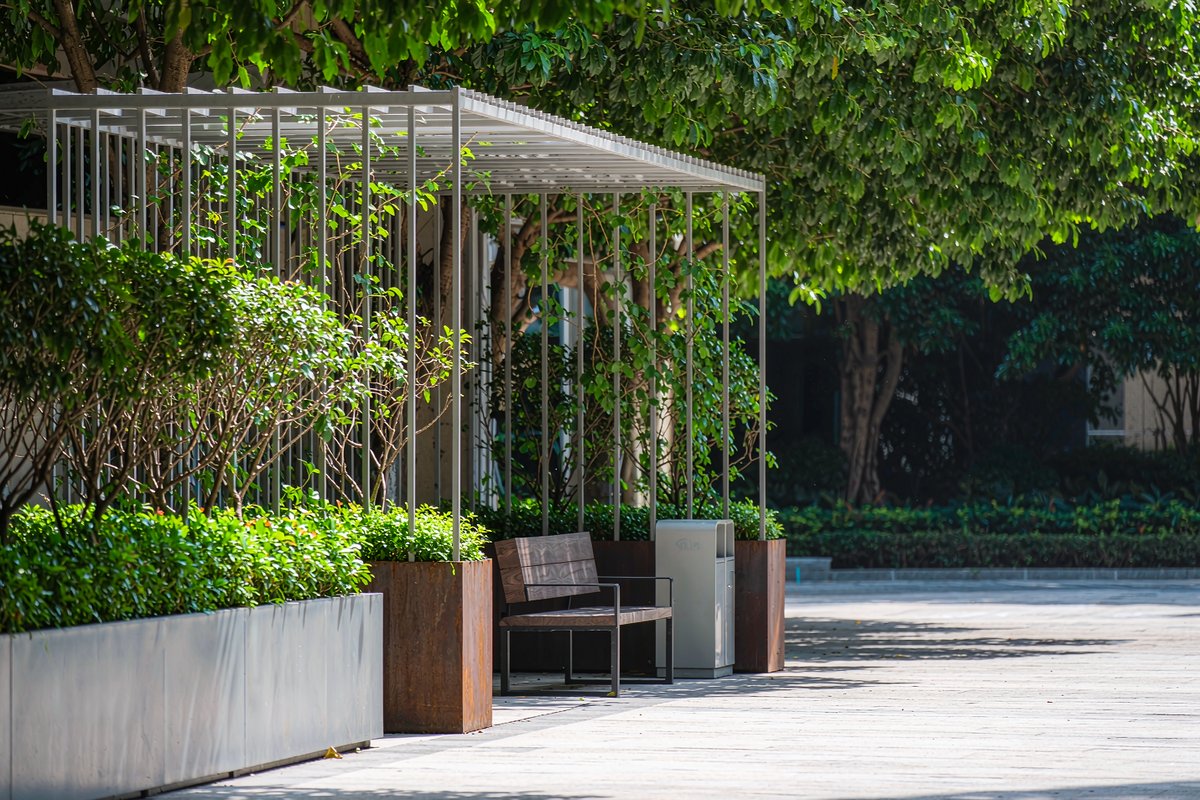
Urban heat island (UHI) has moved from climate research to the tender document. Cities that recorded record surface temperatures are now writing cooling targets into public-space briefs — and when they do, site furniture stops being decoration and becomes infrastructure. A bench under a canopy, a planter with real soil volume, a light-coloured bench slat and a permeable paving edge all contribute measurable degrees of relief to a plaza. For landscape architects, municipal parks departments and contractors, this changes what a specification has to prove. This guide explains how urban heat island effect is measured, which green infrastructure strategies actually deliver cooling, and how to specify outdoor furniture that performs as part of the system rather than alongside it.
Why Urban Heat Island Is Now a Procurement Criterion
The mechanism is straightforward. Asphalt, concrete and dark metal absorb solar radiation during the day and release it slowly at night, so a dense district can run 2–5 °C warmer than its rural surroundings — and surface temperatures on unshaded paving regularly exceed air temperature by 20 °C or more. The consequences are practical, not abstract:
- Usability collapses. A bench seat at 60 °C is not a bench; it is a hazard. Plazas become empty at exactly the hours they were designed for.
- Heat equity becomes a mandate. Many cities now map heat vulnerability by neighbourhood and prioritise cooling investment where canopy cover and green space are lowest.
- Budget follows the mandate. Where a project can demonstrate a cooling outcome, it can access climate-adaptation and green-infrastructure funding that a plain furniture replacement cannot.
That last point is the commercial one. A specification that quantifies shade, evapotranspiration and surface reflectance wins funding; a specification that says "six benches, four bins" does not.
The Green Infrastructure Toolkit — and Where Furniture Fits
Cooling strategies are usually presented as a menu. In practice they interact, and site furniture is the connective tissue between them: it is what holds the planting, defines the shade, and determines whether a person can actually sit in the cooled space.
| Strategy | Typical cooling contribution | Relative capital cost | Where site furniture is involved |
|---|---|---|---|
| Street tree canopy (mature, 25%+ cover) | Highest — 3–5 °C at pedestrian level | High, slow to establish | Tree guards, integrated seating walls, root-friendly paving |
| Large-volume planters with shrubs/trees | Localised 1–3 °C, plus evaporative cooling | Medium | Planter body, soil volume, drainage and irrigation |
| Shade structures (pergola, canopy, sail) | 4–8 °C reduction in mean radiant temperature below | Medium | Support posts, integrated benches, anchoring |
| Cool / high-reflectance coatings on furniture | Reduces surface temperature by 10–20 °C vs dark finishes | Low | Bench slats, bin bodies, frame powder coating |
| Permeable or light paving | 5–10 °C lower surface temperature than dark asphalt | High | Furniture footings, pad design, edge restraints |
| Water features and misting | Strong local effect, high running cost | High | Seating edges, guard rails, service access |
The pattern worth taking to a client: shade plus planting plus light-coloured surfaces beats any single measure, and furniture decisions sit inside two of the six rows above.
Specifying Planters as Cooling Infrastructure
Most "planters" sold into public realm projects are oversized pots. As green infrastructure, a planter has to do the things a tree pit does — and that means the specification changes:
- Soil volume, not litres of potting mix. A tree needs 10–15 m³ of usable soil to reach the canopy size that delivers shade. Specify the planter around the root volume first, then size the body.
- Open or semi-open bottoms. Planters sealed at the base become heat reservoirs and root-kill zones. Detail drainage and, where possible, connection to subsoil.
- Irrigation and reservoir capacity. A drought-stressed plant stops transpiring, and a plant that stops transpiring stops cooling. Integrated reservoirs with overflow protection keep performance through a dry fortnight.
- Thermal mass awareness. Dark steel in direct sun radiates onto the leaves above it. Light RAL finishes or a planted inner sleeve reduce the planter's own heat load.
- Load paths. A 12 m³ soil volume weighs 15–18 tonnes wet. The planter is a structural element; specify wall thickness and base plates accordingly, and confirm the slab can take it.
Get those five right and a planter line becomes a defensible line item in a cooling budget. Get them wrong and you have bought a very expensive container.
Shade, Seating and the Microclimate of a Plaza
Shade is where furniture specification and human comfort meet, and the detail that is most often missed is that shade has to be usable. A canopy that shades a walkway but leaves every seat in the sun has cooled nothing for the person who came to sit down.
Three rules cover most layouts:
- Place seating under the canopy, not beside it. Model the sun path at midday in the hottest month, then rotate the seat group accordingly — a 1 m shift often moves a bench from full sun to full shade.
- Design for the shoulder hours. Morning and late-afternoon shade matter for commuters and for outdoor dining. Fixed canopies should be paired with deciduous planting so winter sun still reaches the seats.
- Material beats geometry in the seat itself. Timber and WPC slats sit 15–20 °C cooler in full sun than dark coated steel or aluminium. Perforated and slatted seats also release heat instead of storing it.
For the bins, racks and frames around the seating, orientation matters less but finish matters more: a light RAL grey or a metallic finish on a bin body can be 10–15 °C cooler at 2 pm than a black one of identical design.
Cool Coatings: The Cheapest Degrees in the Specification
If a project needs a fast, low-cost cooling win, it is almost always the finish specification. Powder coating is where a furniture manufacturer can deliver it without changing the design:
- Specify light reflectance (LRV) values explicitly — for example "LRV ≥ 60" for seating and bin bodies in sun-exposed locations.
- Ask for total solar reflectance data on the powder, not just the RAL code; two coatings in the same colour family can differ by 20 percentage points.
- Keep dark colours where they are not a heat problem — shaded colonnades, under-canopy furniture, and wet coastal locations still benefit from dark, high-hiding coatings.
- Verify corrosion performance is not traded away: a cool coating still has to pass salt-spray testing at the specified film thickness.
This is the item to negotiate with the supplier rather than the site contractor, because it costs almost nothing to change at the factory and a great deal to change on site.
A Specification Checklist for Cool Public Spaces
- Solar path modelled for the hottest month; every seat group checked at 12:00 and 15:00
- Soil volume stated in m³ per tree or large shrub, not planter litres
- Planter drainage, reservoir and overflow detailed, with irrigation source identified
- Seating surfaces: timber, WPC or perforated metal in sun-exposed locations
- Coating: LRV and total solar reflectance values stated for sun-exposed elements
- Anchoring and structural design checked against wet soil and water-filled planter loads
- Maintenance access confirmed — cooling performance collapses without irrigation and litter servicing
- Cooling outcomes documented for funding: shade area, canopy cover added, surface temperature reduction
Sourcing Green-Infrastructure Furniture Direct from the Factory
Cooling specifications put unusual demands on a supplier: non-standard planter volumes, engineered drainage and reservoir details, specific reflectance values in the powder coat, and light-coloured finishes that hold their appearance for decades. Those are manufacturing questions, not catalogue questions — and they are fastest to answer with the factory.
AOTUDE manufactures planters, benches, litter bins and site facilities at our Foshan factory in China, and we supply them factory-direct to municipalities, landscape architects and contractors in 40+ countries. Every order supports OEM/ODM development from MOQ 50 pcs per SKU, including custom planter volumes, integrated irrigation and drainage detailing, specified RAL and reflectance coatings, and anchoring engineered for the actual soil load — all backed by a 5–10 year structural warranty with coating test reports supplied in the documentation pack. If you are writing a cooling or green-infrastructure specification and need drawings, soil volumes and reflectance data to match it, send the brief through https://aotude.com and our engineering team will return a specification-ready proposal.
Bottom line: urban heat island mitigation rewards specifications that quantify shade, soil and surface reflectance. Site furniture is the layer where all three are fixed in place — which makes it one of the cheapest places in a public-space budget to buy degrees of cooling.