Aluminum Grades for Outdoor Furniture: 6061 vs 6063, Anodizing and Powder Coating
2026-10-14 · 8 min read · By AOTUDE Furniture Team
Steel dominates heavy-duty street furniture, but aluminum has earned a permanent place in the municipal and commercial site furniture toolkit — especially for coastal promenades, rooftop terraces, transit platforms and any scheme where corrosion resistance, weight or finish stability matters more than maximum rigidity. Yet "aluminum" on a specification sheet tells a buyer almost nothing. The difference between a bench frame that looks new after fifteen years and one that pits, stains or loosens at the joints is decided by two choices made at the factory: the aluminum grade for outdoor furniture (most often 6061 or 6063) and the protective finish applied over it. For municipal buyers, landscape architects and contractors comparing quotations, understanding those two decisions is the fastest way to separate a serious manufacturer from a trader with a catalogue. This guide explains how the two workhorse grades differ, which one belongs in which product, and how anodizing and powder coating compare as finishes.
Quick answer: 6063-T6 is the default grade for aluminum site furniture frames — extrusion quality and anodizing response matter more than strength — while 6061-T6 (tensile ~290–310 MPa vs 6063's ~190–240 MPa) is reserved for load-bearing brackets, bollard cores and mounting plates.
Why Aluminum Deserves a Place in Site Furniture
Aluminum's case rests on four properties that steel cannot match simultaneously:
- Corrosion resistance without coatings. Aluminum forms a self-healing oxide film the moment it is exposed to air. Even if a coating is scratched, the metal underneath does not rust the way bare steel does.
- One-third the weight of steel. A 1.8 m aluminum bench frame can be carried and positioned by two installers without machinery — a real cost factor on rooftops, plazas and pedestrian streets where lifting equipment is not allowed.
- Dimensional stability of extrusions. Extruded profiles hold tight tolerances, so slat channels, fixing holes and joints align consistently across a production run.
- Clean recyclability. Aluminum is infinitely recyclable without property loss, which increasingly matters in lifecycle-scored tenders.
The trade-offs are equally clear: aluminum's elastic modulus is one-third of steel's, so long spans need deeper sections or thicker walls, and it costs more per kilogram. It wins where corrosion, weight and finish quality dominate — not where extreme point loads or impact resistance dominate.
6061 vs 6063: The Two Workhorse Grades Compared
Nearly all structural aluminum in outdoor furniture comes from the 6xxx series, where magnesium and silicon provide strength through heat treatment. Two grades cover almost everything a furniture buyer will encounter:
| Property | 6063 (architectural grade) | 6061 (structural grade) |
|---|---|---|
| Typical form in furniture | Extruded frames, slat channels, decorative profiles | Thicker extrusions, cast parts, machined brackets |
| Tensile strength (T6) | ~190–240 MPa | ~290–310 MPa |
| Extrusion quality | Excellent surface, fine detail, sharp edges possible | Good, but coarser surface finish |
| Corrosion resistance | Very good | Very good (slightly lower in marine atmospheres) |
| Anodizing response | Excellent — clear, even, attractive oxide layer | Good, but oxide can carry a slight yellow tint |
| Weldability | Good | Good, with strength loss in the weld zone |
| Relative material cost | Lower | 10–20% higher |
| Best used for | Bench frames, planter bodies, slats, decorative rails | Load-bearing arms, bollard cores, mounting plates, heavy table legs |
The practical reading of this table: 6063 is the default for furniture, because extrusion quality and anodizing response matter more than ultimate strength in most seating and planter applications. 6061 earns its premium where sections are heavily loaded — cantilevered bench supports, parasol bases, bike rack arms, or hardware that will be torqued hard. A quality-conscious manufacturer will mix both deliberately: 6063 for the visible frame, 6061 for the brackets and anchor points. A supplier that cannot name the grade at all is usually buying whatever extrusion is cheapest that week — which is exactly the kind of hidden variance that a comparable steel specification question, explored in our steel gauge selection guide, is designed to expose.
How Manufacturing Process Shapes the Grade Choice
Grade and process are inseparable, and it is worth knowing which process produced the parts you are quoting:
- Extrusion produces the long, constant profiles that define modern aluminum furniture — bench rails with integrated slat channels, planter rims, table edge trims. Extrusion suits 6063 best and delivers the cleanest surface for visible parts.
- Casting (gravity or low-pressure die casting) creates curved corners, decorative ends and complex joints. Cast parts commonly use 6061-family alloys or specialized casting alloys; wall thicknesses are heavier, and surface quality is slightly textured.
- Sheet and plate fabrication appears in perforated panels and machined brackets, typically 6061 or 5052. 5052 sheet, incidentally, is worth mentioning: with excellent formability and strong corrosion resistance, it is the usual choice for bent and perforated panels on aluminum litter bins and planter bodies.
When you review a quotation, ask which process and grade apply to which part — "aluminum frame" that turns out to be a thin cast part on a bench rated for public use is a red flag.
Anodizing vs Powder Coating: Choosing the Finish
Because aluminum already protects itself, finishing is about appearance, abrasion resistance and stain control rather than corrosion alone. The two dominant systems are anodizing and polyester powder coating, and they behave very differently in service:
| Factor | Anodizing | Polyester powder coating |
|---|---|---|
| Nature of layer | Grows from the metal itself (10–20 µm typical) | Applied film, 60–120 µm typical |
| Color range | Silver, bronze, black, titanium — limited palette | Any RAL, plus textures and wood-grain effects |
| Scratch behavior | Color is integral; scratches show metal, not white film | Chips reveal bare metal, which still resists corrosion |
| Abrasion and UV performance | Excellent, no chalking | Excellent UV grades available; cheaper polyesters can chalk |
| Best applications | Coastal and high-touch areas, premium architecture finishes | Colour-matched schemes, brand colours, mixed steel/aluminum products |
Neither finish is universally superior. For seaside promenades, anodized 6063 is the classic specification because the finish cannot peel and salt-spray staining wipes off. For a city programme that requires furniture to match a corporate or district colour palette, powder coating is the only realistic option — and on aluminum it holds up remarkably well because the substrate still resists corrosion beneath a chip. Buyers comparing coatings on steel will find the logic transfers; our article on powder coating RAL colour selection covers the colour and film-thickness side in depth. For a parallel look at how stainless steel grades behave in the same environments, see our stainless steel grades guide.
A Specification Checklist for Aluminum Furniture
Before awarding a contract that involves aluminum frames or panels, require the supplier to state, in writing:
- Alloy and temper for each component type (e.g. 6063-T6 extrusions, 6061-T6 brackets) — not just "aluminum".
- Wall thickness of extrusions and weight per finished unit, which together reveal under-engineering faster than any drawing.
- Finish system and film thickness: anodizing class or powder film in microns, plus UV testing basis.
- Fastener material: stainless fixings and isolation washers or bushes wherever aluminum touches steel or concrete, to prevent galvanic corrosion — the single most common assembly error in mixed-material furniture.
- Replacement part availability for slats and fixings at least ten years after purchase.
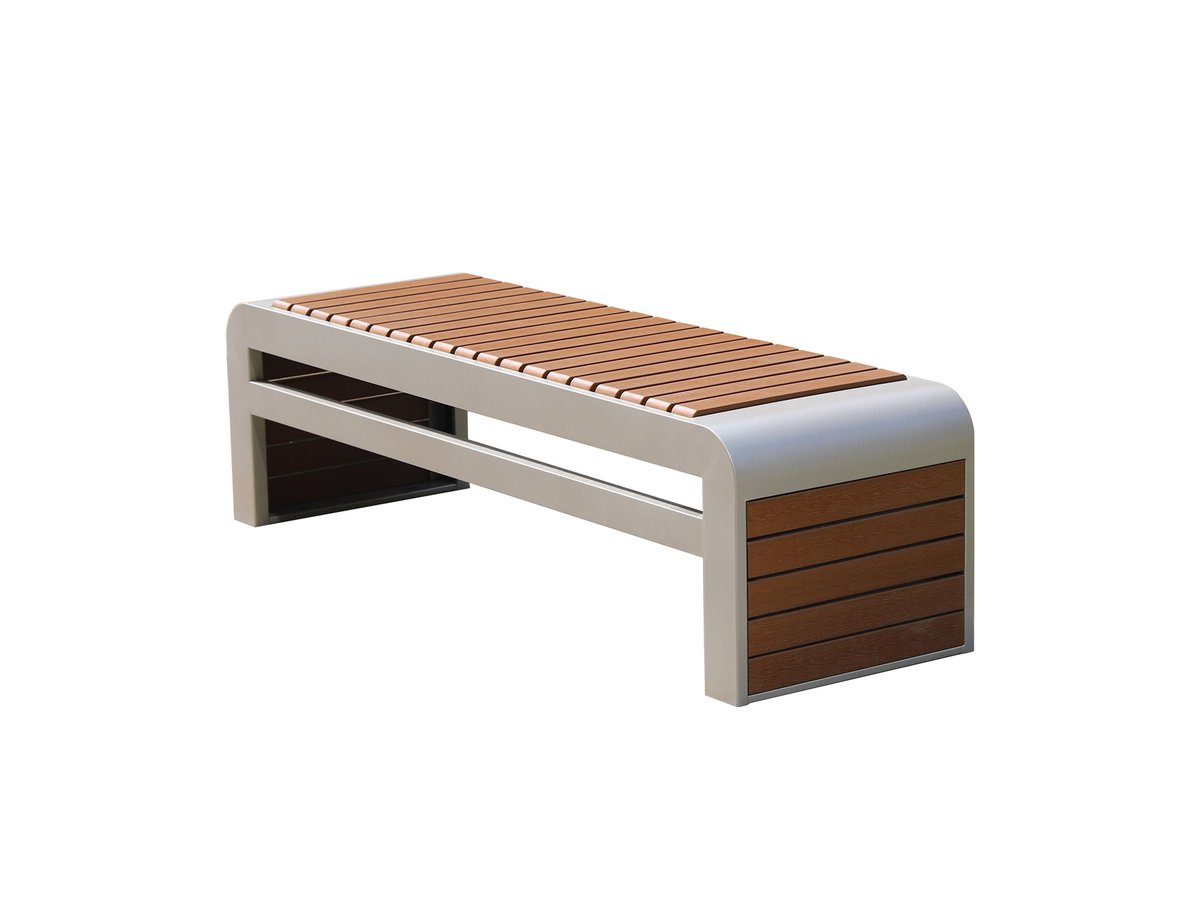
Products such as the aluminum backless bench show how this works in practice: 6063-T6 extruded side frames carrying replaceable hardwood or WPC slats, a combination that keeps the structure light and corrosion-proof while allowing the wear surface to be renewed. For schemes assembling a full seating package, the outdoor seating category gathers the matching benches and lounge pieces.
Sourcing Aluminum Furniture Factory-Direct
Aluminum rewards suppliers who control their own extrusion sourcing, welding and finishing lines, because grade substitution and thin film are invisible in photographs. AOTUDE manufactures aluminum and steel benches, litter bins, planters, bike racks and supporting street furniture at its 20,000 m² factory in Foshan, China, exporting factory-direct to municipal, design and contracting clients in over 40 countries. Because we produce rather than trade, we can state alloy, temper and wall thickness for every aluminum component, apply anodizing or polyester powder coating to any RAL, quote OEM/ODM production from your drawings with per-model MOQ from 5 pcs (custom runs from 50 pcs), and back structures with 5–10 year warranties. If you are evaluating aluminum furniture for a coastal or premium public space scheme, send us your drawings or target specification — we will return material datasheets and a factory-direct quotation, at https://aotude.com.
Frequently asked questions
Is 6061 or 6063 aluminum better for outdoor benches?
6063 is the default for bench frames, planter bodies and visible profiles, because extrusion quality, surface finish and anodizing response matter more than ultimate strength in most seating applications. 6061 earns its premium where sections are heavily loaded — cantilevered supports, bollard cores, mounting plates and hardware that gets torqued hard. Mixing both deliberately in one product is standard good practice.
Which finish is better for outdoor furniture, anodized or powder-coated aluminum?
For seaside promenades and high-touch areas, anodized 6063 is the classic specification: the oxide layer grows from the metal itself, so it cannot peel, and salt-spray staining wipes off. For schemes that must match brand or district colours, polyester powder coating is the only realistic option — and on aluminum it performs well, because a chip exposes bare metal that still resists corrosion on its own.
Does aluminum outdoor furniture rust?
Aluminum does not rust the way carbon steel does: it forms a self-healing oxide film the moment it is exposed to air, so even a scratched finish does not start red-rust corrosion. The real failure mode is galvanic corrosion where aluminum touches steel or concrete — isolate those contacts with stainless fasteners and compatible washers or bushes, and inspect the joints during routine maintenance.