
2026-09-28
Steel Gauge Selection for Outdoor Site Furniture: A Buyer's Guide to Wall Thickness and Load Ratings
How to specify steel gauge and wall thickness for public benches, litter bins and planters: gauge-to-mm conversion, load expectations, corrosion allowances and the thickness checkpoints that separate 10-year furniture from 2-year furniture.
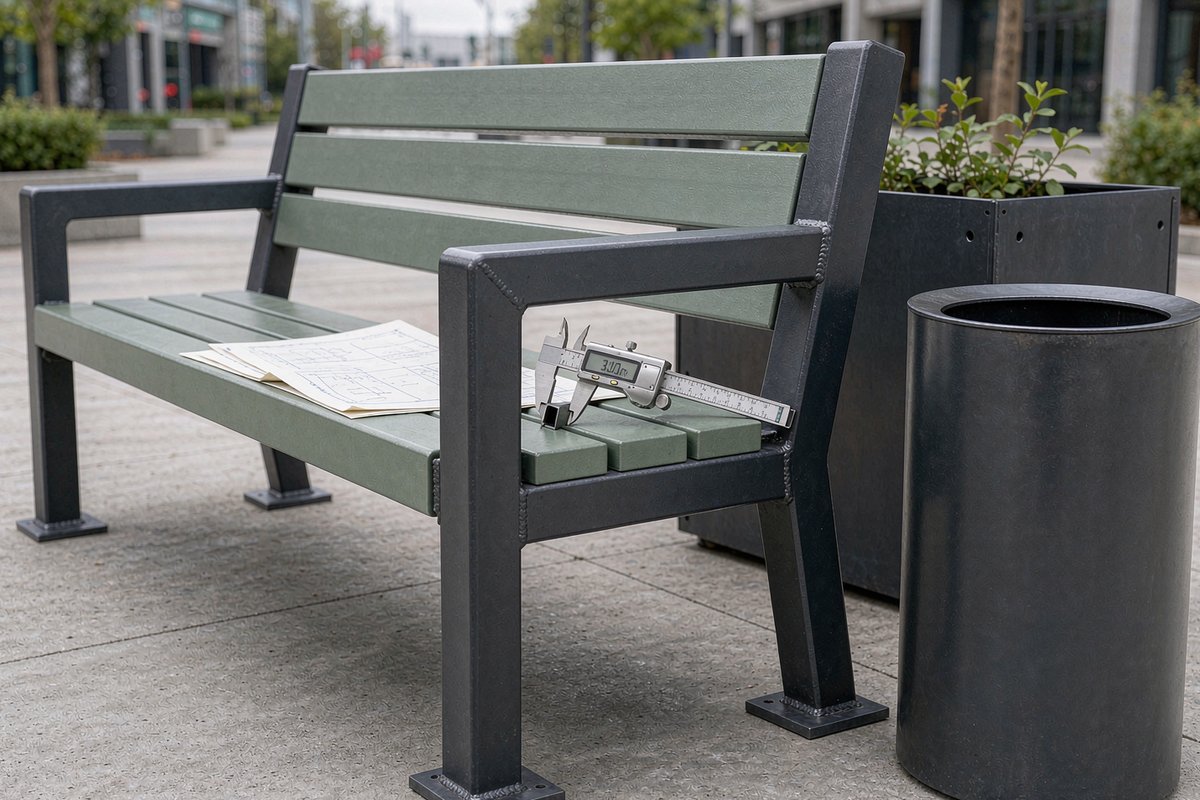
Ask two factories to quote "a steel park bench" and you can receive two products that look identical in photographs yet differ by 40% in weight — and by five years in service life. The hidden variable is steel gauge: the wall thickness of the tubes, sheets and plates that form the frame. For municipal buyers, landscape architects and contractors procuring site furniture internationally, gauge is the single most exploited specification gap. A supplier under pressure on price rarely cuts the powder coating first; they quietly move from a 2.5 mm tube to a 1.5 mm one, because the drawing nobody checks is the cross-section. This guide explains how steel gauge works, what thickness each furniture class actually needs, and how to write a specification that a low-cost quote cannot quietly escape.
Gauge, Millimeters and Why the Conversion Matters
Gauge is a legacy numbering system where a higher gauge number means thinner material — the opposite of what most buyers intuitively assume. International procurement should always convert gauge to millimeters and write the dimension explicitly in the tender:
| Gauge (approx.) | Sheet thickness | Common use in site furniture |
|---|---|---|
| 18 gauge | ~1.2 mm | Decorative panels only; dents easily, unsuitable for structural parts |
| 16 gauge | ~1.5 mm | Light-duty bin bodies, private courtyards, low-traffic areas |
| 14 gauge | ~2.0 mm | Standard bench frames, planter walls in sheltered locations |
| 12 gauge | ~2.5–2.8 mm | Public benches, bin frames, bike racks in urban plazas |
| 11 gauge | ~3.0 mm | Heavy-duty street furniture, transit and high-vandalism zones |
| 10 gauge and below | 3.5 mm+ | Structural bases, mounting plates, bollards, security furniture |
Two rules follow from this table. First, specify millimeters, not gauge numbers, because gauge charts vary slightly between standards (US, UK and Chinese conventions do not align perfectly) and because "12 gauge" from one mill may not match another. Second, separate structural thickness from skin thickness: a bench can legitimately combine a 3.0 mm load-bearing frame with a 1.5 mm decorative back panel, but only if the drawing says which is which.
Matching Thickness to Load and Location
Wall thickness is ultimately a load and abuse question. The environments below describe what public furniture actually experiences, not laboratory conditions:
- Parks and greenways (low abuse): 2.0 mm steel frames are generally adequate for seating loads and incidental impact, provided coatings and drainage are correct
- Urban plazas and streetscapes (medium abuse): 2.5–3.0 mm is the working standard — this range resists standing loads, skateboard grinding, trolley strikes and the constant torque of people rocking on armrests
- Transit hubs, stadiums, coastal promenades (high abuse): 3.0 mm minimum on all primary members, plus full-weld construction and anti-vandal fixings; anything thinner becomes a maintenance ticket within two seasons
- Planters and bins: walls carry soil loads or waste weight continuously, so 2.0–3.0 mm steel or 1.5 mm stainless is typical; thinner sheet metal turns into a rust problem as soon as the coating is scratched
Static load ratings add a second dimension. A credible specification states numbers, not adjectives: for example, seat frames tested to 300 kg static load per seat position, armrests to 150 kg downward, and planter walls deflection-limited under fully saturated soil weight. Suppliers who publish test values for these figures are usually the same ones whose gauge claims can be trusted.
Corrosion: Thickness Is a Warranty, Too
Steel in the public realm corrodes from the outside in, and the clock starts at the first deep coating scratch. Wall thickness is therefore a corrosion reserve, not only a strength reserve. A 1.2 mm panel that rusts through from a scratch loses structural integrity in a fraction of the time a 3.0 mm member needs for the same pit depth. Three specification points protect this reserve:
- Galvanized or pre-treated substrate beneath the powder coat — hot-dip galvanizing or zinc-rich primer under polyester powder roughly triples the life of a scratch site
- Sealed tube ends and drainage holes — open tube ends funnel water into the section where it cannot evaporate; internal rust is invisible until the frame fails
- Thickness verified at delivery — wall thickness is the easiest specification to audit: a $20 ultrasonic gauge or even a cross-section photo of a sample cut confirms compliance in minutes
A Four-Point Thickness Checklist for Your Next Tender
- Every structural member specified in mm (e.g. "main frame: 60 x 40 x 3.0 mm rectangular tube"), not gauge alone
- Skin vs. structure explicitly separated on the drawing, with skin panels no thinner than 1.5 mm on public furniture
- Static load values for seats, backs, armrests and bins stated and test-backed
- Pre-delivery verification method agreed: sample cut, ultrasonic reading or weighbridge weight per unit, since total unit weight is the cheapest fraud detector of all
That last point deserves emphasis: weight does not lie. If two quotes for the same bench differ by 8 kg, one of them is not the bench you specified.
Specify the Steel, Not the Photograph
At AOTUDE, gauge selection is part of every quotation, not a negotiable surprise. Our Foshan factory manufactures benches, litter bins, planters and bike racks from 2.0–3.0 mm pre-treated steel as standard, with full material and wall-thickness declarations on every drawing, sample-cut verification available before shipment, and hot-dip galvanized or zinc-primed options for coastal and de-icing environments. As a factory-direct manufacturer with MOQ from 50 pieces, we support OEM/ODM projects with engineering drawings you can audit, container-optimized packing, and a 5–10 year structural warranty backed by the steel we actually put in the frame. Browse the range at https://aotude.com or send us your tender drawings — our engineering team will return a thickness schedule and load ratings within days.