Green Public Procurement for Street Furniture: How Tender Evaluation Criteria Are Shifting
2026-10-08 · 7 min read · By AOTUDE Furniture Team
For two decades, most municipal furniture tenders were decided the same way: collect quotes, check compliance, award to the lowest compliant bidder. That model is quietly disappearing. Across Europe, North America and the Gulf, procurement teams are rewriting tender evaluation criteria for street furniture to reward what actually matters over a fifteen-year service life — total lifecycle cost, embodied carbon, repairability and end-of-life recovery — instead of the number on the quotation. For municipalities, landscape architects and contractors who specify public space furniture, understanding this shift in green public procurement for street furniture is no longer optional: it determines who wins awards, which products get specified, and how much a city pays over the life of its inventory. Here is what is changing, why it is changing, and how both buyers and suppliers should respond.
Why Lowest-Price Awards Are Losing Ground
The lowest-price rule survived for so long because it is simple and defensible. Its problem is that street furniture punishes cheap decisions with unusual efficiency. A litter bin that costs 30% less but needs repainting every three years, consumes proprietary spare parts and cannot be recycled at end of life simply moves the cost from the capital budget to the operations budget — where nobody compared it. Several forces are now pushing procurement reform:
- Budget pressure on operations. Cities facing flat maintenance budgets increasingly refuse capital purchases that create future liabilities they cannot fund.
- Climate reporting obligations. Municipalities with net-zero commitments must account for the embodied carbon of everything they buy, and furniture fleets are no longer exempt.
- Legislation on repair and circularity. Right-to-repair rules, recycled-content mandates and landfill diversion targets are migrating from electronics into the broader public purchasing framework.
- Failure fatigue. Public works departments that replaced cheap fleets twice in a decade have become vocal internal advocates for quality-weighted evaluation.
The practical result is the spread of the MEAT model — Most Economically Advantageous Tender — in which price is one scored criterion among several, not the deciding one.
The Evaluation Criteria Now Appearing in Furniture Tenders
Weightings vary by jurisdiction, but a consistent pattern has emerged in recent street furniture and site furnishings tenders. A typical quality-weighted scorecard now looks like this:
| Criterion | What it actually measures | Typical weighting | Evidence buyers request |
|---|---|---|---|
| Lifecycle cost (LCC) | Purchase price + cleaning, recoating, spare parts and disposal over 10–15 years | 20–35% | Cost-in-use schedule per product family |
| Technical quality and durability | Frame gauge, coating system, corrosion reserve, load ratings | 20–30% | Material specs, film thickness, test reports |
| Environmental performance | Embodied carbon, recycled content, coating VOCs | 10–25% | EPDs, recycled-content declarations |
| Repairability and spare parts | Replaceable slats, fixings availability, disassembly | 10–15% | Spare-parts price list with availability commitment |
| Aesthetic and urban fit | Design integration with the streetscape scheme | 10–20% | Portfolio, references, samples |
| Delivery and local service | Lead time, installation support, warranty response | 5–10% | Production capacity proof, warranty terms |
Two observations follow from this table. First, the criteria that now carry real weight — durability evidence, EPDs, spare-parts commitments — are exactly the documents a genuine manufacturer can produce and a trading company cannot. Second, the spread between bidders on lifecycle cost is routinely far larger than the spread on purchase price, which means the evaluation method, not the discounting, decides the outcome.
Material evidence is the layer most scorecards actually score, and it is where a trading company runs out of answers: the green public procurement material reference compares the six materials we build in by grade, maintenance demand and failure mode, which is the form a durability criterion can be answered in.
Lifecycle Costing: Making Quotes Actually Comparable
Lifecycle cost scoring only works if bidders cost the same things over the same horizon. Well-drafted tenders now fix the assumptions upfront rather than leaving them to interpretation:
- A fixed analysis period — commonly ten or fifteen years — applied identically to every bid.
- Defined maintenance events with unit costs supplied by the buyer: one recoat cycle, one slat replacement round, annual cleaning hours per unit.
- Disposal and recovery costs included at end of life, which penalises mixed-material constructions that cannot be separated.
- A discount rate for future costs, stated in the tender so bidders cannot influence the arithmetic.
The effect on bidding behaviour is immediate. Suppliers with thin coatings and non-replaceable components either reprice honestly — and lose on score — or withdraw. For buyers, the cheapest defence is to align this schedule with the specification checklist approach described in our park bench buying guide, so that the technical schedule and the cost-in-use model describe the same product.
Embodied Carbon and Environmental Declarations
The newest and fastest-moving criterion is carbon. A growing number of tenders now award points for a verified Environmental Product Declaration (EPD) covering the furniture's cradle-to-gate footprint, with additional credit for recycled steel or aluminium content and low-VOC powder coatings. Three things matter in practice:
- Verification quality. Points increasingly require third-party-verified EPDs to recognised standards, not self-declared figures on a datasheet.
- Material choices drive the score. Steel frames with high recycled content, thermally modified or documented timber slats and durable powder-coated finishes all score better than short-life plastic components — a shift explored further in our urban furniture trends for 2026.
- Durability is a carbon strategy. A bench that serves two streetscapes for thirty years has half the annualised footprint of one replaced every ten. Buyers increasingly recognise that the greenest furniture is the furniture they do not have to buy twice.
Repairability and Circular Design Clauses
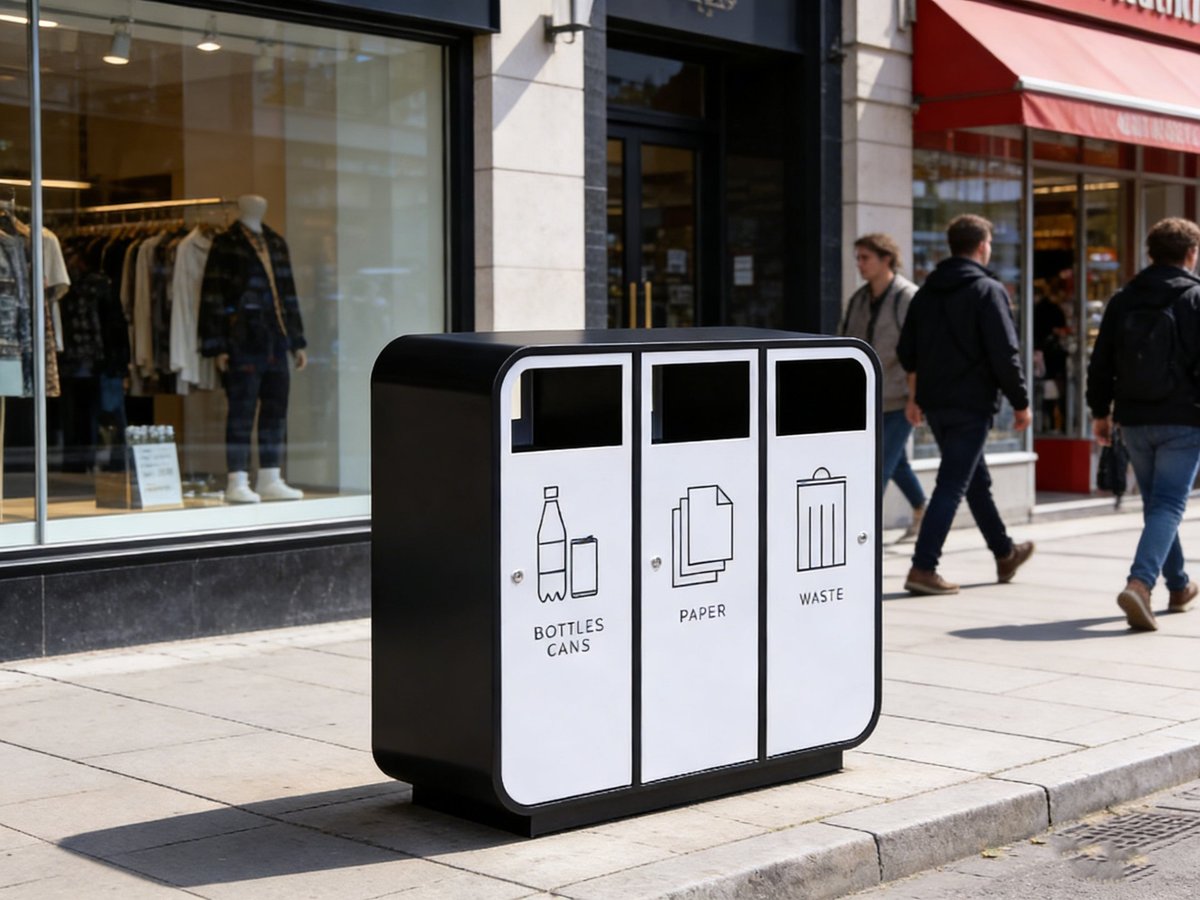
The final cluster of new criteria targets what happens after installation. Recent tenders have included clauses requiring replaceable hardwood or WPC slats, fixings available for at least ten years after purchase, modular components that can be rebuilt rather than skipped, and take-back or recycling options at end of life. Warranty scope is being scrutinised more closely too — a structural warranty that covers coatings, not just frames, scores very differently from one that does not, as our comparison of outdoor furniture warranty terms explains. Products designed for disassembly, such as modular multi-stream recycling stations like the Triovista triple recycling station, are naturally positioned to score well under these clauses: individual panels and streams can be replaced in service and the steel body recycled cleanly at end of life.
How Suppliers Should Respond to the New Scorecards
Manufacturers and their distribution partners can treat the criteria shift as a competitive moat rather than a compliance burden. A practical preparation checklist:
- Publish film thickness, steel gauge, coating systems and load ratings for every product family — scorecard criteria cannot award points for information that is not supplied.
- Commission or compile recycled-content declarations now; full EPDs where volumes justify them.
- Maintain a public spare-parts price list with an availability commitment in writing.
- Structure warranty documents to cover structure, coating and fixings explicitly, with exclusions stated rather than hidden.
- Price lifecycle scenarios proactively and include them with quotations, so evaluators do not have to model them for you.
What This Means for Your Next Furniture Tender
For buyers, the shift rewards suppliers who can document what their products are made of and how long they last — which is, conveniently, what a factory-direct manufacturer controls end to end. AOTUDE manufactures benches, litter bins, planters, bike racks and supporting street furniture at its 20,000 m² factory in Foshan, China, supplying municipalities, landscape architects and contractors in more than 40 countries on a factory-direct basis. Because we produce rather than trade, we can state steel gauge, hot-dip galvanizing thickness, polyester powder-coat systems and RAL colours for every SKU, quote OEM/ODM production to your drawings from per-model MOQ from 5 pcs (custom runs from 50 pcs), supply recycled-content and coating documentation for green procurement scorecards, and stand behind structures with 5–10 year warranties. If your next tender scores lifecycle cost, environmental performance or repairability, send us the evaluation matrix — we will return product documentation and a factory-direct quotation built to answer it. The catalogue itself, in the form most tender teams want to read it, starts at our municipal outdoor furniture range and runs to the model-level specification sheets.