
2026-09-30
Outdoor Furniture Warranty Comparison: What 5-Year and 10-Year Guarantees Actually Cover
How to compare outdoor furniture warranties for public projects: structural vs coating vs hardware coverage, exclusions that quietly void claims, warranty arithmetic for lifecycle costing and the documents a credible guarantee must include.
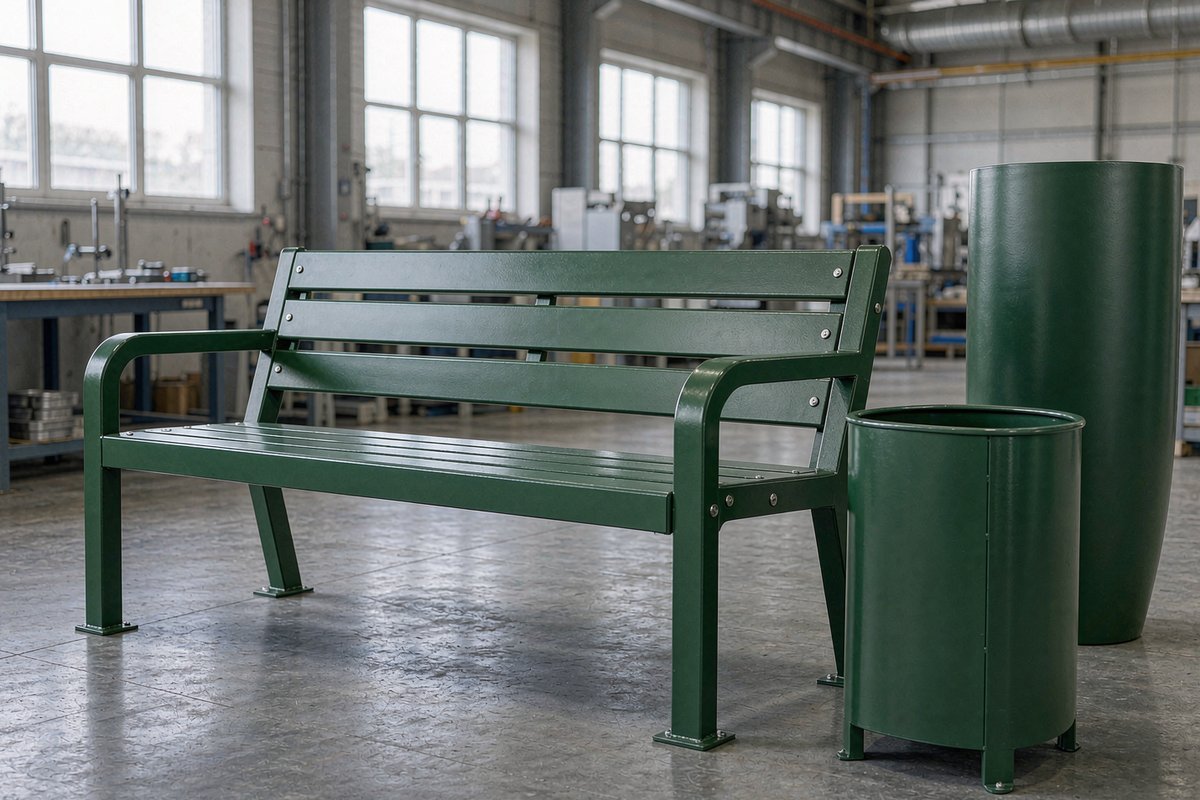
Two suppliers quote the same municipal bench. One offers a "3-year warranty"; the other offers "10 years." Most buyers stop reading there and choose the bigger number — yet the two documents can be nearly identical in real protection, and the 10-year one can even be the weaker of the pair. A site furniture warranty is not a duration; it is a set of defined coverages, exclusions and claim procedures. For municipal departments, landscape architects and contractors comparing outdoor furniture warranties across international suppliers, the difference between a marketing promise and a bankable guarantee lies in about a page of fine print. This guide breaks warranties into their actual components, shows how to compare them line by line, and explains how to translate warranty terms into lifecycle cost.
What a Warranty Actually Covers — and What It Splits Apart
Credible manufacturers do not warranty "the furniture." They warranty layers of it, each with its own duration:
| Coverage layer | Typical duration (quality suppliers) | What it protects | What it usually excludes |
|---|---|---|---|
| Structural frame | 5–10 years | Welds, frame members, load-bearing failure, rust-through of structural steel | Impact damage, vehicle strikes, vandalism, overload beyond rated load |
| Powder coating / finish | 1–3 years | Peeling, blistering, massive fading under normal UV exposure | Scratches, abrasion, graffiti, chemical damage, coating near cut edges |
| Wood / WPC slats | 1–5 years | Delamination, rot, splitting of the material itself | Natural weathering, surface checking, color drift, grain raising |
| Hardware and fixings | 1–2 years | Manufacturing defects in bolts, rivets, hinges | Loss, theft, routine replacement, corrosion from de-icing salts (sometimes) |
| Moving parts (lids, hinges) | 1 year | Mechanical failure under normal use | Wear items, misuse, missing maintenance |
Read that table from the buyer's chair and two things become clear. First, a "10-year warranty" that covers only the structural frame while the coating — the part that determines whether the bench looks serviceable — is covered for a single year is a one-year warranty in practical terms. Second, exclusions define the warranty's real value more than durations do.
The Exclusions That Quietly Void Claims
This is where international buyers lose the most money. Common exclusion clauses are reasonable individually; stacked together, they can make a warranty unclaimable:
- "Improper installation voids warranty." If the supplier does not provide written installation specifications (anchor torque, substrate requirements), this clause is a blank check against you.
- "Damage from coastal environments excluded." Some exclusions draw the coastal line at 500 m from the shoreline — a term that eliminates most seaside promenade projects retroactively. Corrosion coverage near salt water must be negotiated explicitly, ideally with hot-dip galvanized substrate specified in the contract.
- "Routine maintenance required per manual." Legitimate in principle, but ask for the maintenance manual before ordering. A "manual" requiring quarterly professional inspection of every bench is a warranty designed to be denied.
- "Color fading excluded" or capped at a delta-E value. A vague "fading not covered" is a red flag; a defined threshold (e.g. fade beyond grade 4 on the grey scale within the coating warranty period is covered) is a sign of a manufacturer who tests coatings properly.
One further question separates serious suppliers from everyone else: who inspects the claim, and how? A warranty that requires you to ship a failed bench back to the factory at your expense is worth less than one that accepts photo documentation, a cutting sample or a third-party inspection report.
Translating Warranty into Lifecycle Cost
For procurement files, a warranty is an input to lifecycle arithmetic, not a standalone virtue. A simple model makes the comparison honest:
- Expected service life = warranty-backed years (not marketing years) + estimated post-warranty years, discounted for the environment's severity.
- Annualized cost = (unit price + freight + installation) ÷ expected service life.
- Risk adjustment = probability-weighted cost of out-of-warranty failures. If coatings are covered for only 1 year in a coastal project, add a repaint or replacement allowance from year 2.
Worked example: Supplier A quotes $280 per bench with a 3-year limited warranty. Supplier B quotes $340 with a 10-year structural and 3-year coating warranty and documented galvanizing. On an 8-year planning horizon, Supplier B's annualized cost is roughly half of Supplier A's once one repaint cycle for A is priced in — before counting the administrative cost of replacing benches in a live public space. The pattern repeats across bins, planters and bike racks: warranty depth is usually cheaper than warranty absence.
A Comparison Checklist for Your Next Tender
- Coverage split stated in writing: structural / coating / slats / hardware, each with its own duration
- Exclusions list requested in full before order confirmation, with coastal and de-icing environments declared by you
- Claim procedure defined: documentation accepted (photos, samples, third-party inspection), response time, remedy (repair, replacement parts, or replacement unit)
- Installation and maintenance documents supplied by the manufacturer as part of the contract
- Warranty backed by an entity that will still exist in 10 years — a factory, not a trading company with a Gmail address
- Test evidence behind the promise: coating UV/ salt-spray test reports, static load test records
That last line is the fastest filter. Manufacturers who publish salt-spray hours and load test values are manufacturers whose warranty numbers came from a testing lab, not a marketing meeting.
Warranties Are Earned at the Factory
At AOTUDE, the warranty is a summary of how the furniture is built, not a separate promise. Our Foshan factory manufactures benches, litter bins, planters and bike racks on pre-treated and hot-dip galvanizable steel with polyester powder coatings validated by salt-spray and UV testing, which is how we back every order with a 5–10 year structural warranty. As a factory-direct manufacturer with MOQ from 50 pieces, we support OEM/ODM projects with written installation specifications, maintenance manuals and coating test reports included in the documentation pack — so the warranty you file with your tender is the same one our production line answers for. Compare the range and request test reports at https://aotude.com, or send us your project environment (coastal, de-icing, high-vandalism) and our team will return the correct warranty configuration for it.