
2026-09-24
Bike Rack Layout Best Practices for Public Spaces: A Planner's Spacing and Specification Guide
How to plan public bike rack layouts: rack spacing, aisle clearances, capacity formulas and material specifications for municipal plazas, parks and streetscapes.
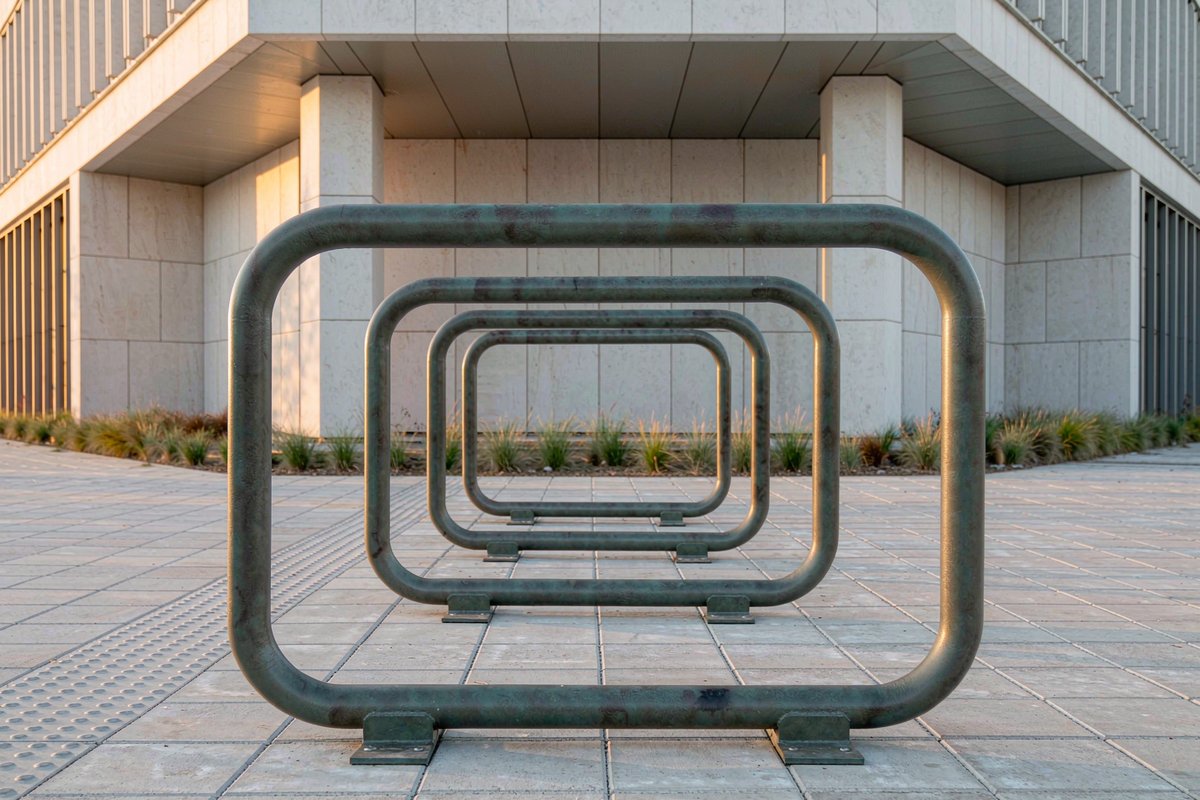
As cities push cycling mode share upward, bike parking has quietly become one of the most contested pieces of street furniture in the public realm. A poorly planned bike rack layout generates complaints from three directions at once: cyclists can't lock their frames properly, pedestrians are squeezed off the sidewalk, and maintenance crews inherit a fixture that loosens, rusts or gets hit by sweeping equipment. The good news is that most layout failures trace back to a handful of predictable dimensioning and placement mistakes. This guide condenses the spacing rules, capacity math and specification details that municipal planners, landscape architects and contractors should get right before the first anchor bolt is drilled.
Start with Demand, Not with Racks
The most common planning error is installing a fixed number of racks without estimating turnover. A practical capacity framework used in municipal cycling plans:
- Retail and café frontages: 1 rack space (2 bikes) per 300–500 m² of gross floor area
- Transit stations and hubs: peak-hour boarding counts × 15–20% of riders arriving by bike, plus a 20% growth buffer
- Parks and plazas: 1 rack space per 20–30 projected peak visitors, weighted toward entrances and activity nodes
- Schools and campuses: 1 space per 10 students and staff at secondary level
Once demand is estimated, divide by two (each standard rack holds two bicycles) and round up in modules — racks placed in visible, well-lit groups of 4–8 spaces are used more heavily and are cheaper to service than scattered singles.
The Spacing Dimensions That Decide Everything
Bicycle parking fails in the details. These are the clearances that separate a functional installation from a daily source of complaints:
| Dimension | Minimum | Recommended | Why it matters |
|---|---|---|---|
| Rack-to-rack spacing (parallel rows) | 750 mm | 1,000 mm | Handlebars overlap below 750 mm; 1,000 mm allows loading with panniers |
| Rack-to-wall or kerb | 600 mm | 750 mm | Rear wheel needs room to swing in perpendicular |
| Aisle between rack rows | 1,200 mm | 1,500–1,800 mm | Two bikes passing; accessible route compliance |
| Distance from pedestrian thru-route | 600 mm | 900 mm+ | Keeps handlebars off the walking line and wheelchairs clear |
| Overhead clearance | 2,000 mm | — | Uprights, awnings and tree canopies block frame parking |
Two rules of thumb reinforce the table. First, a rack only works if a bike can park perpendicular to it — diagonal or parallel parking against a wall halves effective capacity and encourages bad locking habits. Second, reserve the first 600 mm behind any rack as a no-obstacle zone: planter edges, bollards and signage poles placed in that band make every second space unusable.
Rack Types and Where Each One Belongs
Not all racks behave the same in public space. Choosing the right type for the location prevents most user complaints:
- Inverted-U (Sheffield) racks — the default for sidewalks and plazas. Two contact points support a frame at both wheels, work with any lock type, and survive abuse well. Specify 48 mm tube diameter so standard locks reach frame and wheel.
- Wave / continuous racks — space-efficient for long runs, but only the "valley" positions lock properly; expect real capacity around 1.5 bikes per module rather than 2.
- Front-wheel slots (butterfly racks) — acceptable only where attendants supervise; they damage wheels and are the most common source of accessibility complaints because bikes fall sideways.
- Decorative or art racks — excellent for place-making, but audit each design against the spacing table above. Many sculptural racks look good in renders and fail the 750 mm test in reality.
Placement Principles for Streetscapes and Parks
Beyond dimensions, siting determines whether a rack is actually used:
- Visibility beats quantity. Racks within 15 m of an entrance, in sight of foot traffic, see 2–3× the occupancy of hidden courtyards.
- Lighting is part of the specification. A rack outside a light pool is a security complaint waiting to happen; coordinate fixture layout with furniture layout.
- Protect the drainage plane. Anchor into paving joints or use surface plates with stainless anchors; core-drilled installs without proper sealing become rust streaks within one winter.
- Sweeping and snow clearance paths. Keep rack footprints out of plow and sweeper turning radii, or crews will report them as obstructions by month two.
- Don't block accessible routes. Most accessibility standards treat a rack as a protruding object; maintain the clear width of the accessible path around and between installations.
Materials and Anchoring: What Survives a Decade Outdoors
Public bike racks take more mechanical abuse than almost any other site furniture — leaned-on bikes, chain locks grinding the coating, salt spray, and the occasional vehicle contact. The specification baseline:
- Hot-dip galvanized steel with an outdoor-grade polyester powder coat (60–80 µm minimum), or 316/304 stainless for coastal and premium locations
- Tube gauge of 2.5–3 mm on uprights; thin-wall racks bend under lateral loads and once bent, they never look acceptable again
- Tamper-resistant stainless fasteners and either embedment with epoxy grout or surface plates with security shear anchors
- RAL color matching so the racks read as part of the city's furniture family rather than an afterthought
Sourcing Bike Racks from a Factory Directly
For procurement teams buying at municipal scale, rack quality is ultimately a manufacturing question. AOTUDE, a factory-direct outdoor furniture manufacturer based in Foshan, China, supplies inverted-U and custom bike racks alongside its benches, planters and litter bin lines — hot-dip galvanized, powder-coated in any RAL color, with OEM/ODM customization from 50 pcs per SKU and 5–10 year structural warranties backed in writing. Because racks ship together with the rest of the streetscape order, color matching and hardware standards stay consistent across the whole project. Layout drawings and anchor templates are provided with every order; see the full range at https://aotude.com.
Bottom line: capacity from demand data, clearances from the spacing table, rack type matched to location, and a galvanized-plus-powder-coat spec. Get those four right and the bike rack becomes the least controversial piece of furniture on the street — which is exactly what good street furniture should be.