
2026-10-22
Custom Outdoor Trash Bin Manufacturer: OEM Litter Bin Runs
How custom outdoor litter bin runs work: which changes need new tooling, quantity thresholds per model, the approval sequence and the drawing pack to send.
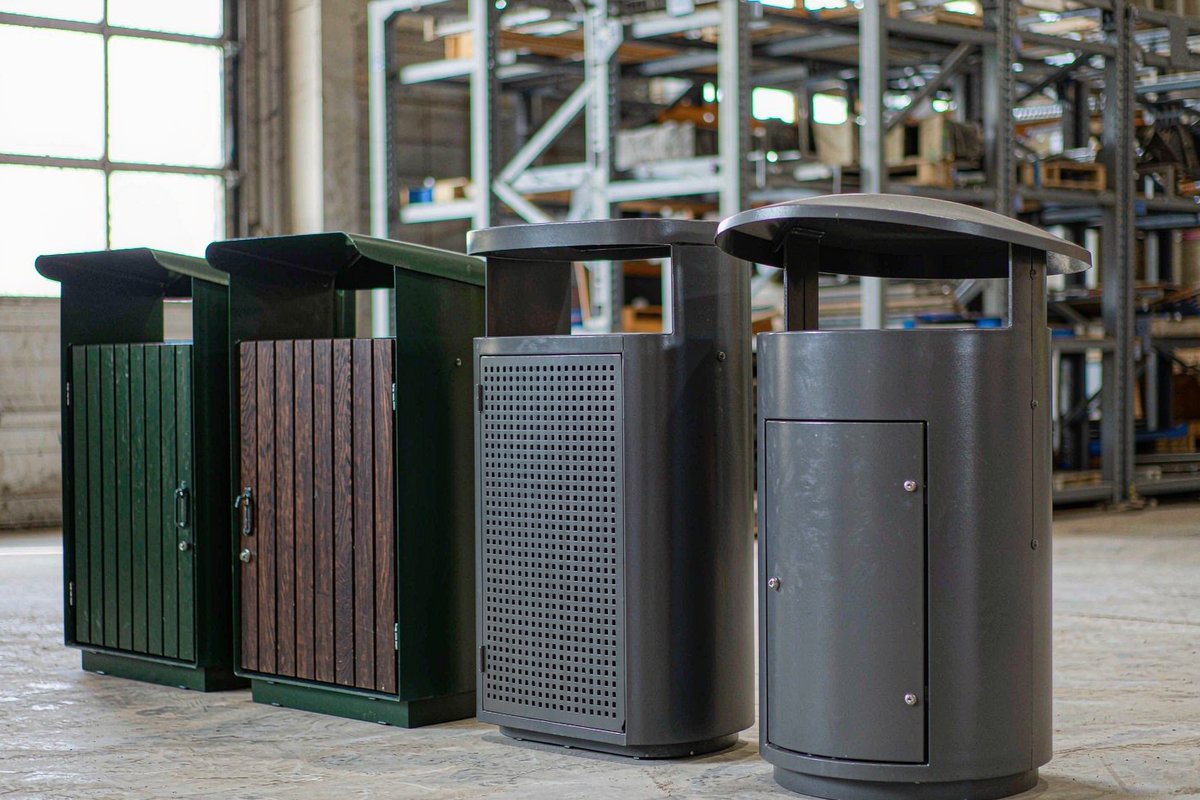
A custom outdoor trash bin is rarely a new product. It is a catalogue body with a defined set of layers changed: colour, aperture, liner system, branding, mounting. The question that decides your cost is which of those layers need tooling and which do not, because that also sets your quantity threshold and your schedule. Colour, logos, split openings and base plates are drawing-level changes; a new shell profile or new body proportions is tooling. Mark the layers on one drawing and a manufacturer can quote in a single pass.
Quick answer: Specify customisation by layer. Any RAL colour, laser-cut artwork, split openings, liner type and base detail are drawing changes, available on custom runs from 50 pcs per model. A new shell profile, new proportions or a body that must match an existing streetscape is tooling, quoted per design and confirmed with sales. Below that threshold, take the closest catalogue model plus drawing-level changes.
The Four Layers Buyers Actually Customise
Most custom enquiries sit in one of four layers, and they carry very different cost structures. Sorting your brief into these layers before you send it is the fastest way to avoid a quotation that answers a different question than the one you asked.
| Layer | Typical changes | Tooling impact | Quantity threshold | Effect on schedule |
|---|---|---|---|---|
| 1. Finish and colour | Any RAL colour, two-tone body, icon panel colour, texture | None — powder-coat batch change | Per-model, from 5 pcs | Adds a coating batch to the standard run |
| 2. Graphics and identity | Laser-cut city logo, cast badge, etched park name, stencil number | Programming only for laser-cut; a new pattern for cast badges | From 50 pcs per model; cast badges quoted per design | Artwork proof before production |
| 3. Function | Split openings, ashtray module, hood or canopy top, hinged front door, liner type, base plate or embedded post | Drawing revision, sometimes a new jig | From 50 pcs per model | One drawing approval cycle |
| 4. Form | New shell profile, new body proportions, matching an existing bin, non-standard height | New tooling or forming programme | Quoted per design — confirm with sales | Tooling plus a pre-production sample |
Layers 1 and 2 ride on a standard run. Layer 3 needs a drawing revision but reuses the body. Layer 4 is a new product and should be priced and scheduled as one.
What Changes Without New Tooling
The list is longer than most buyers expect, which is why a custom-looking bin often costs little more than the catalogue model it is based on. All of the following are available on the outdoor trash bin range as drawing-level changes:
- Any RAL colour on body, hood and door, including a contrasting interior.
- Two-tone bodies — dark frame with a lighter door, or body and hood in different colours.
- Split or single openings, including an aperture shaped for cups and wrappers rather than mixed waste.
- Hood, canopy or open top, which changes rain and wind performance more than it changes the look.
- Liner interface and base detail — galvanized or rigid plastic liner, top lift-out versus side-door access, surface base plate or embedded post.
- Branding — laser-cut logos, icon panels, cast badges, park or precinct names cut into the door.
- Stainless tamper-resistant fasteners where repeated servicing or theft is a concern.
If your brief stops here, you are buying a configured catalogue bin, and the price should reflect that.
What Needs Drawings or Tooling
These change the body itself and need a quotation rather than a configuration sheet:
- A shell profile that does not exist in the range, or a body that must visually match a bench or planter family already on site.
- Non-standard proportions — a tall slender bin for a tight pavement, or a wider body where collection runs are infrequent.
- A door or hinge arrangement built around an existing collection vehicle, or a one-piece anti-vandal body with a hinged lockable front on exposed sites.
Each needs a dimensioned drawing, material call-out and finishing specification before anyone can quote honestly. Start from the specification library, which carries the material and finish references we build to — the coating schedule and the material comparison — so a drawing can cite an existing standard instead of describing a finish in prose.
Quantity Thresholds and How MOQ Is Set
Thresholds exist because of set-up, not because of steel. A colour change costs a powder batch; a laser program costs a fixture set-up; a new shell costs tooling. That is why they step rather than scale smoothly.
| Your requirement | Route | Quantity basis |
|---|---|---|
| Catalogue model in a non-standard RAL colour | Configured catalogue run | Per-model, from 5 pcs |
| Catalogue model with logo, split opening or ashtray module | Drawing-level custom run | From 50 pcs per model |
| New shell profile or new body proportions | New design and tooling | Quoted per design, confirmed with sales |
| Mixed project — several models, one shipment | Combined run, thresholds unchanged | Counted per model, not per order |
The last row catches buyers out. A project needing four bin models does not reach a threshold with 50 units in total; the threshold applies to each model, because each carries its own set-up.
One number also needs care: liner volume. Catalogue litres describe the body, not what a liner holds, because double walls and the liner's own wall thickness take a share. We do not publish a usable liner figure until it has been measured for that liner, and the litter bin capacity table states which values are body volumes and which are pending factory confirmation. If your brief is driven by an emptying interval, specify the interval and let the liner be sized against it.
The Approval Sequence
Custom runs fail on approvals more often than on fabrication. Hold to this order:
- Brief and layer check. You send the requirement; we confirm which layer it sits in and what it triggers.
- Dimensioned drawing. Overall dimensions, aperture size and position, opening direction, liner type, base detail, anchor hole centres.
- Finish and artwork proof. RAL references, gloss level, two-tone break lines, vector logo and its cut size.
- First-article review on new-tooling runs, against the approved drawing.
- Production and inspection, with the approved drawing as the inspection reference.
Steps 1 to 3 are where a project locks down or drifts. Send vector artwork rather than a screenshot, and state the revision you are approving — a logo re-cut after production is a scrap body.
How to Specify: What to Send Us
One email with these items is enough for an accurate quotation on a custom run:
- Site and use — park, streetscape, transit stop or campus, and the servicing regime planned.
- Model or reference — the closest catalogue model, or a photograph of the bin being replaced.
- Which layers change — finish, graphics, function or form, and nothing else.
- Quantities per model — split by model and colour, since thresholds apply per model.
- Dimensions you must hold — overall height, footprint, aperture height, or the constraint that matters on site.
- Liner and collection method — existing liner in stores, bag-only, or a liner to be specified with the bin.
- Finish references — RAL numbers, gloss level, and a vector logo file if branding is required.
- Mounting surface and destination — paving, concrete or soft landscape; port or site address; FOB or delivered.
- Tender requirements — drawing format, material declarations, test reports or samples needed for submission.
If you already have a drawing, send it even if it is rough. Send your requirement to our sales team and we will come back with the route, the threshold that applies to your quantity and a drawing for approval — not a price against a product we have assumed you meant.
Planning a public-space project? Browse the commercial outdoor trash bin range, check the specification library for material and finish references, or look at the Fairway Slat Hood Bin as a starting point for a slat-bodied custom run.