2026-09-21
How to Choose Outdoor Trash Bins for Parks: A Municipal Buyer's Checklist
A practical procurement checklist for parks departments and landscape contractors: capacity, liner systems, corrosion protection, anti-vandal hardware and the real cost drivers behind park litter bins.
Specifying outdoor trash bins for a park sounds simple — pick a container, place it, done. Anyone who has managed a public space knows better. The wrong bin becomes a maintenance burden within months: rusted bodies, missing lids, liner chaos and constant complaints. This checklist distills what parks departments, landscape architects and contractors should verify before placing an order.
1. Capacity and Service Frequency
Match bin volume to realistic footfall, not wishful thinking. As a rule of thumb used in municipal planning:
- Low-traffic areas (neighborhood greenways, walking trails): 40–60 L is sufficient with weekly servicing
- Medium-traffic parks (community parks, playgrounds): 70–100 L, serviced 2–3 times per week
- High-traffic zones (city-center plazas, festival lawns, transit hubs): 100 L+ or dual-body bins, daily service in peak season
Undersized bins overflow; oversized bins waste crew time and collect standing odors. If your servicing schedule is fixed, size the bins to the schedule — not the other way around.
2. Liner System: The Most Underrated Feature
The inner liner determines how fast a crew can service a bin. Look for:
- Rigid galvanized or plastic liners that lift out with one hand
- Standard liner dimensions so replacements can be bought anywhere, years later
- Locking or stay-open lid hardware so hands stay free during collection
Bins without a proper liner system cost more in labor within the first year than the liner itself would ever cost.
3. Corrosion Protection: Coating Stack Matters
Outdoor furniture lives in rain, UV, bird droppings, fertilizer overspray and — in coastal cities — salt air. The minimum spec for a 10-year service life:
1. Hot-dip galvanized steel body (or weathering corten steel for signature landscapes)
2. Outdoor-grade polyester powder coating, UV-stable, minimum 60–80 µm film thickness
3. Drainage at the base so condensation and rain never pool inside the body
Avoid painted-only (non-galvanized) bodies in any wet or coastal climate. Repainting costs far more than the coating premium over a decade.
4. Anti-Vandal Hardware
Public hardware gets abused. Specify:
- Stainless or zinc-plated fasteners with tamper-resistant heads
- Hinged lids with restrainers or detachable-with-tool designs
- Minimum 1.5–2 mm steel gauge on exposed panels; heavier on hood edges
5. Aesthetics and Place-Making
A bin is one of the most repeated visual elements in a park. Match it to the landscape language:
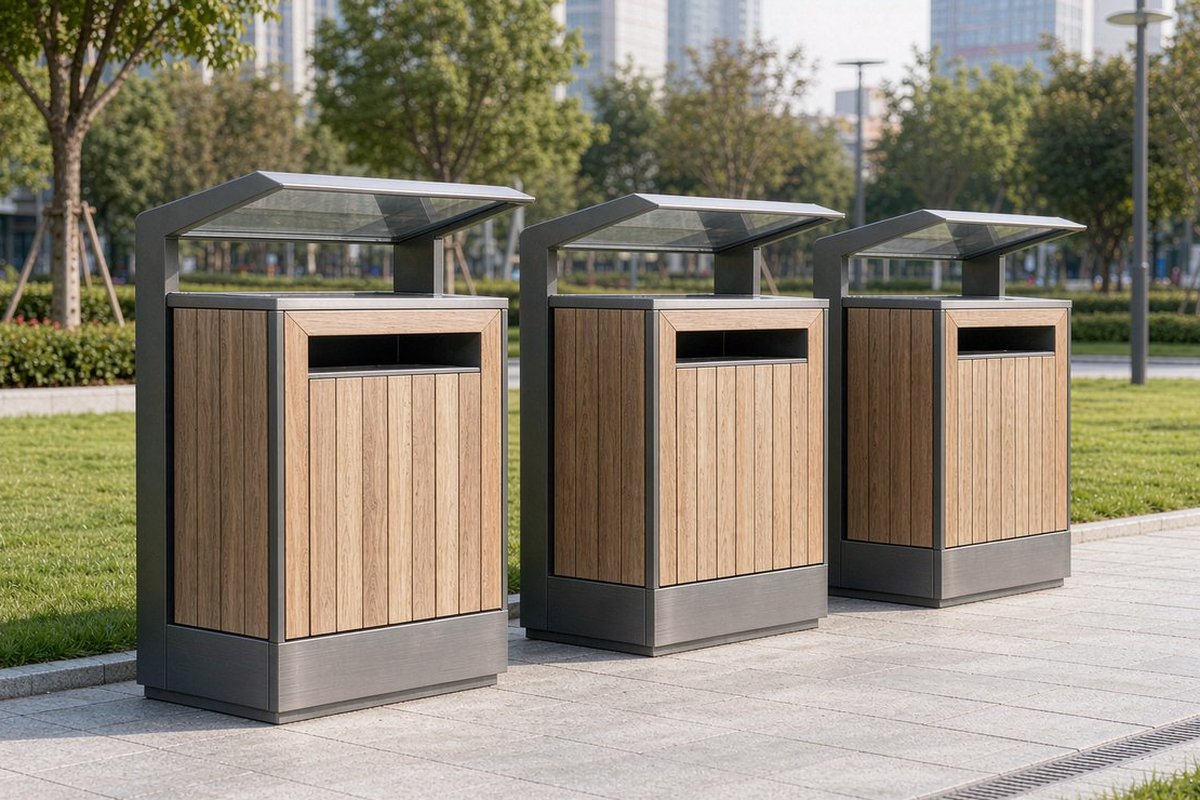
- Timber-clad bodies for natural, park-like settings
- Fluted or perforated steel for contemporary plazas
- Corten steel for heritage and rust-toned landscape palettes
- Custom powder-coat colors (RAL) to align with city branding — a service most factories, including AOTUDE, offer from modest order quantities
6. Total Cost of Ownership, Not Purchase Price
A galvanized, powder-coated bin typically costs 20–30% more upfront than a bare-steel alternative — and avoids repainting cycles, premature replacement and complaint handling for a decade. Across a 40-project sample we analyzed, quality furniture delivered a 40–60% lower 10-year lifecycle cost than budget alternatives.
Buying from a Factory Directly
When sourcing from a manufacturer (rather than a reseller), verify: OEM customization (colors, logos, dimensions), MOQ per SKU, export packing quality, and warranty terms in writing. AOTUDE, a factory-direct manufacturer in Foshan, China, supplies park and street litter bins from 50 pcs per SKU with 5–10 year structural warranties and worldwide shipping.
Bottom line: capacity first, liner second, coating third. Get those three right and the bin will quietly do its job for a decade.