
2026-09-29
OEM Site Furniture Container Packing: A Buyer's Guide to Loading Plans and Landed Cost
How OEM container packing decisions decide landed cost for imported benches, bins and planters: loading plans, knocked-down vs assembled, protection layers and the packing details to fix before production starts.
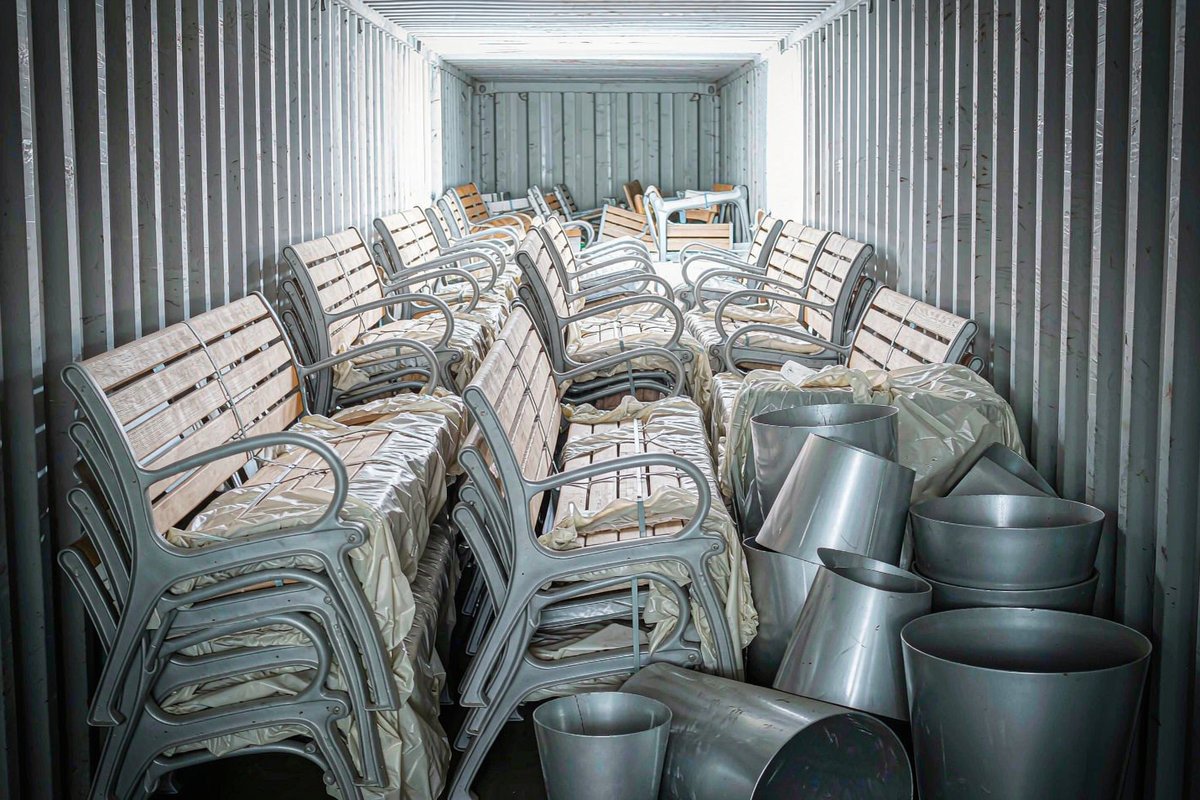
Two importers can buy the same bench from the same factory at the same unit price and still end up with landed costs 25% apart. The difference is rarely the FOB price — it is container packing. How many units fit in a 40HQ, whether frames travel knocked-down or welded, how much protective material is spent per piece, and what happens when a forklift slips during loading all land in your final cost per installed seat. For municipalities, landscape contractors and distributors buying OEM site furniture from overseas, packing is a specification, not a formality. This guide explains the loading-plan decisions that matter, the packing modes available, and the details to lock down before production starts.
Why Container Packing Decides Landed Cost
Ocean freight is charged per container, not per unit. That single fact makes packing efficiency the highest-leverage cost lever in an import program:
- Fill rate is money. Moving from 60% to 90% fill on a 40HQ that carries 120 benches means the same freight invoice delivers 180 units — a straight 33% reduction in freight cost per piece.
- Volume, not weight, is usually the limit. Steel furniture is dense but bulky; most site furniture shipments cube out before they weigh out. That means reducing packed volume — nesting, stacking, knocking down — beats reducing kilograms.
- Damage is a hidden freight cost. Every crate that arrives with bent legs or chipped coating costs a replacement unit, a second shipment and a project delay. Protective packing that looks expensive on the packing list is almost always cheaper than a claims cycle.
What Actually Fits in a Container
Real load counts vary with product geometry, but the ranges below reflect typical OEM site furniture shipments. Use them to sanity-check any packing plan you receive:
| Container | Internal volume | Typical site furniture load (mixed) | Best-suited packing mode |
|---|---|---|---|
| 20GP | ~33 m³ | 40–70 benches, or 250–400 small planters | Knocked-down or nested |
| 40GP | ~67 m³ | 90–140 benches, or 600–800 planters | Nested + stacked |
| 40HQ | ~76 m³ | 110–180 benches, or 700–900 planters | Nested, stacked, modular |
| 40HQ (bins, assembled) | ~76 m³ | 200–350 litter bins | Stacked with lid-off nesting |
| LCL / palletized | per m³ | Suitable for samples and pilot orders only | Crated pallets |
Ask your supplier for a documented loading plan — a drawing showing how each SKU is arranged, not a verbal promise of "we will fill the container." A credible plan states pieces per layer, layers per stack, and total units, with the arithmetic visible.
Knocked-Down vs Fully Assembled
The single biggest volume decision is whether products ship assembled.
| Packing mode | Volume vs assembled | Trade-offs to price in |
|---|---|---|
| Fully assembled | 100% (baseline) | Zero site labor, but lowest container utilization and highest damage exposure on long protrusions |
| Partially assembled (legs off) | 25–40% reduction | Small site labor; strong balance for benches and bike racks |
| Fully knocked-down (flat pack) | 50–65% reduction | Requires site assembly labor, clear instructions, and correct fastener kits — best for large projects with installation crews |
| Nested | 30–50% reduction | Applies to planters and bins with tapered bodies; near-zero labor cost |
For a 300-piece streetscape package, partially assembled shipping is usually the sweet spot: it keeps the assembly burden low while recovering a third of your freight volume. Fully knocked-down makes sense only where a contractor is already mobilizing a crew with tools.
Protection Layers That Survive a 40-Day Voyage
Corrosion protection specified at the factory is worthless if the coating is abraded in transit. Specify the packing stack explicitly:
- Powder-coat-safe interleaving — foam or EPE sheets between coated surfaces, never bare steel-on-coating contact
- Corner and edge protection — cardboard or plastic angle protectors on every exposed frame end and lid edge
- Shrink wrap on complete units where moisture and dust exposure is expected
- Desiccant plus VCI film for humid routes and long sea legs; condensation inside a container is the leading cause of "new" furniture arriving with surface rust
- Wooden crates or steel strapping on heavy planters and stacked columns, with the stack height limited to what the bottom unit can bear
- Fastener and small-part kits packed per unit or per pallet, labeled in English, so installation crews are never guessing
One more specification item worth writing into the purchase order: fumigation and ISPM 15 compliance for any solid-wood packing material. Non-compliant wood packaging is a routine cause of customs hold-ups and re-export orders.
What to Fix Before Production Starts
Container packing cannot be optimized after the goods are built. Lock these points into the PO and the approved sample stage:
- Unit dimensions and packing dimensions for every SKU, in millimeters, with and without packing material
- Loading plan drawing with pieces per layer and total units per container, approved in writing
- Stacking limits — maximum units per stack and whether stacking is permitted on the coating
- Assembly level per SKU, plus the fastener kit contents and instruction sheet language
- Packing material specification by name and thickness, so "protective packing" cannot be substituted with a single layer of bubble wrap
- Photo documentation at loading — container number, seal number, layer-by-layer photos and a final loaded-container shot before the doors close
Those loading photos are the most useful quality document you will receive all year: they prove what was shipped, in what condition, and they settle most damage claims in a single email.
Packing as Part of the Specification
At AOTUDE, container packing is engineered alongside the product. Our Foshan factory builds benches, litter bins, planters and bike racks for export, and every quotation includes a documented loading plan with pieces-per-container figures, coated-surface interleaving and ISPM 15 compliant packing as standard. As a factory-direct manufacturer with MOQ from 50 pieces, we support OEM/ODM projects with custom dimensions, RAL powder-coat colors, per-unit fastener kits and layer-by-layer loading photos before the doors close — backed by a 5–10 year structural warranty. Send us your bill of quantities at https://aotude.com and our export team will return a loading plan, container count and landed-cost estimate for your project.