
2026-10-07
Recycled Plastic Lumber vs Timber for Park Furniture: A Specifier's Material Comparison
Recycled plastic lumber vs timber for public park furniture: durability, maintenance, whole-life cost, sustainability claims and a specification checklist for buyers.
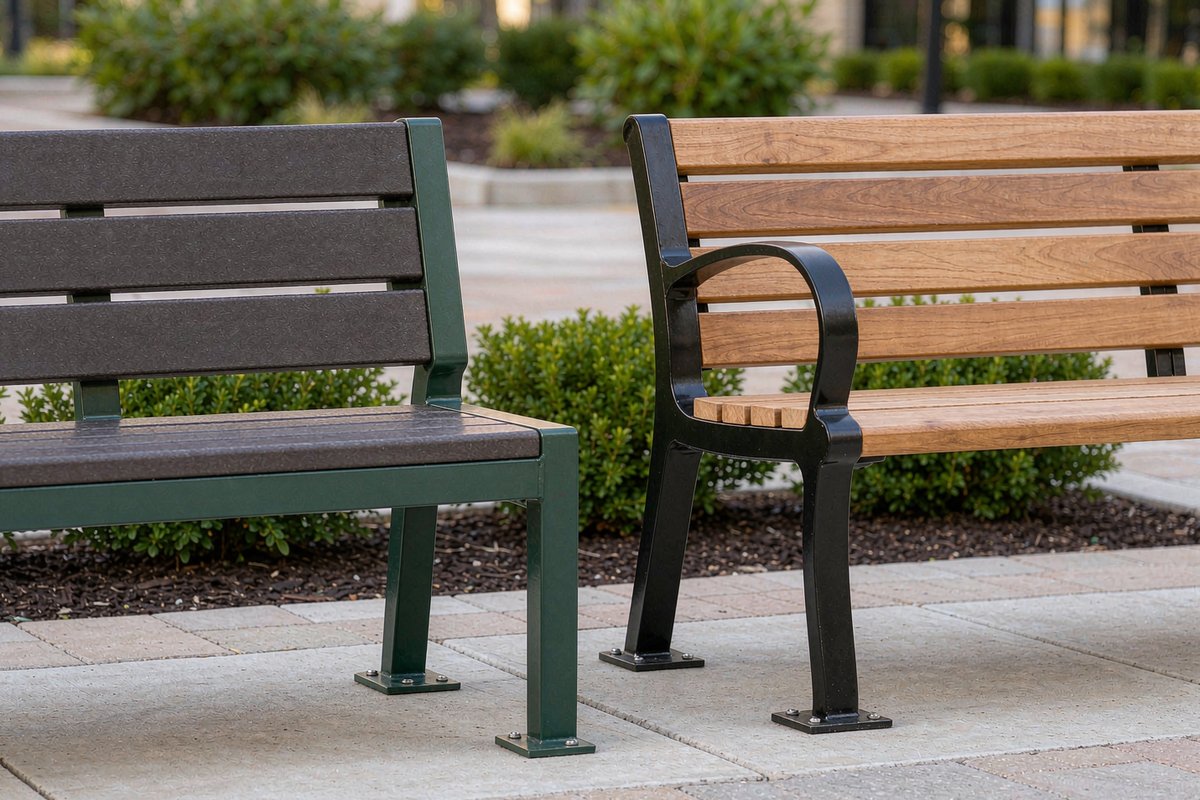
Every year, parks departments and landscape architects face the same quiet specification decision: slat the benches, tables and decking in timber, or in recycled plastic lumber. Both look like wood in a rendering, both are sold as "sustainable," and both can be purchased for a similar unit price. But they behave very differently over a fifteen-year service life — in maintenance labor, splinter liability, colour retention and end-of-life disposal. This guide compares recycled plastic lumber and timber for park furniture on the criteria that actually decide a tender: durability, maintenance, whole-life cost, sustainability evidence and specification clarity.
What Each Material Actually Is
The confusion starts with naming. "Composite" and "recycled plastic" are often used interchangeably in marketing, but they are not the same product, and neither is the same as solid timber.
- Recycled plastic lumber (RPL) — a solid, homogeneous profile made from 100% post-consumer or post-industrial plastic waste, usually HDPE from bottles and containers. No wood flour filler, so it does not absorb water, rot or support mould growth.
- Wood-plastic composite (WPC) — a blend of roughly 50–70% wood flour with polyethylene or PVC binder. It looks and machines more like timber, but the wood fraction can absorb moisture and support fungal growth if the surface is breached.
- Solid timber (hardwood or softwood) — natural wood, typically documented teak, iroko, robinia or pressure-treated pine. Unmatched warmth and grain, but a living material that moves, checks and needs periodic protection.
For a public bench or picnic table, RPL sits at the "installed and forgotten" end of the spectrum, timber at the "beautiful but managed" end. The right answer depends on who maintains the site and for how long it must look good.
Durability Comparison
| Performance factor | Recycled plastic lumber (RPL) | Solid timber | Wood-plastic composite (WPC) |
|---|---|---|---|
| Moisture absorption | Effectively none | Absorbs; swells and shrinks | Low but non-zero |
| Rot and fungal attack | Immune | Requires treatment or naturally durable species | Vulnerable if wood flour exposed |
| Splintering risk | None | Can splinter when weathered | Low |
| Insect damage | Immune | Termites/borers in some species | Low |
| UV / colour fade | Moderate; pigments fade gradually | Greys and silvers naturally | Can fade and chalk |
| Graffiti and staining | Cleans well; non-porous | Penetrates grain; hard to remove | Moderate |
| Structural span | Lower stiffness; needs shorter spans or steel reinforcement | High stiffness; long clear spans | Mid-range |
| Fixing behaviour | Expands thermally; needs slotted holes | Moves seasonally; needs gaps | Moderate movement |
The key structural caveat for RPL is stiffness. Recycled plastic lumber is considerably less rigid than timber of the same section, so it typically requires closer joist spacing, thicker profiles or an internal steel or aluminium reinforcement to resist sagging under a 200 kg static load test. A supplier who quotes RPL slats over the same span as timber without addressing deflection is a supplier worth questioning.
Maintenance and Whole-Life Cost
Maintenance is where the material choice shows up on the operating budget. Timber is rarely expensive to buy and rarely cheap to own, because it needs work almost every year.
- Timber, inspected annually — sanding, re-oiling or re-staining every 12–24 months in exposed sites; replacement of split or splintered slats; occasional structural refastening as the wood moves.
- RPL, inspected annually — a pressure-wash once or twice a year, replacing the occasional UV-faded or graffitied board. No sealing, no oiling, no rot repair.
- WPC, inspected annually — periodic cleaning of the surface; risk of moisture ingress if the cap layer is scratched, which can lead to swelling and mould.
Because collection crews and maintenance staff are paid every year while the furniture is bought once, a material that removes two repainting cycles over ten years often wins on discounted whole-life cost even at a higher initial price. Buyers comparing quotes on unit price alone rarely see this, which is why the specification should ask for a stated maintenance regime and a ten-year consumables allowance, not just a unit cost.
Sustainability: Read the Evidence, Not the Label
Both materials carry sustainability claims, and both can be substantiated or overstated.
For recycled plastic lumber, the strong argument is diverted waste: a bench made from RPL keeps hundreds of plastic bottles out of landfill or the ocean, and the material is itself recyclable at end of life. Ask the supplier for the percentage of post-consumer content and, ideally, third-party verification.
For timber, the strong argument is renewable, low-embodied-energy sourcing — provided it is legally harvested and responsibly managed. The relevant proof is chain-of-custody documentation, species name, and country of origin. A "sustainably sourced hardwood" claim with no certificate number is not evidence.
For WPC, the recycled content varies widely by manufacturer, and the wood fraction may not be recycled or certified at all. Do not assume "composite" means "recycled."
A defensible tender line reads: "Slat material to be 100% post-consumer recycled HDPE, minimum 95% recycled content, with supplier declaration" — or "slats to be [species] with botanical name and country of harvest stated on the invoice." Vague terms such as "eco-friendly" or "green material" should be struck out.
Specification Checklist
Before awarding a park furniture package that mixes or standardises on a slat material, confirm each of the following:
- Material definition — exact formulation (100% RPL, WPC with stated wood fraction, or named timber species); recycled content percentage and evidence.
- Structural performance — stated slat section, span, and maximum deflection under a defined static load; reinforced or unreinforced.
- Fixing method — slotted holes or expansion allowance for thermal movement; tamper-resistant fasteners where public risk is high.
- Colour and UV — pigment system, expected fade over ten years, and availability of touching up or replacing individual boards.
- Frame and coating — slat material never stands alone; pair it with a hot-dip galvanized and powder-coated steel or aluminium frame rated for the same service life.
- Warranty scope — confirm the slat warranty separately from the frame warranty, and confirm whether fading, splintering and structural sag are covered.
- End-of-life — is the material recyclable at the end of its service life, and who takes it back?
Getting these answers on one page makes the comparison honest, and it stops the tender from being decided on the lowest unit price of a material that will be repainted twice before the first competitor product needs a pressure wash.
Where AOTUDE Fits
AOTUDE manufactures recycled-plastic-lumber, timber and WPC slat options on a single platform, so the slat decision can be made on the client's maintenance budget rather than on what a middleman happens to stock. As a direct factory in Foshan, China, we ship public benches, picnic tables, planters, litter bins and bike racks without importer markup — per-model MOQ from 5 pcs per model, and we handle OEM/ODM projects including custom RAL colours, branded components and private-label packing. Every frame carries a 5–10 year warranty depending on finish and application.
If you are comparing recycled plastic lumber against timber for a public-space project, send us your drawing, span and load requirements and we will quote both options side by side. Request a quote and we will return a material comparison, a loading plan and a landed-cost estimate.