
2026-10-26
Recycling Station Dimensions: Footprint, Height and Service Clearance
Recycling station dimensions in mm, inches and feet for two- and three-stream models, with the footprint-per-stream maths and service checks to send with a quote.
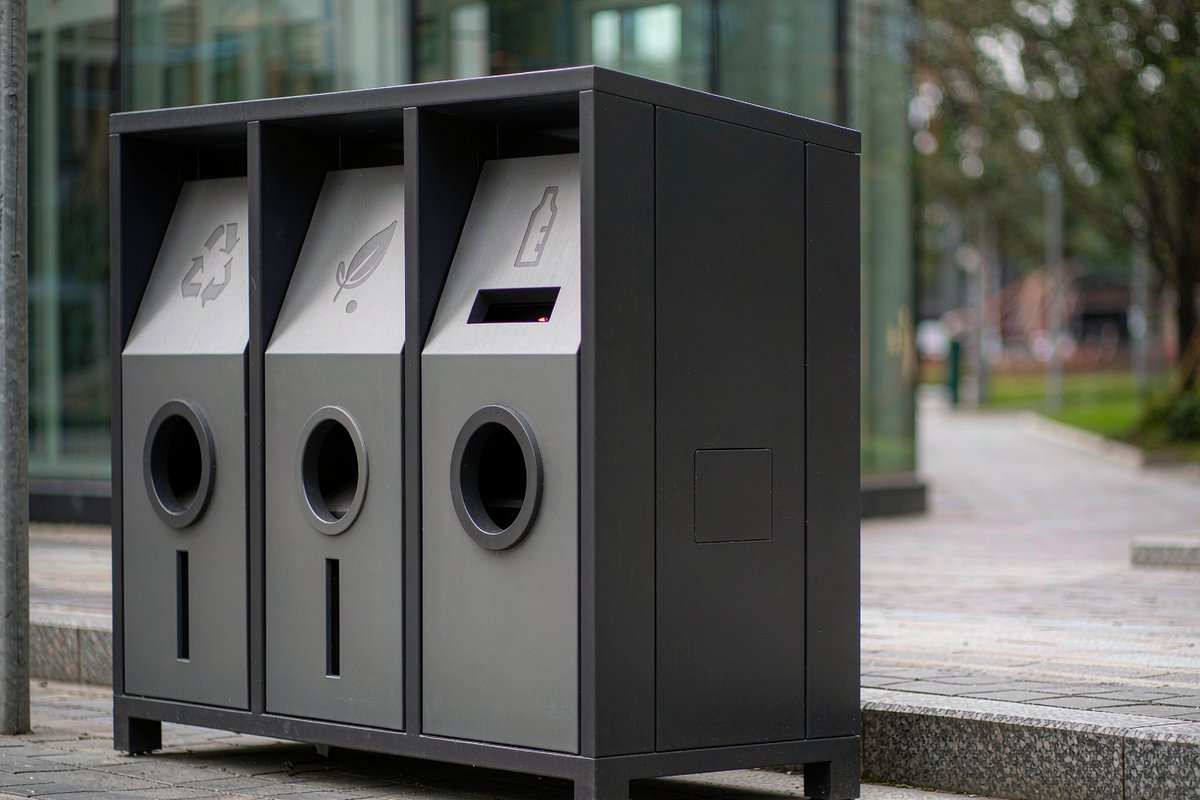
A two-stream recycling station in our catalogue measures 800 × 420 × 950 mm; the three-stream models measure 1290 × 400 × 1050 mm and 1500 × 450 × 1000 mm. Those are overall body dimensions — width along the pavement, depth from the kerb, height to the top panel — and they are the numbers a layout drawing has to accept before anything else in the specification matters.
Quick answer: two-stream 800 × 420 × 950 mm (31.5 × 16.5 × 37.4 in); three-stream 1290 × 400 × 1050 mm (50.8 × 15.7 × 41.3 in) or 1500 × 450 × 1000 mm (59.1 × 17.7 × 39.4 in). Depth is the dimension that fails on site most often — check it against the clear pavement width you actually have.
All three models share the same construction logic: powder-coated galvanized steel body, independent removable liners, cam-locked access doors. The sizing decision is therefore about frontage, not about build. The recycling station range covers stream counts and panel systems model by model, and the specifications centre covers how the split between compartments is decided once the collection contract is known.
Recycling Station Dimensions in mm, Inches and Feet
Figures are overall dimensions, measured to the outside of the body and the highest point of the top panel. Use them directly on a layout drawing; the imperial columns are rounded for readability, not for fabrication.
| Model | Streams | Width (mm) | Depth (mm) | Height (mm) | Width (in) | Depth (in) | Height (in) |
|---|---|---|---|---|---|---|---|
| Duotone classified bin | 2 | 800 | 420 | 950 | 31.5 | 16.5 | 37.4 |
| Trisort triple sorting bin | 3 | 1290 | 400 | 1050 | 50.8 | 15.7 | 41.3 |
| Triovista triple station | 3 | 1500 | 450 | 1000 | 59.1 | 17.7 | 39.4 |
In feet the same bodies read 2.6 ft, 4.2 ft and 4.9 ft wide, at depths of 1.3 to 1.5 ft. Width runs parallel to the kerb or wall the station stands against, so that is the figure competing with bench runs, tree pits and door openings. Height is measured from finished ground level, after paving — a station set on a sub-base slab reads lower once the surface course goes down.
What Each Dimension Actually Controls
The chart answers "does it fit"; it does not answer "will it work". Each dimension drives a different part of the specification:
- Width sets how many streams fit a given frontage, and whether the body can sit between fixed objects. A 1500 mm station will not go into an 1100 mm gap between a tree pit and a lighting column, whatever the drawing scale suggests.
- Depth sets the clear pavement left in front of the station, and the room behind it if the door is on the back face.
- Height sets the reach to the aperture and the sightline from the approach. A taller body reads from further away, which helps on a wide frontage and hurts in a heritage setting.
One dimension is absent from the chart: which face the door is on. That is fixed at order, because a rear-access body cannot be turned around on site.
Footprint Per Stream: The Number Buyers Forget
Tenders usually quote total station length and stop there. What decides whether the station is used properly is the width each stream gets, because a narrow compartment fills first and then receives the wrong material. Divide overall width by stream count:
| Model | Streams | Overall width (mm) | Width per stream (mm) | Width per stream (ft) |
|---|---|---|---|---|
| Duotone classified bin | 2 | 800 | 400 | 1.3 |
| Trisort triple sorting bin | 3 | 1290 | 430 | 1.4 |
| Triovista triple station | 3 | 1500 | 500 | 1.6 |
These are geometric shares of the body, not liner volumes. Liner volume per compartment is pending factory confirmation and must not be inferred from body size or from a photograph — ask for it in writing before the collection contract is signed, because emptying frequency per stream depends on it rather than on the total.
The consequence is worth stating plainly: a three-stream station on a 1290 mm body gives each stream less frontage than a two-stream station on an 800 mm body. Where one material dominates the waste stream, a wider three-stream body is the safer specification.
Service Clearance and Door Swing
No single clearance figure is safe to publish, because it depends on the collection method. Build the envelope from three measurements:
- Door swing plus handling. Open the door type you are specifying and add the width of the liner the crew carries. A liner that must be lifted and turned needs more room than one that slides out on a trolley.
- Trolley route. Measure the collection trolley used on site and keep that band clear of the station face, so nobody drags a full liner across planting or up a kerb.
- Approach and standing space. Keep the pedestrian route on the paved surface. On a narrow footway, mount the station against the wall rather than mid-pavement.
Draw the footprint, offset it outward by those three figures on the door face, then check the rectangle against the site plan, the drainage falls and the nearest crossing. If it does not fit, the answer is another model or another orientation — not a smaller clearance.
Choosing a Body by Site Constraint
| Site constraint | Body to start from | Why it fits |
|---|---|---|
| Narrow footway, wall or railing behind | 800 mm two-stream | Shortest frontage in the range; sits inside a tight gap |
| Wide frontage, needs to read from distance | 1500 mm three-stream | Largest panel area for icons; width and height make it a wayfinding object |
| Campus or estate run with consistent stream names | 1290 mm three-stream | Slimmer than the 1500 mm body, so a repeated run does not crowd the walkway |
| Heritage or landscaped setting | 800 mm two-stream, specified body colour | Smallest visual mass; colour and panel matched to the palette |
| One stream has no collection route | Two-stream, or single-stream plus residual | More apertures than the contract can service will always contaminate |
Stream count, apertures, panel artwork and body colour are specified per project, and we do not claim that any configuration is compliant with a national recycling-labelling regulation — acceptance of colours, icons and stream names stays with your waste authority.
Bodies are supplied with base plates for surface mounting on a concrete slab, with in-ground options on request. On paved public realm surface mounting is usually the better choice, since it can be re-levelled when the paving is renewed. Base plate plans and fixing centres are issued with the approval drawing for your engineer to check against the slab build-up; we will not size a fixing for a slab we have not seen. Where the station stands on a bridge deck, podium or roof terrace, say so at enquiry — the fixing detail and loading case change.
How to Specify: What to Send Us
Send these seven items and the reply is a dimensioned drawing and a price, not a conversation:
- Site plan or sketch with the station position marked, plus the clear width along the frontage.
- Stream count and the stream names used across the estate, taken from the collection contract.
- Colour scheme: RAL references, or the local signage colours to match.
- Panel artwork or the icon set you must follow, as PDF or vector.
- Door face and approach direction, so the access side is correct at fabrication.
- Fixing substrate: paving on slab, in-ground, deck or podium.
- Quantity per model, delivery port and required on-site date.
To check the range before drawings exist, the two-stream Duotone classified bin at 800 mm and the three-stream Triovista station at 1500 mm bracket it: if neither width works on your frontage, the answer is a custom body rather than a compromise on a standard one. Custom widths, stream counts and panel layouts run from 50 pcs per model; catalogue models are available from 5 pcs.
Photographs are not dimensions. A station that looks proportionate beside a bench in a marketing image may be 300 mm deeper than the footway allows, so specify from the chart and your own site measurements, then send the drawing through our contact page for a dimensioned confirmation before the tender closes.