
2026-10-19
Site Furniture Lead Times: How to Plan a Project Schedule from Purchase Order to Installation
A practical guide to site furniture lead times: production stages, standard vs custom timing, where schedules slip, and a backward-planned schedule from purchase order to installation.
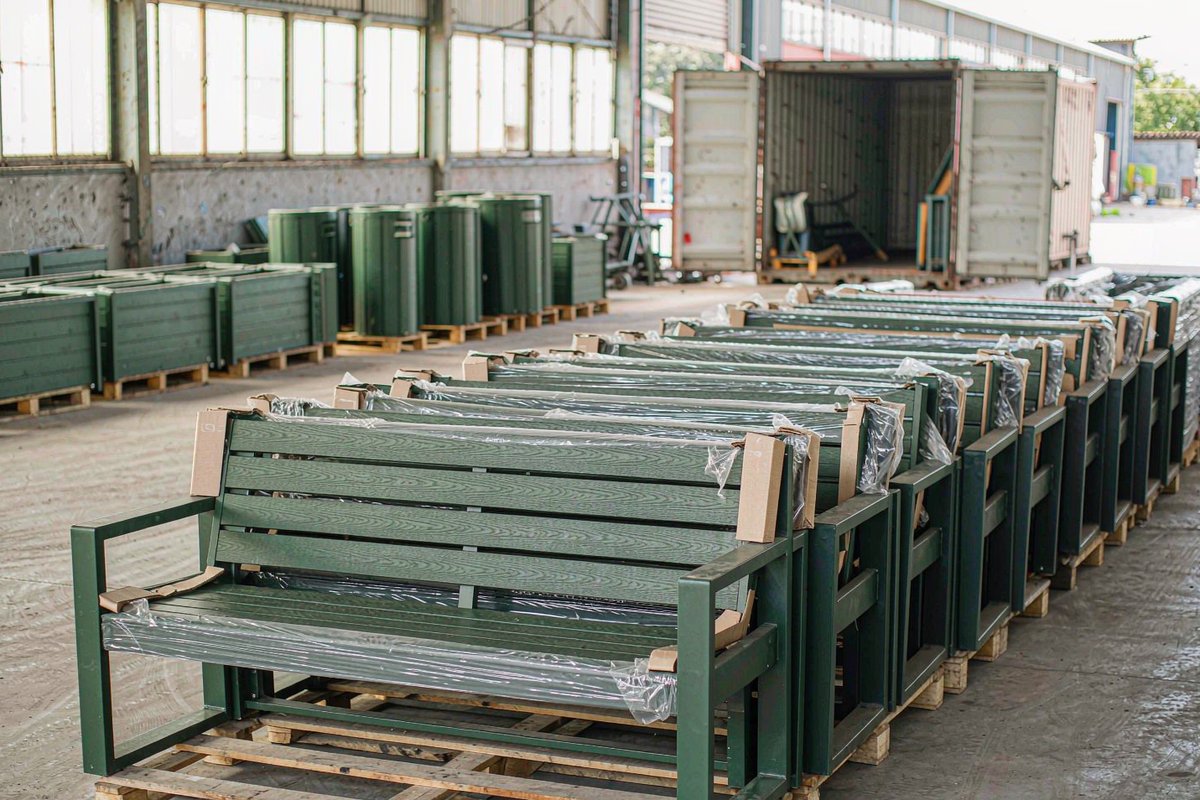
Site furniture lead times are usually discovered at the worst possible moment: the paving is finished, the opening date is fixed, and the benches are still in a galvanizing queue six thousand kilometres away. Contractors and municipal buyers tend to treat delivery as a purchasing detail to be confirmed after the award, when in reality the schedule is set by decisions taken months earlier — the drawing package, the sample approval route, the colour selection and the shipping window. This guide breaks an outdoor furniture order into its real production stages, shows where the clock is actually lost, and lays out a backward-planned schedule you can put in front of a client with confidence.
Lead Time Is a Design Constraint, Not a Purchasing Detail
A public realm scheme usually runs on two clocks. The construction programme is driven by civil works, and the furniture package is treated as loose furnishing that can be dropped in at the end. That assumption holds for catalogue stock bought off a shelf. It fails for any project with a specified RAL colour, a custom slat profile, a project-specific laser-cut pattern or an OEM frame drawn to a landscape architect's detail.
Once a product is made to order, the delivery date is the sum of a chain of dependent steps, and several of those steps — sample approval, galvanizing, powder coating, vessel booking — are batch processes that cannot be compressed by paying overtime. Buyers who understand the chain early can move it by weeks simply by approving drawings faster or by choosing a stock colour instead of a special one. Buyers who do not end up air-freighting a fraction of the order at several times the unit cost.
The Stages of a Site Furniture Order
The durations below are typical for a steel-framed bench, bin or planter package produced in Asia and shipped to Europe or North America. Treat them as a planning baseline, not a quotation — every project has its own constraints, and the largest variable is how fast the client side responds.
| Stage | Typical duration | Who controls it |
|---|---|---|
| Order confirmation and deposit | 3–7 days | Buyer (PO, payment terms, LC) |
| Shop drawings and submittal package | 1–2 weeks | Manufacturer, then buyer's review |
| Sample / pre-production approval | 2–4 weeks including shipping | Buyer's design team |
| Material procurement (steel, WPC, hardwood, castings) | 1–2 weeks | Manufacturer |
| Fabrication and welding | 3–5 weeks | Manufacturer |
| Hot-dip galvanizing (if specified) | 1–2 weeks, queue dependent | Galvanizer |
| Powder coating and curing | 3–7 days per batch | Coater, colour dependent |
| Assembly, QC and packing | 1–2 weeks | Manufacturer |
| Container booking and loading | 1–2 weeks | Freight forwarder |
| Sea freight to EU / US East Coast | 30–40 days | Carrier and routing |
| Port clearance and inland delivery | 1–2 weeks | Buyer's broker |
| Installation on site | 3–10 days per zone | Contractor |
For a standard product in a stock colour, purchase order to site in Europe commonly lands at 12–16 weeks. For a custom OEM range with a bespoke colour, a first-article sample and a peak-season sailing, 20–26 weeks is realistic. The difference is rarely manufacturing speed; it is the number of approval gates and batch processes in between.
Standard vs Custom: What Actually Moves the Clock
| Variable | Effect on lead time | How to keep control |
|---|---|---|
| Catalogue item, stock RAL | Baseline | Confirm stock colour availability in writing before tender |
| Special RAL or custom colour | +1–3 weeks | Approve a physical colour chip, not a screen image |
| Custom slat profile or cast component | +3–6 weeks (tooling) | Approve tooling drawings before the PO, not after |
| Pre-production sample required | +2–4 weeks | Ask for a sample from the same production line, and ship it air |
| Hot-dip galvanizing specified | +1–2 weeks | Book galvanizing capacity with the PO, not after fabrication |
| Mixed container of several SKUs | +1–2 weeks | Sequence production by unloading order, not by SKU number |
| Peak season (Aug–Oct, pre-Chinese New Year) | +2–4 weeks | Reserve vessel space at PO stage |
Two of these deserve emphasis. Tooling is the longest single item in any custom programme and it is often triggered late, because the drawing approval process runs in parallel with tender evaluation rather than before it. And galvanizing is a queue, not a task — a galvanizer running flat out for a bridge contract will not reshuffle the line for forty benches, so a two-week nominal step can become four.
Where Site Furniture Schedules Actually Slip
In our experience supplying municipal and contractor packages, delays cluster in a small number of predictable places:
- The submittal loop. Drawings are issued, comments come back in three weeks instead of three days, and the revision is re-issued without marking what changed. Each loop costs a week.
- Sample approval by photograph. Approving a powder coat from a phone photo almost always produces a second round once the physical sample arrives.
- Late colour decisions. Landscape architects finalise the palette after the structure is built, which pushes coating to the end of the programme where there is no float left.
- Under-specified fixings. Anchor type and substrate are resolved on site, so the fixing kit is re-ordered and the installation crew waits.
- One container, one sailing. A single missed vessel adds a full month, not a day. Splitting the order into two shipments is often cheaper than recovering a lost month with air freight.
- Clearance paperwork. Missing certificates of origin, treatment certificates for timber packaging or declaration of conformity can hold a container at port longer than the sea voyage saved.
Backward Planning from an Opening Date
The reliable way to build a furniture schedule is to start at the opening date and subtract. The table below assumes a custom OEM package shipped to Europe; adjust the freight leg for your own route.
| Weeks before opening | Milestone that must be complete |
|---|---|
| 26 | Design freeze; furniture schedule and quantities locked |
| 24 | RFQ issued with drawings, colour references and fixing requirements |
| 22 | Order placed; deposit paid; production slot booked |
| 21 | Shop drawings approved; tooling released |
| 19 | Pre-production sample approved |
| 18–13 | Fabrication |
| 13–11 | Galvanizing and powder coating |
| 11–10 | Assembly, QC, pre-shipment inspection |
| 10 | Container loaded and sailed |
| 3–2 | Container arrives; customs clearance |
| 2 | Site delivery and installation |
| 0 | Opening |
The useful discipline here is to publish the four buyer-controlled dates — design freeze, PO, drawing approval, sample approval — as contractual milestones with named owners. In most slipped projects, at least one of those four dates was never written down.
What to Send With the RFQ to Compress Lead Time
Suppliers can only schedule what they can price. A complete enquiry typically removes one to two weeks of clarification from the front of the programme:
- Product references or drawings with principal dimensions and material callouts
- Quantities per SKU and per delivery phase
- RAL or equivalent colour reference, plus the substrate and finish system expected
- Mounting method and substrate assumptions, with anchor type if already decided
- Any load, impact or accessibility standard the product must satisfy
- Packaging and labelling requirements, including pallet dimensions if site storage is tight
- Target delivery window, destination port or door address, and required incoterm
- Documentation needed at import: test reports, certificates, treatment declarations
Buffer, Phasing and Recovering a Slipped Programme
Three levers are worth agreeing before anything goes wrong. A schedule buffer of two to three weeks placed before the installation window, not after it, absorbs the normal variance of coating and shipping without touching the opening date. Phasing — shipping the high-traffic zone first and the peripheral zones later — turns one all-or-nothing delivery into a sequence that keeps the site working. A defined recovery path, such as air freight for a limited number of units or a temporary hire fleet for the opening event, converts a crisis into a priced option.
What does not work is compressing fabrication. Welding, galvanizing and coating each have minimum cure and process times; a supplier who promises to halve them is either outsourcing to an unverified line or planning to skip a step you specified.
Sourcing Site Furniture Factory-Direct
AOTUDE manufactures outdoor benches, litter bins, planters and supporting site furniture at its Foshan factory in China, supplying municipalities, landscape architects and contractors in 40+ countries factory-direct. Because production, galvanizing, powder coating and packing are planned as one schedule rather than bought in from traders, we can quote a realistic purchase-order-to-sailing window at the enquiry stage and hold it in the contract. We work from your drawings as an OEM/ODM partner with per-model MOQ from 5 pcs (custom runs from 50 pcs), support pre-production sample approval before bulk runs, and back every frame with a 5–10 year structural warranty plus spare slats, fixings and fittings for later maintenance. Send your furniture schedule, quantities and target delivery date to https://aotude.com and we will return an itemised quotation with a production calendar attached.