
2026-10-02
Winter Maintenance of Outdoor Site Furniture: A Municipal Guide to Cold-Weather Durability
A cold-weather care guide for benches, bins and planters: de-icing salt corrosion, freeze-thaw damage, plow-safe practices and a winter maintenance checklist.
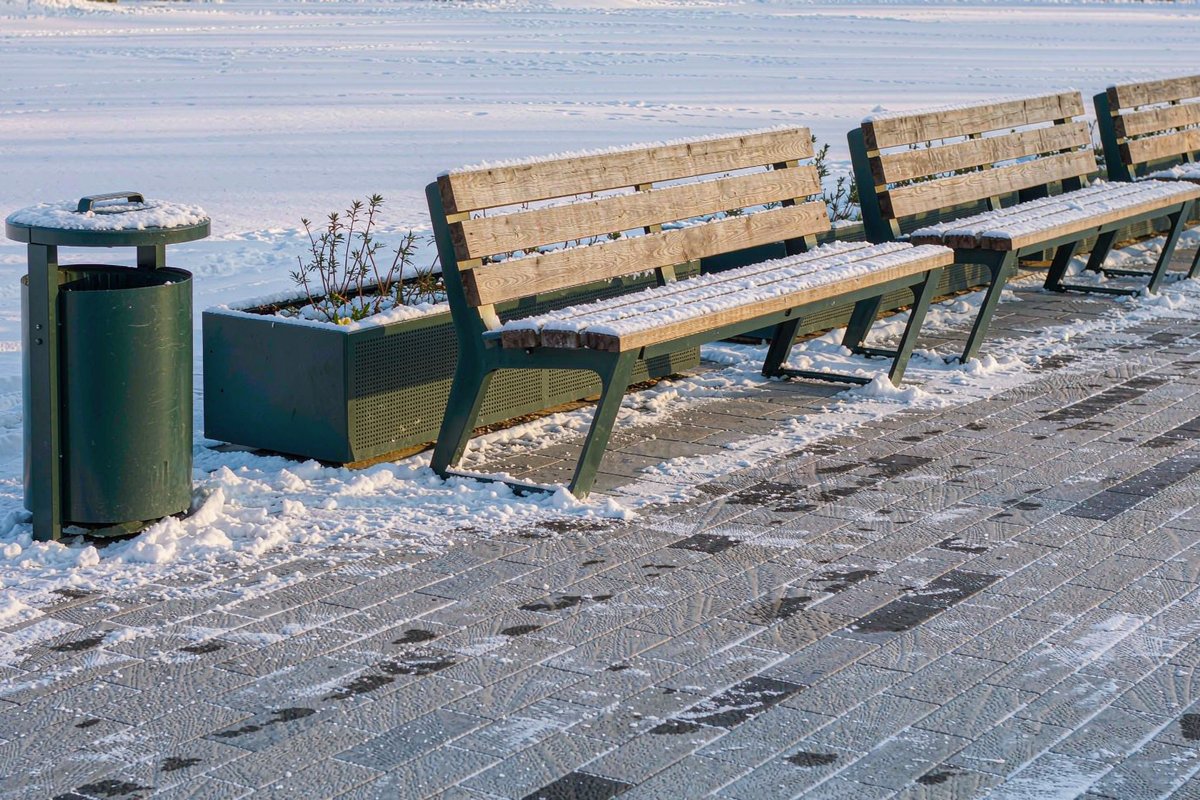
Every spring, parks departments rediscover the same invoice: split hardwood slats, rust weeping from bin bodies, planters heaved out of level, and paint scars where a plow blade found a bench leg. Winter is the most destructive season in the life of public-site furniture, and most of that damage is not caused by the weather itself — it is caused by salt, standing water, snow-handling equipment and small specification choices made months earlier. This guide sets out how winter actually attacks outdoor site furniture, which materials and details hold up best, and the winter maintenance routine that keeps benches, litter bins, planters and bike racks in service instead of in the replacement budget.
Why Winter Is the Most Expensive Season for Site Furniture
Cold-climate municipalities spend two to three times more per furniture unit per year than temperate ones, and the gap is almost entirely winter-driven. Three mechanisms compound each other:
- Corrosion acceleration. De-icing salt (sodium chloride, and calcium or magnesium chloride where temperatures drop lower) turns pavement splash into a concentrated electrolyte. A coating chip that stays cosmetic all summer becomes a perforation site within one or two winters.
- Freeze-thaw cycles. Water expands roughly 9% as it freezes. Every horizontal surface, joint, seam and un-drained planter that can hold water becomes a hydraulic press, cycling dozens of times each season.
- Mechanical damage. Snow plows, loaders, brush cutters and salt spreaders operate fast and close to fixed objects. Fixed furniture that is poorly sited or poorly marked takes the hits.
The budget consequence is quiet but real: furniture rarely fails outright in winter — it fails prematurely, in year three or four instead of year ten, and the cost lands after the warranty conversation has been forgotten.
The Four Winter Threats, Ranked by What They Destroy
Understanding which threat kills which material is the core of a sensible winter specification:
- Chloride splash — the coating and thin-metal killer. Attack concentrates 0–300 mm above paving, where salt-laden slush and spray hit. Bin bodies, bench legs, planter bases and rack uprights take the worst of it.
- Freeze-thaw — the masonry and hardware killer. Concrete and GFRC with fine cracks, un-drained planters, and fixings seated in water-filled holes spall, heave and shear.
- Snow-handling equipment — the geometry killer. Plow blades shear anchor bolts and deform lightweight frames; stored snow piles bury bins and hold meltwater against them for weeks.
- Trapped moisture — the timber killer. End-grain exposure, capped joints and debris-packed undersides keep hardwood and plywood slats wet for months, feeding rot from the inside.
Materials Compared: How They Survive a Cold-Climate Winter
| Material | Salt / corrosion resistance | Freeze-thaw behavior | Repair cost after winter | Notes for cold climates |
|---|---|---|---|---|
| Hot-dip galvanized steel, powder coated | Excellent (duplex system) | No effect | Touch-up only | Best-value frame for salted pavements |
| Powder-coated steel (2–3 mm, no galvanizing) | Good if coating intact; poor at chips | No effect | Touch-up, monitor chips | Demand 60–100 μm film and pre-treatment |
| Stainless steel (304/316) | Excellent (316 best) | No effect | Minimal | Premium cost; use where budget allows |
| Cast / ductile iron, galvanized | Very good | No effect | Minimal | Heavy, vandal-resistant, classic look |
| Thick hardwood slats (oak, FSC) | Unaffected structurally | Slats absorb water; rot risk | Slat replacement | Needs end-grain sealing and drainage gaps |
| WPC / recycled plastic lumber | Unaffected | No rot, minor brittleness at extreme cold | Rarely needed | Low-maintenance choice for wet, salted sites |
| Concrete / GFRC | Good if well detailed | Vulnerable — spalls if unsealed or cracked | Expensive patching | Air-entrained mix and sealer essential |
| Un-coated or thin-gauge steel (<1.5 mm) | Poor — perforates fast | No effect | Full replacement | Avoid entirely on salted routes |
Two conclusions come straight off this table. First, the frame is not where cold-climate furniture dies — the coating and the details are: galvanized-plus-powder-coated steel outlives powder-alone by years at almost no added cost. Second, wood slats and WPC behave oppositely in winter: hardwood loses service life to moisture, WPC loses almost none, which is why many cold-climate cities have shifted seat slats to WPC or pressure-fit timber inserts that can be swapped cheaply.
Coating and Detailing Choices That Cut Winter Maintenance in Half
Most winter durability is decided at the factory, not by the crew with the shovel. When specifying, require:
- Duplex corrosion protection on all steel within splash range: hot-dip galvanizing (ISO 1461) under a UV-stable polyester powder coat.
- Stated film thickness and pre-treatment, not just the color — degreasing, phosphating or blasting before powder, with 60–100 μm film.
- Drainage everywhere water can sit: drain holes in bin bodies and planter bottoms, open bench undersides, spacers that let slats dry, and fixings specified with sealing washers.
- No horizontal ledges or upturned channels that collect slush; close or cap open tube ends so they cannot fill and split when frozen.
- Rounded, plow-friendly geometry: no protruding anchor plates at kerb-adjacent positions, and frames heavy enough (or anchored well enough) to survive a blade strike.
A supplier who can document galvanizing standards, film builds and drainage detailing will quietly save a city more money than any discount on unit price.
The Annual Winter Maintenance Checklist
Municipal crews can capture most of winter's cost with a three-touch routine:
Before winter (autumn shutdown):
- Inspect and touch up every coating chip on frames within 300 mm of paving; treat bare steel with zinc-rich primer first
- Clear all drainage holes in bins and planters; confirm planter overflows are open before the first freeze
- Re-seal hardwood end grain; replace any slat already holding moisture
- Torque-check anchor bolts after the ground's first hard freeze
During winter:
- Instruct plow operators on furniture offsets; mark perimeter furniture with reflective bands or snow stakes
- Keep snow storage piles at least 1 m from bins and benches — buried furniture stays wet for weeks
- Use chloride products per label; avoid piling salt directly against coated steel and concrete
After winter (spring audit):
- Rinse salt residue off all frames with fresh water — the single highest-value hour of the year
- Photograph and log damage per unit to build a real durability record for the next tender
- Re-check fixings, planters for heave, and drainage before spring rain arrives
Siting and Layout: Designing Furniture for the Plow, Not Against It
Half of winter damage is a layout problem. Three siting rules cost nothing at design stage:
- Set fixed furniture back from plowing paths. A 500 mm offset behind the kerb line or kerb-adjacent cycle track keeps blades away from legs and bodies.
- Group furniture into snow-storage-free zones. Benches and bins belong on the sunny, drained side of a plaza, not in the low corner where the loader pushes everything.
- Specify removable or semi-permanent units where seasonal clearance is aggressive. Cafés and event plazas often do better with socket-mounted furniture lifted each November than with fixed frames taking blade strikes every storm.
Source Furniture That Is Engineered for Winter, Not Just Priced for Summer
Cold-climate performance is a manufacturing question: galvanizing standards, film thickness, drainage detailing, WPC or hardwood slat options, and anchoring engineered for frozen ground. AOTUDE manufactures benches, litter bins, planters and bike racks at our Foshan factory in China and supplies them factory-direct to municipalities, landscape architects and contractors in 40+ countries, with full OEM/ODM customization from MOQ 50 pcs per SKU — including hot-dip galvanized duplex coatings, specified RAL colors, WPC or FSC hardwood slats, and drainage and anchoring details matched to your climate zone. Every product is backed by a 5–10 year structural warranty, and export-grade container packing arrives with coating and material documentation for your tender file. Review the range and send your drawings through https://aotude.com — our engineering team will return a cold-climate-ready specification, not a catalog page.
Bottom line: winter punishes detailing, not price tags. Specify duplex coatings, real drainage and plow-aware siting, then run a three-touch maintenance routine — and cold-climate furniture will reach the same service life as its temperate-climate counterparts at a fraction of the lifetime cost.