
2026-10-12
Bollard and Barrier Selection Guide: Specifying Fixed, Removable and Flexible Bollards for Public Spaces
A bollard selection guide for public spaces: fixed vs removable vs flexible, spacing and clearance figures, impact ratings, foundation depth and a specification checklist for buyers.
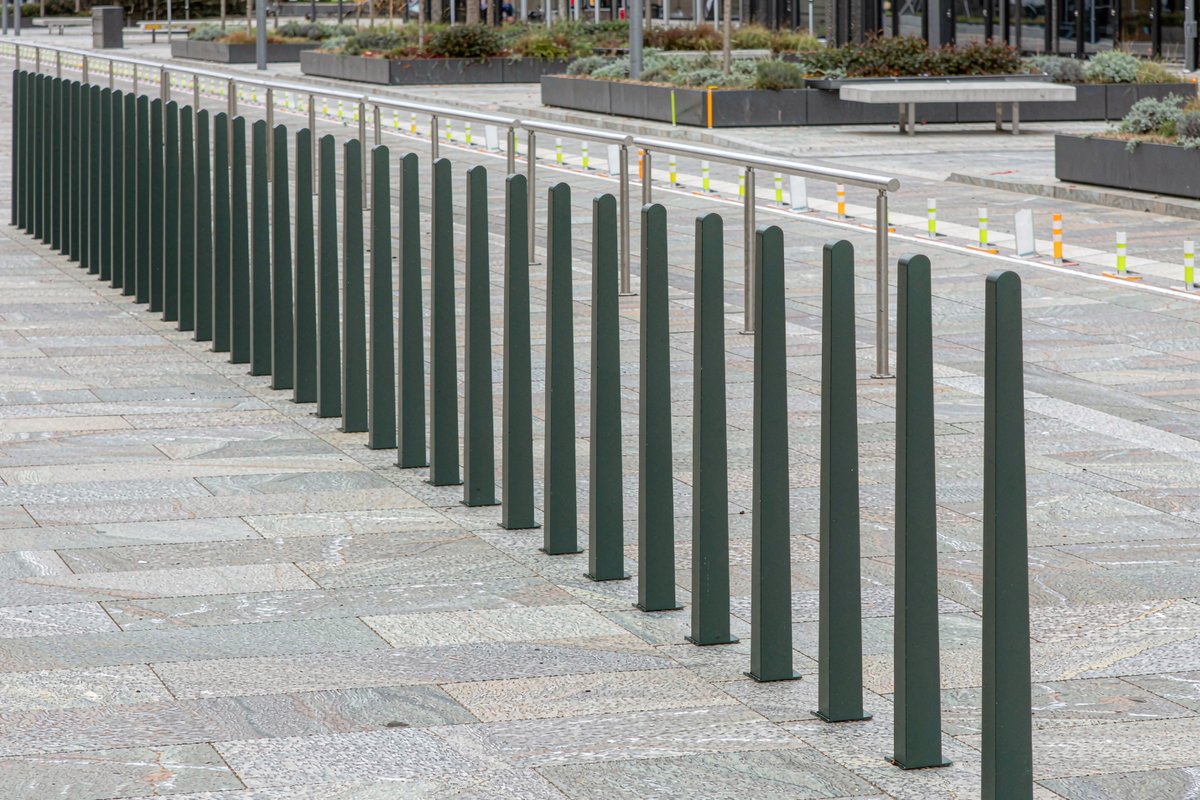
Bollards are the cheapest piece of site furniture on most drawings and the most frequently re-ordered one after handover. They are also the item most often specified by a line on a plan rather than by a product: a row of dots at the plaza edge, priced at whatever the contractor's supplier happens to stock. The result is predictable — bollards that pull out of their foundations after one winter, spacing that lets delivery vans through the gap you meant to close, or an access-control line installed to a decorative standard when the client assumed it was crash-rated. This bollard selection guide sets out how fixed, removable and flexible bollards differ, what spacing and clearance figures to design to, and which specification details to fix before you request quotations.
Start With the Job, Not the Look
Almost every bollard in a public realm is doing one of three jobs, and each job points to a different product family:
- Access control — keep vehicles out of a pedestrian zone while allowing maintenance, emergency and delivery access when needed. The defining requirement is removability, not impact resistance.
- Vehicle threat protection — stop or slow a vehicle that is deliberately or accidentally driven at a crowd. The defining requirement is a certified impact rating and a foundation engineered for it.
- Visual and tactile delineation — separate a cycle lane from a footway, protect a corner, guide pedestrians. The defining requirement is daytime visibility and night-time reflectivity.
Naming the job first prevents the most expensive mistake in the category: paying for crash-rated bollards where a removable decorative post would have done, or installing decorative posts where the risk assessment called for a certified barrier line.
Fixed, Removable and Flexible Bollards Compared
| Type | How it works | Typical impact capability | Maintenance | Best suited to |
|---|---|---|---|---|
| Fixed (in-ground) | Cast or core-drilled into a concrete foundation, no moving parts | Decorative to certified, depending on model and foundation | Lowest — occasional recoating and cleaning | Zone edges, footway corners, permanent vehicle exclusion |
| Fixed (surface-mount) | Base plate bolted to existing paving or slab | Decorative unless backed by a reinforced slab | Low, but anchor condition must be inspected | Retrofits where excavation is not possible |
| Removable / lift-out | Steel sleeve cast in the ground; post lifts out and is stored | Decorative | Medium — sleeves fill with grit and need flushing | Maintenance and emergency access points, markets, event zones |
| Collapsible / folding | Hinged base with a lock, folds flat to paving | Decorative | High — hinges are the failure point | Occasional-vehicle routes, historic settings where a fixed line is unacceptable |
| Flexible / spring-back | Polymer or steel spring base absorbs impact and returns upright | Low-speed impact only, not a certified barrier | Very low — posts are sacrificial and replaceable | Cycle lanes, car parks, low-speed vehicle conflicts |
| Rope-and-post / belt barrier | Posts with rope, chain or retractable belt between them | Decorative — no vehicle capability | Medium — ropes and belts wear and are replaced | Queue management, terrace edges, event layout |
The pattern is simple: anything that has to move will have a wear point; anything that has to stop a vehicle needs a certified rating and a foundation to match. Flexible bollards absorb a low-speed knock and save the vehicle and the post, but they are not a substitute for a certified barrier line in a hostile-vehicle-protection scheme.
Bollard Spacing and Clearance: The Numbers to Design To
Spacing is where bollard lines are most often wrong, because the aim is to block vehicles while admitting the users you want — including wheelchairs and mobility scooters. As a working basis for layout:
| Requirement | Typical figure | Notes |
|---|---|---|
| Clear gap between bollards (pedestrian zone) | 900–1200 mm | Below 900 mm creates an obstacle for wheelchairs and prams; measure the clear gap, not centre-to-centre |
| Absolute minimum clear gap | 900 mm | Must be maintained to keep an accessible route |
| Prevent car access | ≤ 1200 mm clear gap | Wider gaps admit cars; check against the smallest vehicle you need to exclude |
| Prevent van/lorry access | ≤ 1500 mm clear gap | Confirm against the actual delivery fleet, not a generic assumption |
| Cycle lane delineator spacing | 1500–2000 mm | Wide enough for handlebars; posts must be highly visible |
| Bollard height (vehicle control) | 900–1000 mm above finished level | Lower posts are a trip and vehicle-overrun hazard |
| Bollard height (visual guidance only) | 750–1000 mm | Match height across the whole line for a clean streetscape |
| Foundation depth (in-ground, decorative) | 400–600 mm concrete | Oversize the excavation in weak ground; hole diameter matters more than depth in soft fill |
Two rules follow from this table. First, clear gap is what a risk assessment and an accessibility audit will measure — a 1000 mm centre-to-centre line of 100 mm posts leaves a 900 mm gap and an 89 mm post leaves 911 mm, so always state the clear gap in the schedule and the bollard diameter separately. Second, spacing for access control should be checked against the vehicles that legitimately need to enter, because the acceptable gap for a maintenance van is the reason gates and removable posts exist.
Decorative or Crash-Rated? Getting the Impact Rating Right
If a bollard line is part of a hostile-vehicle-protection strategy, decorative products are the wrong answer regardless of how heavy they look. Certified products are tested to recognised standards — impact ratings are published with the vehicle class, mass and speed at which the product was tested, and the certification applies to the whole assembly including its foundation, not to the post alone.
Practical consequences for a specification:
- Ask for the certification certificate and the tested foundation detail, not just a claim of "anti-ram".
- Note that a certified system's spacing is fixed by the certification — you cannot stretch it to suit a drawing.
- Certified bollards need a reinforced foundation that the landscaping package may not have allowed for; foundation works must be priced by the right trade.
- Decorative and certified product can be mixed on one site, but they must be on separate lines with clear design intent.
Fixings, Foundations and the Failures That Follow
- Weak substrate. Surface-mount plates bolted into a 60 mm paving screed will pull out. Anchor into a structural slab or switch to in-ground posts.
- Drainage through the hole. In-ground sleeves fill with grit and water; specify a drainage outlet or a sleeve that can be flushed, or removable posts will seize within a season.
- Utilities. Core-drilled positions must be set out against a service scan — bollard lines run along exactly the lines where ducts and cables are buried.
- Thermal movement and lifting. On exposed sites, specify lifting eyes or a lifting handle so crews do not damage the coating while removing posts.
- Coating damage at the base. The base is where impact and abrasion occur; a zinc-rich primer under the powder coat, plus a galvanized option for coastal and de-icing exposure, is cheap insurance.
Every one of those failures is a fixing failure, and the same logic governs benches and bins: what disappears, bends or comes loose is almost always the part that was meant to hold the asset down. Our guide to anti-vandal street furniture specification works through the fastener, weld and geometry decisions that close those routes off before tender.
Bollard and Barrier Specification Checklist
- Job and risk category stated (access control / threat protection / delineation)
- Type: fixed in-ground, surface-mount, removable, collapsible, flexible, rope-and-post
- Material and wall thickness in millimetres; grade of steel, aluminium or polymer
- Surface protection: hot-dip galvanizing where required, powder coat film thickness in µm
- Colour by RAL number, not colour name
- Impact rating and certificate reference, if applicable — with the tested foundation detail
- Clear gap and centre-to-centre spacing, both stated; accessible route maintained
- Height above finished level, and reflectivity / visibility treatment for night use
- Foundation detail: hole diameter, depth, concrete grade, reinforcement, drainage
- Anchor and fixing grade, tamper-resistant option where abuse is expected
- Spare posts, sleeves, ropes and belts available as reorder items
- Warranty scope and exclusions in writing; packaging and container quantity for importers
Sourcing Bollards and Barriers Factory-Direct
AOTUDE manufactures bollards, rope-and-post barrier lines, benches, planters and litter bins at its Foshan factory in China, supplying municipalities, landscape architects and contractors in 40+ countries factory-direct — so the price you compare is a manufacturer's price rather than a distributor's catalogue markup. We build steel, stainless steel, aluminium and polymer bollards with specified wall thickness, hot-dip galvanizing for coastal and de-icing exposure, RAL-matched powder coating, and foundation details drawn for your contractor. As an OEM/ODM manufacturer we produce to your drawings and drawings' spacings from per-model MOQ from 5 pcs (custom runs from 50 pcs), support sample approval before bulk production, hold spare sleeves, ropes and belts as reorder items, and back every bollard and barrier assembly with a 5–10 year structural warranty. Send us your layout and we will return an itemised factory quotation at https://aotude.com.