
2026-11-06
Custom Picnic Table Manufacturer: Configurations, MOQ and Terms
What a custom picnic table manufacturer can change for you: top material, geometry, accessible ends, anchoring and finish — plus MOQ, packing and quoting terms.
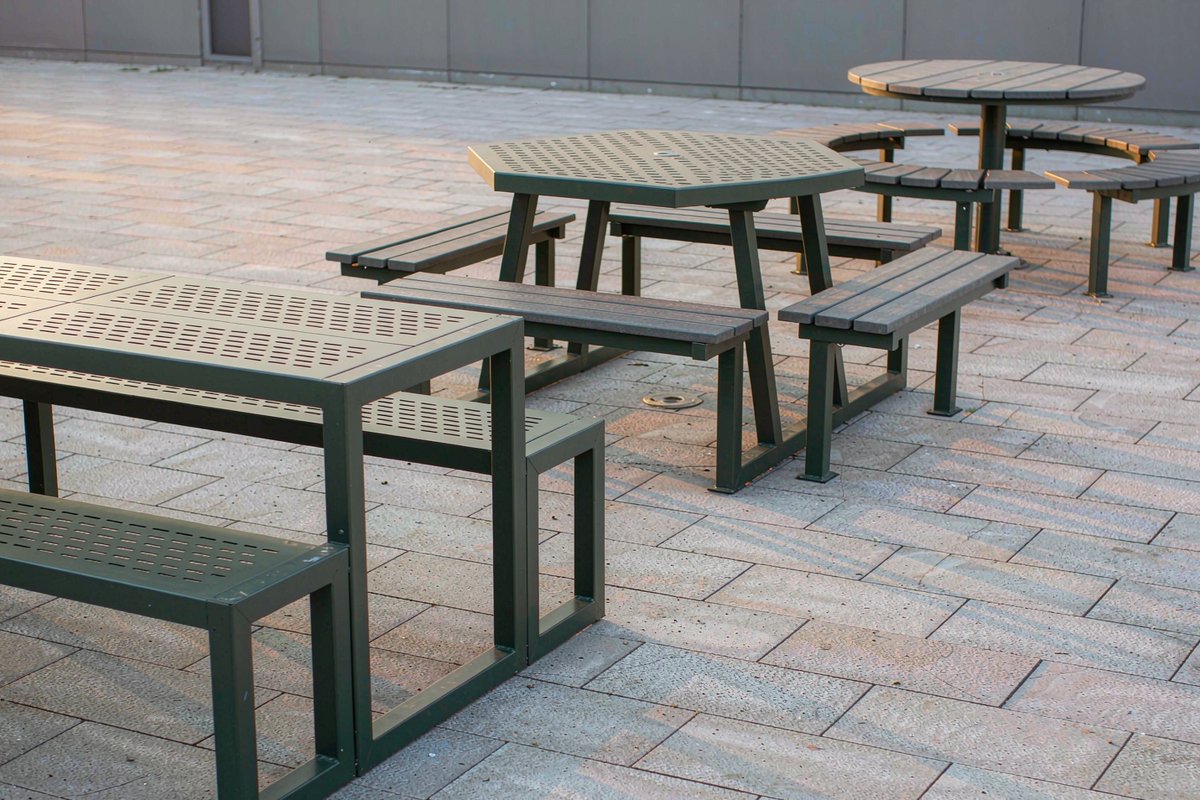
A custom picnic table manufacturer starts from a proven frame and adapts it to your site: top material, geometry, anchoring, finish and — on one end — the deliberate absence of a seat, so a wheelchair can pull up to the table itself. This article sets out what can realistically be changed on a commercial picnic table, at which order size each change becomes viable, and what to send us so the quotation comes back in days rather than weeks.
What a picnic table factory can actually customize
A picnic table looks like a fixed archetype — table, two benches, done — but almost everything about it is a manufacturing choice, not a law of nature. In a factory with its own welding, punching and coating lines, the negotiable parts are:
- Top material. Perforated steel (drains and dries fast), WPC slats (timber look, no oiling programme), or hardwood slats sourced through documented, traceable supply chains.
- Geometry. Rectangular with attached benches, hexagonal with integrated bench wings, or a circular group table with curved benches around a central column.
- The accessible end. One end built without a seat board or leg, so the top overhangs and a wheelchair pulls straight up to the table at seat height — more on this below.
- Anchoring. Embedded legs cast into a concrete footing for lawns, or surface base plates with expansion anchors for paved areas.
- Finish. Hot-dip galvanized steel as the corrosion base, powder coat in any RAL color on top.
- Details. Umbrella hole (a 2-inch fitting on our rectangular models), logo plates, two-tone color splits between frame and slats.
What a factory cannot change is the physics of public furniture: a top that is too thin will drum and flex, and a frame that was never braced for people sitting on the table itself will rack out of square within a season or two. Any custom specification should therefore start from a welded steel sub-frame with a fully supported top — which is how all four of our platforms are built.
Four customization levels, four different minimums
Customization is a ladder, and each rung carries its own minimum order quantity. Knowing the ladder before you ask for a quote saves a round of email and usually a round of internal approvals too.
| Customization level | What changes | Typical minimum |
|---|---|---|
| Catalogue finish change | RAL powder-coat color, logo plate on a standard model | From 5 pcs per model (selected builds); most models 20 pcs |
| Catalogue configuration change | Accessible end, umbrella hole, anchor type on a standard model | From 5 pcs per model (selected builds); most models 20 pcs |
| Geometry or material change | Different top material or geometry applied to a standard frame | From 50 pcs per model |
| Mixed container | Any combination of catalogue and custom models shipped together | Per container plan; model minimums still apply |
Two practical notes. The 5-piece entry point exists so that a pilot area — one schoolyard, one highway rest stop — can be installed and evaluated before a full rollout commits to volume. And mixed containers matter more than buyers expect: frames nest and tops pack flat, so picnic tables, park benches and litter bins routinely share one 40ft container, and the consolidation alone often reaches the container minimum. Our article on OEM container packing shows how a loading plan is built.
Choose the base platform before you customize
The most common mistake in custom picnic table projects is customizing the wrong base platform. Each of the four platforms in our range covers a different site logic, and the customization headroom differs accordingly.
| Platform | Construction | Key dimensions | Customization headroom |
|---|---|---|---|
| Rectangular perforated steel (e.g. Perforated Picnic Table) | Perforated steel top and attached seats, heavy-gauge galvanized + powder-coated tube frame | 1800 x 1500 x 750 mm; 2-inch umbrella hole | RAL color, accessible end, anchor type, logo plate — the workhorse for parks and rest areas |
| WPC rectangular (e.g. WPC Picnic Table) | Teak-look WPC slats on table and benches, sculptural tapered steel legs | 1800 x 1500 x 750 mm; umbrella hole | WPC tone, RAL leg color, accessible end; suits food courts and resort dining terraces |
| Hexagonal WPC (Hexagon WPC Picnic Table) | One-piece welded underframe, integrated bench wings, lift-off fasteners for flat-pack shipping | Table width 1500 mm, overall width 2300 mm | WPC tone, RAL color, anchor points; compact footprint for campgrounds and school yards |
| Circular group table (Circular Group Picnic Table) | Round table on a central pedestal with three freestanding curved benches; hardwood slats | Table diameter 1500 mm, overall diameter 2600 mm | Bench count and arc, hardwood or alternative slats, wheelchair-accessible gap on request |
A quick rule of thumb: the more vandal pressure a site takes, the more the top material decision dominates; the more mixed-ability access matters, the earlier the accessible end must enter the drawing — it is a configuration choice, not an accessory bolted on afterwards. All four platforms and their catalogue specifications are listed on the picnic tables category page.
The accessible end: what actually changes
A wheelchair-accessible picnic table changes one end: the seat board and the leg under it are omitted, so the top overhangs and leaves clear knee space for a wheelchair or a chair to pull straight up to the table at seat height. The top itself is unchanged — same material, same surface, same structural support — which is why the accessible end should be specified at order stage rather than improvised on site.
We describe the construction, and we do not claim that any configuration is compliant with any particular regulation: accessibility codes vary by jurisdiction and by funding program, and your local authority is the one that defines what your project must meet. What we can do is build the end to the clearances your specification calls for and confirm the details in writing per model. The picnic tables category page walks through the accessible-end construction and the questions to ask before ordering.
Anchoring, siting and clearances
Two anchoring methods cover nearly every site. Embedded legs cast into a concrete footing suit lawns and unparkable greens, and they resist both wind uplift and unauthorized relocation. Surface base plates with expansion anchors suit paved plazas and retrofit projects where cutting new footings is not an option. Both are supplied with stainless fasteners and a fixing drawing your contractor can work from.
On spacing between tables and circulation clearance around them: treat any published figure as planning guidance and confirm the final layout against the model and the site, because an accessible end needs a different approach path than an attached-bench end. Our specifications hub collects the dimension tables — including bench and seat dimensions in mm and inches — and flags anything still awaiting factory confirmation, so start there and then confirm with us in writing for your specific layout.
How to specify: what to send us
Custom quoting is fast when the first email contains the facts a production planner needs. Send us:
- The base platform you want to start from, or your own drawing (PDF, DWG, or a dimensioned sketch).
- Top material: perforated steel, WPC (give the tone), or hardwood slats.
- Geometry: rectangular, hexagonal or circular group — and overall footprint constraints.
- Whether any tables need a wheelchair-accessible end, and how many.
- Anchoring: embedded legs or surface base plates, and what the ground is made of.
- Umbrella holes and any accessory fittings, per table.
- Finish: RAL number for the powder coat, and the corrosion base for your climate.
- Quantity and phasing: pilot quantity first, or the full rollout in one release.
- Destination port and incoterms preference — we quote FOB and CIF, with 30% deposit and balance against the bill of lading.
With items 1–5 in the first message, a working quotation with configuration drawings typically comes back in days. If you are still at the comparing stage, our picnic table size chart converts every standard dimension for tender documents, and our supplier comparison guide explains how to evaluate frames, tops and trade terms side by side.
Custom picnic tables reward buyers who settle platform, accessible ends and anchoring early, then let the factory handle the rest. If you have a drawing, a RAL number and a destination port, send them to our team and we will come back with a quotation you can put in front of a committee.