
2026-11-07
How Many Recycling Bins Do I Need? A Stream-by-Stream Sizing Method
How many recycling bins a site needs is set by collection streams and lift frequency, not footfall alone. A per-stream sizing method with a fill-rate table.
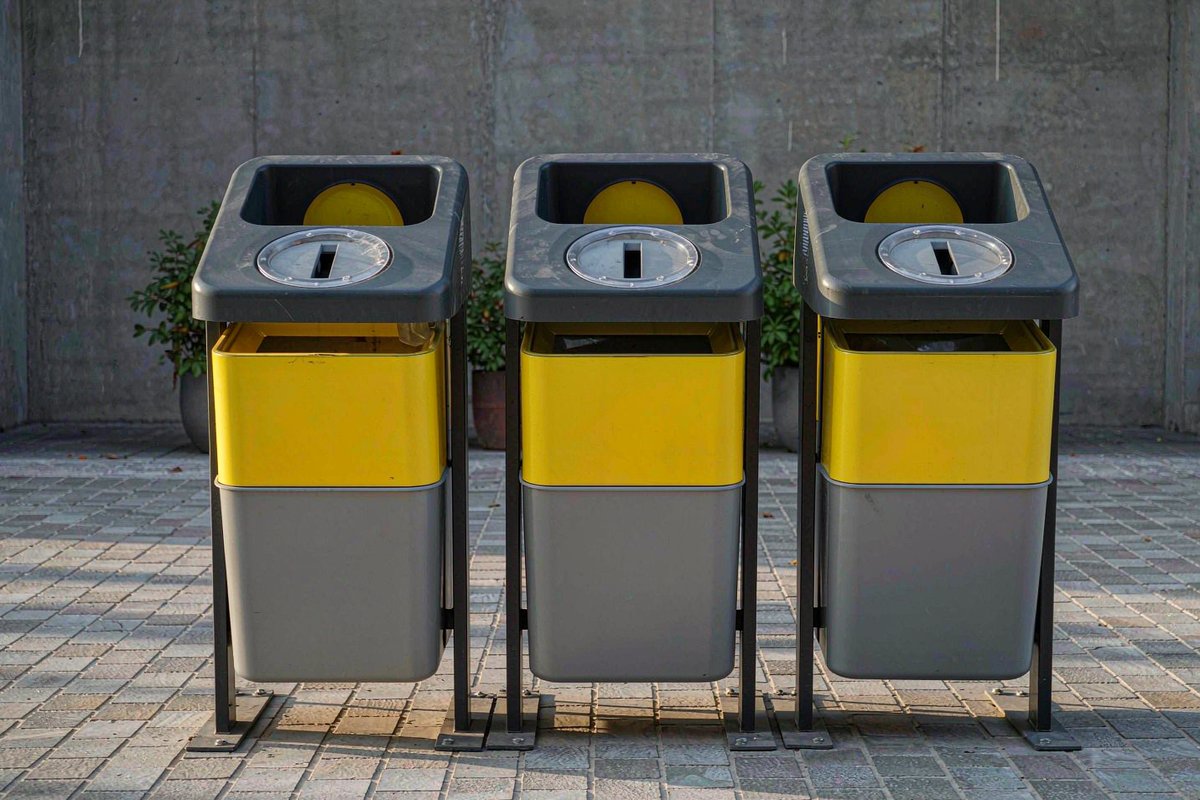
For a typical plaza, park or campus frontage, start with one dual-stream station per collection point, at roughly one collection point per 300–600 m² of high-footfall plaza or 800–1,500 m² of park frontage — then let the collection contract decide how many bodies that becomes. The number that matters is stations, not compartments: a three-stream unit serving two streams correctly beats a five-stream unit whose extra streams nobody empties. Size on streams first, lift frequency second, and waste generation third.
That order is the opposite of how most procurement schedules are laid out, which is why bin counts get revised after the first collection quarter. The recycling station range shows the stream configurations available, and the specification centre covers how usable volume per compartment is measured.
Quick answer: stations = collection streams ÷ streams per body, then rounded up per collection point. One point per 300–600 m² of high-footfall plaza or 800–1,500 m² of park frontage is a planning range, not a fixed rate.
Step 1: Count the Collection Streams Before Counting Bins
A recycling station is a contract in physical form. Every compartment on it has to be emptied by someone separately and taken to a separate destination. If your waste contract runs one truck on one route, the site has one stream, no matter how many apertures the drawing shows.
Write the streams down before anything else: recyclables (bottles and cans), paper and card, residual waste, glass where the local scheme separates it, and organics where a food-waste route exists. Each one that survives into the specification needs its own compartment and its own lift.
| Stream on site | Separate collection route? | Bin consequence |
|---|---|---|
| Recyclables (bottles and cans) | Yes — scheme accepts them | 1 compartment per station |
| Paper and card | Yes, and kept dry | 1 compartment, hooded or slotted aperture |
| Residual waste | Always | 1 compartment, every station |
| Glass | Only where the local scheme collects separately | 1 compartment, or a stand-alone glass unit |
| Organics / food waste | Only where a dedicated route exists | 1 compartment, sealed liner required |
| Anything else | No route | Omit — it becomes a contamination bin |
Two streams that are genuinely collected separately will outperform three that are not. The 2-stream vs 3-stream comparison sets out the contractual test for each, and the dimensions chart gives the footprint of each configuration so the count can be tested against the paving.
Step 2: Decide Stations, Then Bodies
Once the stream count is fixed, the body count follows from how many streams each unit carries: two streams on a dual-stream classified bin means a site with two streams needs one body per collection point; three streams on a triple sorting bin still needs one body, but a wider one.
| Streams required on site | Configuration | Bodies per collection point | Frontage needed per point (mm) |
|---|---|---|---|
| 2 (recyclables + residual) | Duotone two-stream classified bin | 1 | 800 |
| 3 (recyclables + paper + residual) | Trisort triple sorting bin | 1 | 1,290 |
| 3, high-footfall frontage | Triovista three-stream station | 1 | 1,500 |
| 4 or more | Two bodies side by side, or a custom run | 2+ | Sum of the bodies plus a service gap |
| 1 stream only | Single litter bin plus a recyclables unit | 2 | 700–1,000, model dependent |
Frontage is the column that fails on site: a 1,500 mm station cannot be dropped into an 1,200 mm gap between a tree pit and a bench run, and moving the bench is a separate approval. Measure the actual clear frontage first, then choose the configuration that fits it — the dual-stream model is the narrowest option at 800 mm, and the three-stream station carries the graphic panels that high-footfall frontages need.
Step 3: Test the Count Against Lift Frequency
Bin count and lift frequency trade against each other directly. Halving the lift interval roughly doubles the bins needed for the same generation rate — and doubling the interval halves them, at the cost of overflow events that outlast the collection crew's next visit.
| Setting | Relative fill rate | Lift frequency to design for | Count adjustment |
|---|---|---|---|
| Street with passing trade | Highest | Daily in season | Add 1 collection point per block end |
| Plaza or park entrance | High | Daily or alternate days | Baseline count |
| Campus or estate interior | Moderate | Twice weekly | Baseline, minus one point per cluster |
| Park path, low footfall | Low | Weekly | Consolidate to route ends |
| Event or festival ground | Spiky | Per event, plus standby | Temporary units on top of the baseline |
The generation rate itself is the variable nobody has data for at design stage, so ask the collection contractor what the existing bins hold per lift on a comparable site. If that figure is unavailable, run the count as ranges and confirm after the first month — a station count is far easier to add to than a paving layout is to re-cut.
Step 4: Place the Points, Then Round Up
Placement changes the count by a surprising margin, because distance determines whether a bin is used or bypassed. Three rules cover most sites: a point at every decision point on the circulation route (path junction, plaza exit, car park to footpath link); a point within short walking distance of every seating cluster; and never a single point hidden behind planting, which collects contamination rather than material.
Usable volume is measured on the liner, not the shell. A nominal body volume loses roughly 10–15% to liner wall thickness and aperture geometry, so the contractable figure is the tested liner. Details in the capacity section of the specification centre; per-model litre figures are pending factory confirmation.
Then round the total up, not down. Bins on a phased site get moved, and a site that opens with one spare point per zone avoids adding a model mid-warranty that no longer colour-matches the first batch.
Step 5: Check What the Count Does to Service Time
Three costs scale with station count and are worth checking before the quantity is signed off:
- Service time. Each compartment is a separate lift, so a three-stream station takes longer per visit than a dual-stream one, even though it is a single body. If the crew is time-boxed, compartment count drives the schedule more than body count does.
- Liner stock. Every compartment needs its own liner size, so standardising on one or two liner sizes across the estate cuts handling errors — which pushes towards repeated configurations rather than mixed ones.
Errors That Show Up Within a Season
- Counting bins from footfall alone, with no stream list — the count then gets redrawn after the first collection contract is signed.
- Specifying three streams where the site has two routes, which produces a contamination bin and a bad estimate for the next site.
- Forgetting the clear frontage. A station that overhangs the pavement gets wet, tripped over and eventually relocated.
- Treating compartments and bins as the same quantity in the schedule of rates. They are not, and the tender reads as under-specified.
- Skipping the lift-frequency check, which is the only way to know whether the count survives a bank holiday.
How to Specify: What to Send Us
Send these eight items through our contact page and we will return a station count per zone, with the configuration and frontage tested against your drawing:
- Plan or site drawing with circulation routes and seating areas marked
- The collection streams your waste contract actually services, named as the local scheme names them
- Lift frequency, and the liner size the collection crew carries
- Clear frontage available at each proposed collection point, in millimetres
- Fixing surface — paving, asphalt, soft landscape, or a raised plinth
- Colour scheme or RAL references, and any existing estate signage to match
- Whether graphic panels or icons are needed, and in which language
- Quantities required at handover, plus any phased opening dates
We will confirm capacities, stream splits and per-model figures in writing before you publish the quantity; until then treat every litre figure as pending factory confirmation. If the site already has a three-stream layout in mind, the custom recycling station route covers stream counts and panel artwork beyond the catalogue range.