
2026-11-01
Custom Recycling Station Manufacturer: Streams, Colors and Branding
How a custom recycling station manufacturer configures stream counts, RAL colors, apertures and panel artwork — plus the MOQ terms and drawings to send your RFQ.
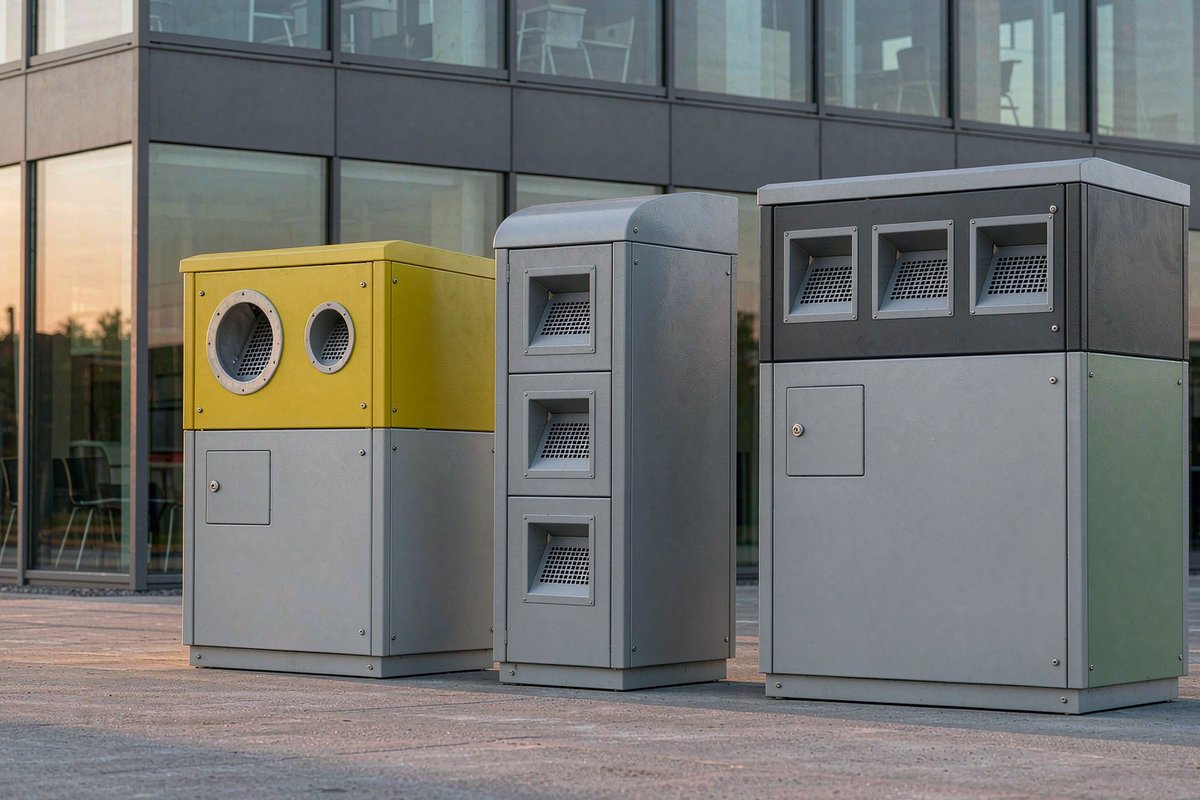
A custom recycling station manufacturer builds multi-stream waste and recycling units to your project specification instead of a fixed catalogue model: the stream count, the body colours, the aperture shapes and the panel artwork are all decided per project. At AOTUDE the catalogue two- and three-stream stations are available from 5 pcs per model, and fully custom configurations — extra streams, RAL colours, your own signage panels — start at custom runs of 50 pcs per model. Below is what can be changed, what stays constant, and exactly what to send us for a quote.
What a Manufacturer Can Actually Customize
Recycling stations are the most configurable product line in site furniture, because the unit has to match both the site and the collection contract behind it. Not everything is equally flexible, though — the table below separates the layers you can specify per project from the structure that is shared across the range.
| Customization layer | What we need from you | Typical minimum |
|---|---|---|
| Stream count (2 or 3 streams) | Stream names matching your collection routes | Catalogue models, from 5 pcs per model |
| Extra streams (4+) | Compartment layout sketch and stream names | Custom runs, from 50 pcs per model |
| Body and door colours | RAL code per colour, per compartment | Custom runs, from 50 pcs per model |
| Aperture shape per stream | Round, rectangular or slot openings | Custom runs, from 50 pcs per model |
| Icon / graphic panels | Vector artwork (AI, EPS or PDF), one panel per stream | Custom runs, from 50 pcs per model |
| Liner system | Liner quantity and withdrawal direction | Configured with any order |
| Timber cladding | Timber species preference and finish | Project-dependent |
The catalogue models — the Duotone two-stream classified bin, the Triovista three-stream station with bold graphic panels and the slim Trisort triple sorting bin — already cover the configurations most parks, campuses and shopping streets need. Customization becomes worth the setup cost when at least one of these is true: your collection contract uses stream names no stock panel covers, your estate signage system prescribes specific RAL colours, or you need more than three streams at one point of throw.
Stream Configuration: Start from the Collection Contract
The single most common mistake in recycling station procurement is specifying streams the site cannot empty. Every aperture on the unit needs its own collection route and someone paid to service it — a compartment with no contract behind it turns into a contamination bin within weeks. So the configuration decision is contractual before it is visual.
| Setting | Recommended configuration | Why |
|---|---|---|
| Park, playground, small plaza | Two-stream (recyclables / residual) | Two streams is the most people get right without supervision |
| Street, mall, high-footfall frontage | Three-stream with graphic panels | Bigger visual target, clearer icons, wayfinding benefit |
| Campus, transport interchange | Three-stream with labelled apertures | Captive audience, consistent stream names across the estate |
| Site with no collection for one stream | Two-stream, or single-stream plus residual | Never add a stream the collection contract cannot empty |
Once the stream count is settled, the split between compartments matters more than the total size of the unit. How the divide is calculated — by expected waste composition per stream rather than equal thirds — is covered in the specifications centre, together with the per-stream capacity figures for each model. Overall footprint and service clearance for the standard models are already documented in our recycling station dimensions guide, so a custom run only changes the frontage and internal layout, not the planning maths.
Colors, Apertures and Signage Panels
Colour is the fastest customization to specify and the one clients underestimate. Two decisions drive it: whether the body should match surrounding furniture (bench frames, bollards, bin hoods) or make the recycling streams deliberately conspicuous, and whether each compartment gets its own colour cue or relies on the aperture shape alone. Both are legitimate — they just answer to different wayfinding strategies. We spray to RAL codes, so a campus can keep every station identical to its existing signage palette.
Apertures and panels do the actual sorting work. Round openings read as "bottles and cans", slots read as "paper", wide rectangular openings read as general waste — but these conventions only work when the icon panel next to them agrees. That is why we ask for vector artwork rather than a photo of your existing bins: the panel is a steel graphic plate, powder-coated and fixed with anti-vandal fasteners, and it reproduces your artwork at the size the station dictates.
One thing a custom recycling station manufacturer should say plainly: the station is built to your specification, and your local labelling or recycling scheme remains the authority on colours, icons and stream names. We do not claim compliance with any national recycling-labelling regulation, because those rules vary by region and are yours to confirm with your waste contractor.
Construction: What Stays Constant Across Every Run
Customization changes what the station looks like and how it divides, not how it is built. Every model in the range — catalogue or custom — shares the same construction logic:
- Fully welded, powder-coated galvanized steel body, one coat system rated for outdoor exposure
- Independent removable liners, one per stream, so each compartment is emptied without touching the others
- Front-opening service doors with cam locks, sized to the liner withdrawal direction
- Closed tops with a dedicated throw-in aperture per stream, so rain and wind-blown litter stay out of the panels
- Weatherproof liners with drain holes at the base
Where a heritage or landscape setting calls for it, the body can be timber-clad to sit consistently alongside wooden benches in the same scheme. Cladding timber is sourced through documented, traceable supply chains, and the cladding is fixed so individual boards can be replaced without dismantling the frame.
Order Path and Quantities
There are two order paths, and they have different minimums. Catalogue models — the three units linked above — run per model from 5 pcs, with most catalogue lines at 20 pcs per model on standard pricing. Custom configurations (extra streams, RAL colour schemes, your panel artwork) start at 50 pcs per model, because the graphic panels, aperture plates and colour separation are set up per specification. Payment terms are FOB or CIF with a 30% deposit and the balance against the bill of loading, the same terms used across the range.
If your project sits between those two paths — say a 30-piece campus rollout with standard three-stream bodies but your own panel artwork — ask anyway: panel artwork on a catalogue model is sometimes the cheapest possible customization, and the 50-pcs threshold applies to full custom runs, not to every change. How the production and shipping stages fit a project programme is covered separately in our lead time planning guide, and the difference between customizing bins versus multi-stream stations is laid out in the custom trash bin manufacturer guide.
How to Specify a Custom Recycling Station
The fastest quotes come from complete RFQs. Send us:
- Site type and setting — park, street frontage, campus, transit hub — plus indoor/outdoor exposure
- Stream list — every stream the collection contract actually empties, in your contractor's wording
- Stream count and compartment split — or ask us to propose one from the stream list
- Dimensions or footprint limit — the clear pavement width the station must fit, in mm
- Colour specification — RAL codes per compartment, per frame
- Panel artwork — vector files (AI, EPS or PDF), one design per stream, with fonts outlined
- Aperture preferences — round, rectangular or slot per stream, or leave it to our standard pairing
- Quantity and target delivery window — units per model, and the site-ready date
- Installation surface — surface-mount, free-standing or in-ground, so fixings are quoted correctly
With those nine items, a custom recycling station quote is a configuration exercise rather than a design exercise — which is exactly where you want to be before the purchase order. If the specification is still open, start with the recycling station range, shortlist a catalogue model as the base, and contact us with the stream list and quantity; we will come back with what changes, what it costs to change, and what stays at catalogue pricing.