
2026-11-09
Outdoor Trash Bin Dimensions: A Litter Bin Size Chart for Buyers
Outdoor trash bin dimensions compared: footprints from 480 to 1,100 mm, heights from 900 to 1,100 mm, plus service clearance and liner guidance for buyers.
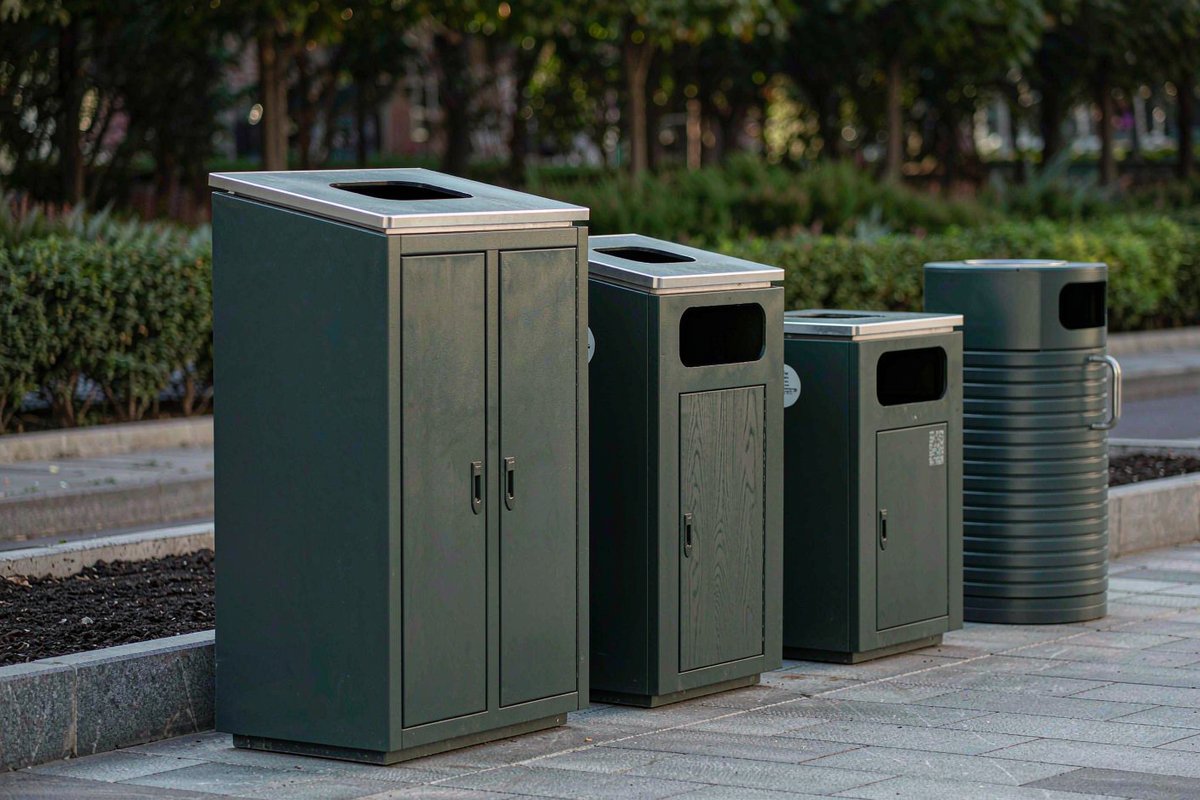
Most commercial outdoor trash bins stand between 900 and 1,100 mm tall, with footprints running from roughly 480 mm square on compact units to 1,100 mm wide on double-door models. Those two numbers — footprint and height — decide three practical things before a single bin is ordered: whether the unit fits the frontage you have marked out on the plan, whether a crew can swing the service door open and pull the liner out without working at arm's length, and how much visual mass the bin adds to the streetscape. This guide puts the current catalogue dimensions in one table, in millimetres and inches, and then explains how to read them against your site.
The size chart: ten models, mm and inches
Every figure below comes straight from the product specification pages, so you can quote it directly into a tender or site plan.
| Model | Footprint W × D (mm) | Height (mm) | Footprint W × D (in) | Height (in) | Typical placement |
|---|---|---|---|---|---|
| Timberline Wood-Slat Litter Bin | 480 × 480 | 1050 | 18.9 × 18.9 | 41.3 | Narrow sidewalks, gateways, small courtyards |
| Corten Curve Hood Bin | Ø600 | 980 | Ø23.6 | 38.6 | Weather-exposed verges; hooded opening |
| Onyx Fluted Round Bin | Ø650 | 900 | Ø25.6 | 35.4 | Plazas, podium decks, building entrances |
| Fairway Slat Hood Bin | 700 × 500 | 1100 | 27.6 × 19.7 | 43.3 | Parks and landscaped trails |
| Meadow Square Canopy Bin | 750 × 550 | 1000 | 29.5 × 21.7 | 39.4 | Playgrounds and picnic settings |
| Zen Round Timber Bin | Ø800 | 950 | Ø31.5 | 37.4 | Waterfronts and premium landscapes |
| Duotone Classified Litter Bin | 800 × 420 | 950 | 31.5 × 16.5 | 37.4 | Shallow frontage; dual-stream sorting |
| Silverline Tall Litter Bin | 950 × 450 | 1050 | 37.4 × 17.7 | 41.3 | Transit stops and urban corridors |
| Lakeside Perforated Litter Bin | 1000 × 500 | 1000 | 39.4 × 19.7 | 39.4 | Promenades and waterfront walks |
| Steelwood Single Litter Bin | 1100 × 500 | 1000 | 43.3 × 19.7 | 39.4 | High-footfall streets and campus cores |
The full line-up lives on the outdoor trash bins category page, where each model links to its own specification sheet with materials, finishes and per-model order minimums.
Why the bands sit where they do
Height between 900 and 1,100 mm. A bin that is much shorter forces users to stoop and gives crews a lower liner to lift; a bin that is much taller starts to block sightlines across seating areas and reads as street clutter rather than street furniture. The 900–1,100 mm band keeps the opening within comfortable reach for standing adults while keeping the silhouette below most bench backrests and signage. Hooded models such as the Fairway Slat Hood Bin sit at the top of the band because the hood adds weather protection over the aperture without adding much body height.
Footprint from 480 to 1,100 mm. Footprint is the dimension that gets projects into trouble, because it competes directly with pedestrian clear width. The 480 mm-square Timberline exists for the opposite reason the 1,100 mm-wide Steelwood Single Litter Bin exists: the first fits a sidewalk niche where every centimetre of clear width is contested, the second serves a corridor where volume collection matters more than floor area. Shallow-but-wide formats like the Duotone (800 × 420 mm) put a sorting aperture on a narrow wall face instead of eating depth from the walkway.
Round versus square bodies. Round bins — the Onyx at Ø650, the Corten hood bin at Ø600, the Zen at Ø800 — have no corners to catch passers-by at pinch points and read lighter in open plazas. Square and rectangular bodies with side doors give crews a flat service face and a door that can open fully against a wall. The choice is a placement decision as much as a style one.
Reading dimensions against the site: four checks
Dimensions on a drawing do not become installable until you add what happens around the bin. Four checks, none of which need factory data — only a tape measure and the footprint above:
- Service-side allowance. Allow at least the door-leaf width on the hinge side plus standing room for the crew, so the liner can be pulled straight out rather than dragged around a corner. On square door models, measure the door leaf on the product page before fixing the bin to a wall.
- Hood overhang. On hooded models the hood projects beyond the body footprint. Position the unit by the hood edge, not the drum edge, or the aperture will foul adjacent planting or signage.
- Collection route. Walk the path a full liner takes from the bin to the collection point. Steps, kerbs and gate thresholds that pass a hand cart decide placement more often than the footprint itself.
- Fixing method. Surface-mounted base plates need a flat pad roughly equal to the footprint plus bolting tolerance; embedded legs need the foundation detailed before the slab is poured. Match the method to the model — each product page states which fixing the design assumes.
For a worked example of how clearance and layout interact across a whole streetscape, the recycling station dimensions guide applies the same logic to multi-stream units.
What the size chart deliberately leaves out
Capacity is not listed in litres or gallons here. Rated liner volumes for our range are pending factory confirmation, and quoting a number before it is confirmed would put an unverifiable figure into your tender documents. Until then, size bins by the calculation method on the specifications hub: take the nominal liner volume and deduct 10–15 per cent as unusable headroom, then divide by expected inter-collection loading. If you need capacity figures written into a tender before factory confirmation lands, say so explicitly in your request and we will flag it as a pending item rather than guessing.
Timber elements follow the same honesty rule: the Timberline's wood-slat door and the Silverline's hardwood door are specified through documented, traceable supply chains, and slat profiles are dimensioned on each product page.
Matching a footprint to a site type
| Site situation | Dimension priority | Reasoning |
|---|---|---|
| Narrow sidewalk, tight frontage | Smallest footprint; shallow depth formats | Protect pedestrian clear width; Duotone and Timberline formats fit |
| Open plaza or podium deck | Round body, mid footprint | No corner catch, lighter visual mass; Onyx or Zen formats |
| High-footfall corridor or campus core | Wide double-door body | Volume between collections; Steelwood and Silverline formats |
| Exposed verge or coastal walk | Hooded opening | Weather protection over the aperture; Corten or Fairway formats |
| Playground or picnic cluster | Canopy-top or hooded square body | Shading, defined opening, family-scale height; Meadow format |
How to specify / what to send us
To get a dimension-checked quotation back quickly, send:
- Site plan or photos showing the intended positions, with clear widths marked.
- Number of units per model, and whether positions repeat across multiple zones.
- Service access route: where liners travel to be collected, and any thresholds on that route.
- Finish: RAL colour for coated models, or natural weathering steel for the Corten hood bin.
- Fixing preference: surface-mounted base plate or embedded, and the substrate type (concrete slab, pavers on screed, deck).
- Any local clearance rule your authority applies to street furniture, so we can flag conflicts early.
- Target delivery window and port or site address.
- Whether capacity figures must appear in the tender now or can follow factory confirmation.
Send the set through the outdoor trash bins category page or directly from the contact form, and each model page carries the per-model minimum order quantity so you can match quantity to the run size. If your project mixes bin sizes with benches or planters, our guide to choosing an outdoor trash bin supplier in China explains how mixed-model containers are consolidated on the same terms.