
2026-10-28
Outdoor Trash Bin Supplier China: A Buyer's Vetting Checklist
How to vet an outdoor trash bin supplier in China: factory evidence, liner and coating checks, MOQ and sample terms, and the RFQ details that get accurate quotes.
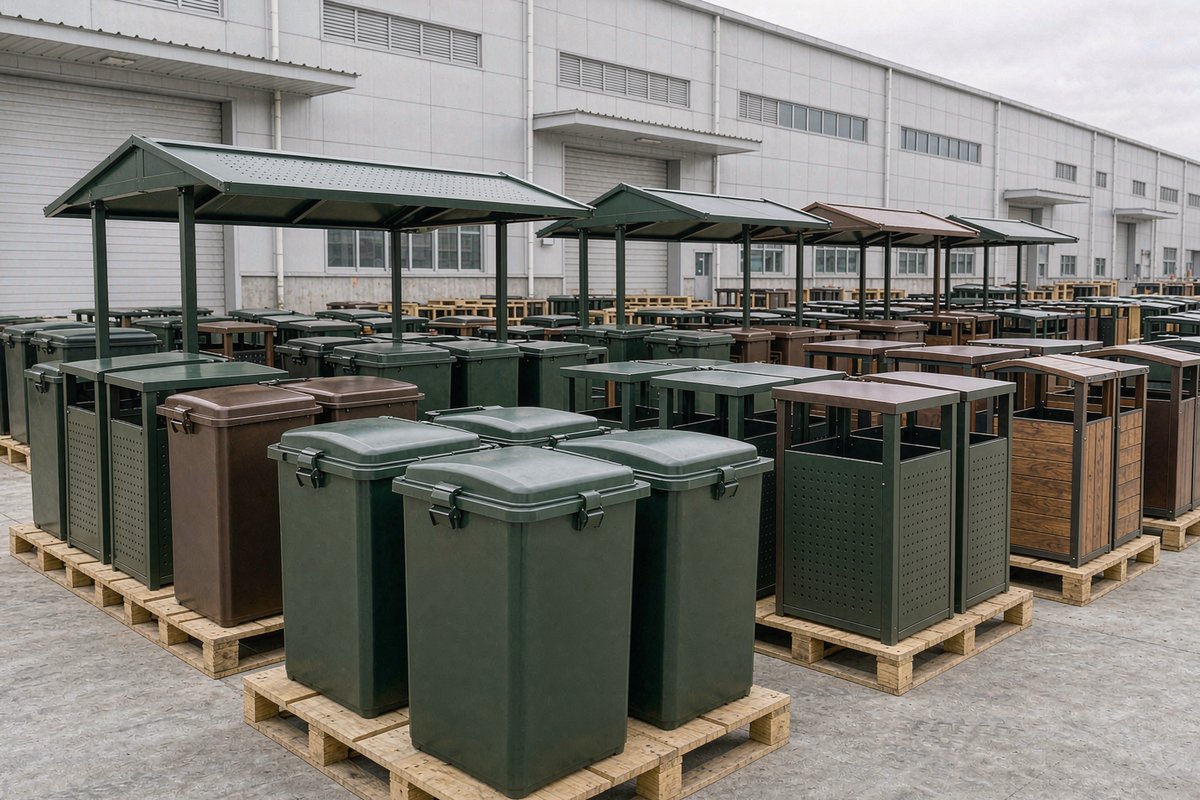
Sourcing an outdoor trash bin supplier in China comes down to four checks, and none of them is the catalogue photo: whether the supplier actually manufactures, whether the bin is designed around a removable liner, whether the coating process suits your climate, and whether the supplier answers a technical RFQ with engineering answers instead of a price list. A supplier that clears all four will quote accurately, pack for export properly, and still be answering spare-parts questions five years after the order. This checklist walks through each check in the order a municipal or landscape buyer should run it.
Quick answer: shortlist suppliers who publish factory evidence and a real product range, then send a technical RFQ — models, quantities, destination port, mounting method, colour and project date. Per-model minimums on our own litter bin line start from 5 pieces, custom runs start at 50 pieces per model, and terms are FOB or CIF with a 30% deposit. Everything else on this page is how to get to that point with confidence.
Manufacturer, trading company or catalogue reseller
The word "supplier" covers three very different businesses. A manufacturer owns tooling, coating lines and the drawings; a trading company buys from several factories and adds export paperwork; a catalogue reseller adds little but margin. All three can deliver an order — but only the first can change a bracket, re-cut a slat profile or match a liner to a body five years later. Before comparing prices, establish which one you are talking to.
| Evidence | What to ask for | Why it matters |
|---|---|---|
| Production site | Factory address, and whether a visit or third-party inspection is welcomed | A trading company will hesitate to name a single factory; a manufacturer books the visit |
| Product drawings | Dimensioned drawings of the actual models on offer | Resellers send rendered images; manufacturers send drawings with wall thicknesses and fixing details |
| Range depth | How many bin models they make, and in which materials | One or two body styles resold from a marketplace is a reseller signature |
| Custom capability | Whether OEM dimensions, RAL colours and laser-cut logos are possible, and from what quantity | Only a manufacturer controls tooling and can quote a custom run |
| After-sales parts | Whether inner liners, locks and hinges are available as spare parts later | The answer reveals whether the supplier built the product or bought it |
A manufacturer answers every row without improvising. That is also the standard we hold ourselves to: our own litter bin range — nine body styles from hooded and perforated steel to timber-clad designs — is browsable with dimensions and build options on the outdoor trash bins category page.
Four technical checks that separate good suppliers
1. The bin must be built around its liner
Ask how the liner is removed. A good commercial bin lifts out or opens through a lockable side door in seconds, holds the bag with retention hooks on the rim, and treats the liner as a replaceable component — not a welded-in part. If a supplier describes a bag resting loose inside a shell, servicing cost will quietly climb for the whole life of the contract. Our specification centre separates nominal body volume from usable liner volume for this exact reason: the servicing maths lives at the liner, not the shell.
2. The coating must match the climate, not the brochure
Steel bins for public space should be hot-dip galvanized before powder coating — the zinc layer protects cut edges and scratches from underneath, and the powder layer carries the colour. Ask each supplier to state the process in that order, and to say what they do at coastal sites, where salt air demands either a heavier coating build or 304 stainless. Weathering (corten) steel is a legitimate third route for signature parkland, but it is the wrong answer near a shoreline. A supplier who cannot explain this trade-off is passing your climate risk back to you.
3. Fixings and lids must be tamper-resistant
Anchoring through base plates or an embedded post with stainless tamper-resistant fasteners, keyed locking lids, pinned hinges — these details are cheap at manufacture and expensive to retrofit. Ask what is standard and what is an option. Anti-vandal detailing is one of the few places where two similarly priced bins are genuinely not the same product.
4. The quote must be a document, not a number
A serious supplier's quotation states the model and dimensions, slat and body materials, coating system, quantity bands, packing method, Incoterms (FOB or CIF) and production lead time from purchase order. If the reply is a unit price in a chat window, you have learned something about how the order will be handled. For reference on how lead time is actually built — and how to plan a schedule backwards from an installation date — see our guide to site furniture lead times and project scheduling.
MOQ, samples and order terms, in plain figures
Commercial bin orders from China follow a predictable structure, and a supplier who states it plainly is easier to plan around:
| Order element | Typical structure | Notes for buyers |
|---|---|---|
| Catalogue models | Per-model minimum; from 5 pcs on selected builds | The figure should be printed on each product page, not revealed at quote time |
| Mixed containers | Each model meets its own per-model minimum | Bins, benches and planters share one container; freight is shared, not duplicated |
| Custom / OEM runs | From 50 pcs per model | Includes RAL colours, laser-cut logos, split recycling openings; drawing and sample approval first |
| Pre-production sample | 1 pc, per project | Approve finish, liner fit and lock before production |
| Commercial terms | FOB or CIF, 30% deposit with balance before shipment | Confirm destination port so the quote prices the right Incoterm |
A sample is the cheapest risk reduction available in this purchase: one unit, shipped before mass production, settles questions about slat feel, liner fit and coating colour that no drawing can. If a supplier resists a sample on a six-figure programme, move on.
What to send us for a supplier-grade quote
If you are comparing suppliers, send every one of them the same RFQ so the answers are comparable. For us, these seven items turn a price enquiry into a firm quotation:
- Models or a benchmark — model names, links, or a reference photo of a bin you are specifying against.
- Quantity per model — even a rough split, e.g. "30 hooded, 20 perforated".
- Destination city and nearest sea port — decides FOB vs CIF and the container plan.
- Mounting method — base plates or in-ground, and the surface they fix to.
- Materials and colours — galvanized + powder coat (RAL code), corten or timber-clad; two-tone if relevant.
- Project date — when the bins must be on site, so production and shipping are planned backwards.
- Project type and stage — municipal tender, private development or distributor stock, which changes the paperwork we prepare with the quote.
Send those through our contact page and you will get back a per-model confirmation, banded quantity pricing and a container loading plan in one reply.
Shortlist with the checklist, decide with the product
The final step of any vetting exercise is reading the actual product pages: dimensions, materials, the stated per-model minimum and the options list tell you more than any company profile. Compare, for example, the Fairway Slat Hood Bin, a canopy-topped steel-and-WPC body for parkland, with the Lakeside Perforated Litter Bin, a free-draining perforated steel body for open plazas — then browse the rest of the outdoor trash bins range to see how far a real manufacturer's option list stretches. Buyers who need the same body branded, recoloured or split for recycling should read how our custom bin programme works from drawing to approval.
Vetting a supplier is mostly asking better questions earlier. Ask about the liner, the coating build, the fixings and the quote format, and the field of candidates will sort itself quickly — then let the sample confirm what the answers promised.