
2026-11-17
Bike Rack MOQ: Counting Units, Not Bike Spaces
Bike rack MOQ counts rack units, not bike spaces. Entry quantities differ by model, so a space count can miss the minimum — here is what to send.
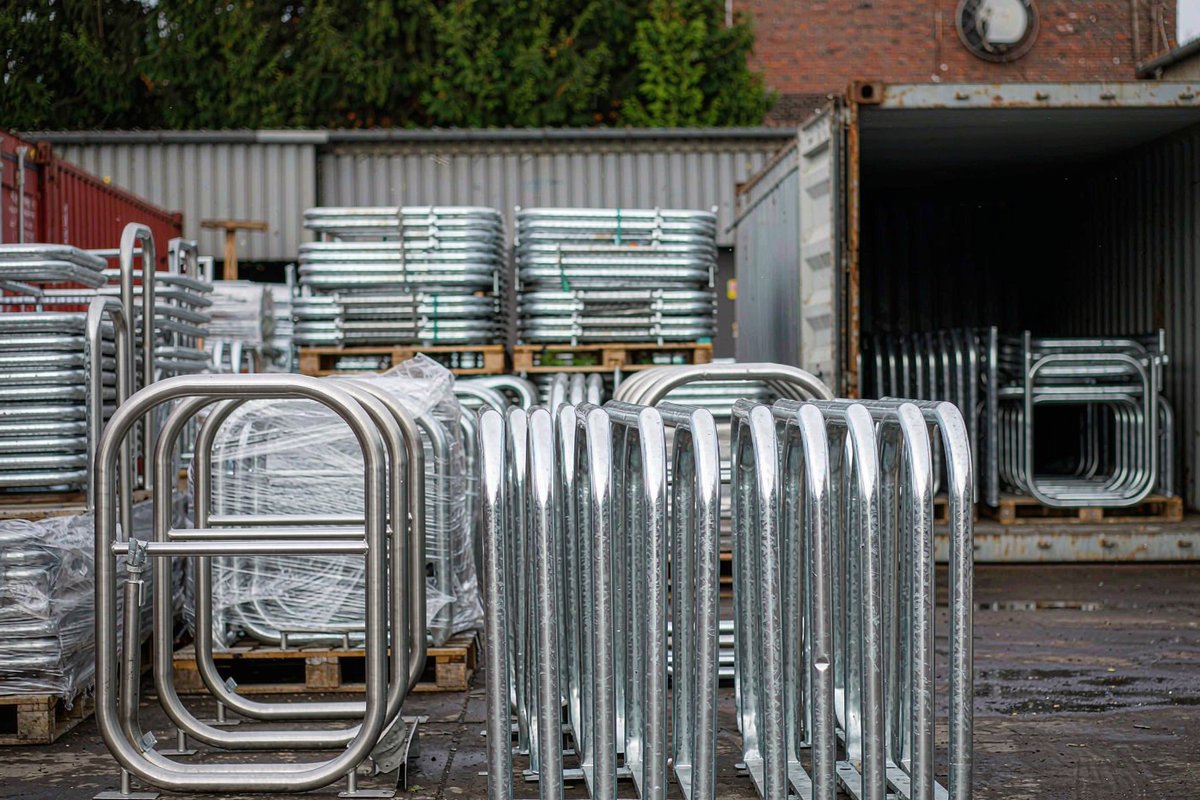
A bike rack MOQ is counted in rack units, not in bike spaces. Your layout produces a space count, but the order is priced and gated on how many racks that count converts into, and the conversion depends on the format you choose. Two formats can serve the same brief with a fourfold difference in unit count, which is why a correctly sized scheme sometimes lands under a model minimum while a smaller-looking one clears it.
Quick answer: MOQ is a per-model figure counted in complete rack units. Across the rack and bollard range the published entry bands start at 50 pcs, with the inverted-U Velo-Safe at 100 pcs; a custom geometry run starts at 50 pcs per model. Bike spaces never appear as a count line, so convert spaces to units before comparing quotations.
Spaces Are a Planning Figure, Units Are the SKU
A space is what your layout drawing measures: how many bicycles the site has to hold. A unit is what leaves the factory: one rack, packed, priced and counted. Only one of them is on the order.
The gap comes from positions per unit. Illustratively, if a multi-position rack carries four positions and a single-bike stand carries one, a brief for forty spaces becomes ten racks in the first case and forty units in the second. Those figures are illustrative only — rated positions per model are pending factory confirmation and are printed with each model rather than asserted in a guide — but the arithmetic shows the problem. Ten units against a 50-unit band is a shortfall; forty units against the same band is an order.
This is also why quotations compared "per space" are hard to read across suppliers: per-space pricing folds the format decision into one number, hiding whether you meet the minimum at all. Ask for the quote per unit and per space with the conversion stated. The bike rack and bollard range lists the formats side by side so the conversion starts from a real model.
What Counts Toward the Minimum, and What Does Not
Buyers assume everything on a site plan is a count line. It is not. Work down this table before concluding a quotation is short of a minimum.
| Line item | Counts toward the model minimum? | What it changes at RFQ |
|---|---|---|
| Rack unit, complete as drawn | Yes — this is the count line | The only figure that moves you toward the minimum |
| Bike spaces | No — derived from the layout | A planning metric; never an order quantity |
| A second or third model | Yes, but on its own line | Per-model minimums do not pool across different models |
| Bollard posts | Yes, on their own line | Posts carry their own per-model minimum, not shared with racks |
| Rope or retractable belt accessory | No — accessory line | Priced and packed with the post, not counted as a rack |
| RAL colour change on a catalogue model | Pending factory confirmation | May run inside the same model minimum, or open a second count line — get it in writing |
| Laser-cut naming plate or cast logo | Moves the item to the custom channel | Adds drawing and first-article review, so it is quoted as a custom run |
| Spare parts and replacement components | Quoted per project | No standing spare SKU list; ask for the specific item |
The colour row is the one that most often turns a clean order into a negotiation: a non-stock RAL may run inside the parent model's minimum or open a second count line, so ask for the answer in writing on the quotation.
Entry Bands Differ by Model
The minimum is not one number across a rack range. It tracks unit value and set-up content: a plain hoop rack needs more units to justify a production run than a fabricated stainless multi-hoop assembly does.
| Model | Format | Frame tube | Published extents (mm) | First quantity band (pcs) | Ground fixing |
|---|---|---|---|---|---|
| Velo-Safe | Inverted U, two-point frame support | Ø 48 mm hot-dip galvanized steel | 750 × 700 × 500 | 100 | Single-point, tamper-proof bolts |
| SteelArch | Twin-hoop multi-position | Ø 48 mm SS304 brushed stainless | 1,500 × 700 × 500 | 50 | Four anchors on twin base rails |
| VertiPark | Vertical stand | Ø 40 mm powder-coated steel | 1,850 × 600 × 400 | 50 | Ballasted freestanding base |
| Guardian belt barrier | Retractable belt post | Ø 63 mm powder-coated steel | H 950, base Ø 360 | 50 | Weighted fillable base |
| Guardian rope post | Rope post | Ø 76 mm SS304 stainless | H 1000, base 350 × 350 | 50 | Free-standing or bolt-down |
Read the quantity column and the procurement consequence is immediate: the simplest unit on the list carries the highest entry band. A project that picks the inverted-U rack because the format is familiar may still have to buy a hundred, while the same brief in a multi-hoop format could clear fifty with fewer units carrying more positions each. That is a value-engineering decision, not a discount negotiation; the price-per-unit breakdown explains how the formats diverge on cost, and the specification centre carries the material and coating data behind both.
One honesty note. Our category pages carry a house statement — per-model minimum from 5 pcs on selected builds — because that floor applies to catalogue modifications across the range. The band printed on each individual product page governs that specific model and is the figure we quote; where the two differ, the product page wins. Ask for written confirmation at RFQ so the order is documented against a single number.
What a Mixed Container Does and Does Not Fix
Sharing a container is the standard way to buy a streetscape package, and it solves freight: racks, bins, benches and planters load together. What it does not do is pool minimums. Fifty racks and twenty bins is one container and two model minimums, each assessed on its own count.
That matters on small sites: a plaza needing a dozen racks and a dozen bins does not reach a rack minimum by adding the bins. The sizing method covers how the space count is derived, because the number you take to a supplier should be the one your layout defends.
Where the 50 pcs Custom Line Applies
Custom geometry is a separate channel with its own threshold. A new length, a different hoop profile, an integrated signage panel or a fixed post format outside the catalogue all put the item through drawing, fixture and first-article inspection before the line runs — and that pre-production work is what the custom minimum pays for.
The practical rule: keep as much of the project on catalogue models as the layout allows, and reserve custom scope for the positions that need it; the custom rack guide sets out what changes at each level. Anchoring deserves the same discipline — the fixing follows the substrate, and the spacing and fixing guidance covers approach clearance and base options. Bollard posts specified beside the racks come off the same rack and bollard range but carry their own count line.
Closing a Shortfall Without Padding the Order
When a brief lands just under a band, there are three legitimate moves.
- Reduce the model count. Two models at half the quantity each is two minimums; one model at full quantity is one.
- Re-test the format against the brief. The same space count in another format changes the unit count, and sometimes the band that applies.
- Fix the variant question in writing. If a colour or fixing change opens a second count line, confirm whether the parent band still applies before redesigning the layout.
The move that only looks legitimate is padding: adding bollards or spare racks to clear a minimum buys inventory, not value. Terms sit alongside quantity, not after it — the trade terms page covers the standard structure. If the minimum is the only thing between a drawing and a purchase order, say so at RFQ.
What to Send Us
To quote a rack order against a real minimum, send:
- Space count from the layout, plus the format or formats you are considering.
- Preferred models by name, or a sketch if the format is not in the catalogue.
- Quantity per model in units — not only in spaces.
- Finish: stock galvanized, a named RAL, or 304 stainless.
- Substrate at each fixing point — asphalt, block paving, slab or new footing.
- Any colour split across the site, so variant count lines surface early.
- Accessories: naming plates, logos, rope or belt, reflective sleeves.
- Target on-site date, destination port and preferred Incoterm.
Send that list and a quotation comes back with the minimum stated per model, the spaces-to-units conversion shown, and any variant that would open a second count line flagged rather than discovered later. If a project sits close to a band and you want the arithmetic checked before the layout freezes, contact us — the earlier the format decision is tested, the fewer drawings get redone.