2026-11-05
Custom Bike Rack Manufacturer: Tube, Mounting and Branding Options
What a custom bike rack manufacturer can change for you: tube diameter, format, mounting, RAL finish and branding plates — plus MOQ, samples and terms.
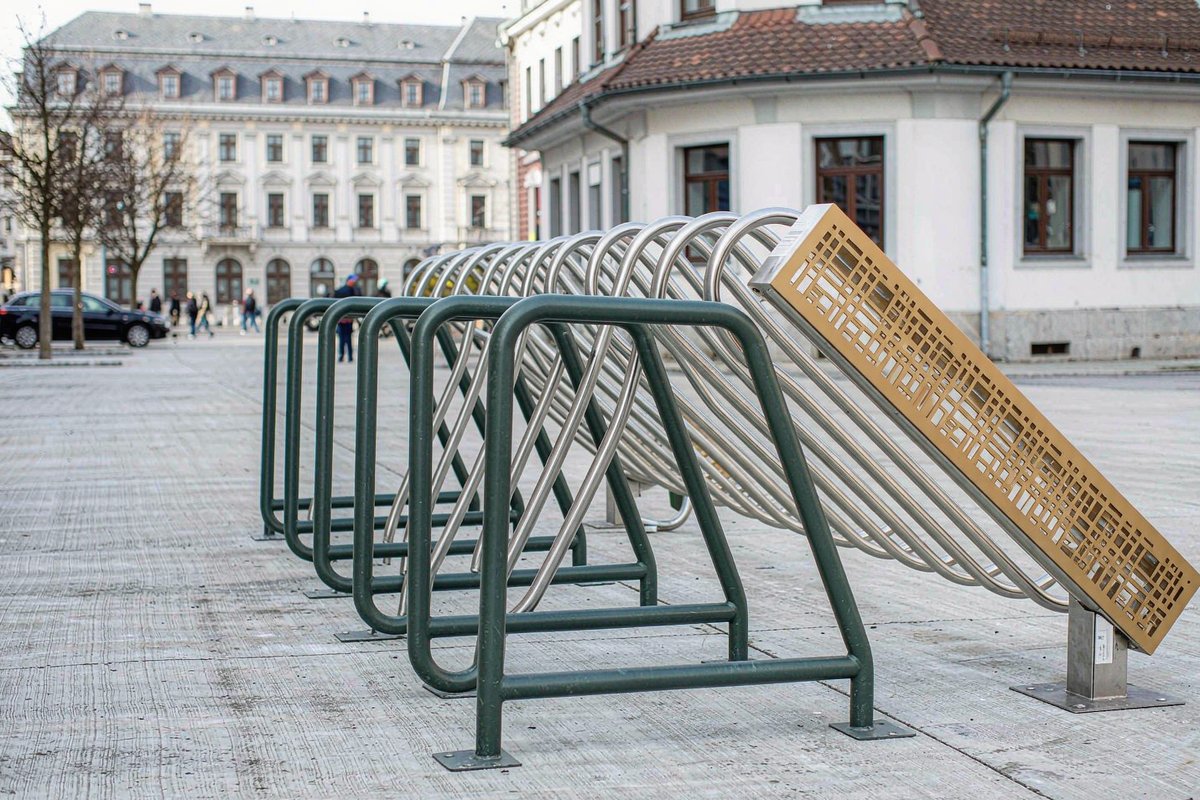
A custom bike rack manufacturer takes a standard rack format — the inverted U, the multi-hoop rail or the vertical stand — and changes the tube, the mounting, the length, the finish and the branding until the rack fits your streetscape, your surface and your lock-through requirements. At AOTUDE that work starts from a working catalogue and moves along four customization levels, from a simple powder-coat color change to a fully bespoke OEM run built from your drawing. This article sets out what can realistically be changed, what each level costs in minimum order size, and what to send us so quoting starts from facts.
What a bike rack factory can actually customize
Bike racks look simple, which is why buyers often underestimate how much of the product is negotiable. In practice, a factory with its own tube bending and welding lines can adjust:
- Tube diameter and wall thickness. Most catalogue racks use 40–48 mm steel tube. A different diameter changes both the look and the feel of the rack, and affects what locks can pass through comfortably.
- Format and geometry. Hoop spacing, overall length, height of the bend, leg angle — all are cutting and bending parameters, not fixed attributes.
- Length and modularity. Multi-hoop rails can be extended or shortened by adding or removing hoop modules. Our SteelArch Multi Bike Rack is built exactly this way: twin continuous base rails carry interchangeable hoop modules, so one custom length covers a whole run.
- Mounting style. Surface flange plates, in-ground sleeves or freestanding ballasted bases. This decision belongs to your civil substrate, not to the rack — more below.
- Finish. Hot-dip galvanizing as the corrosion base, powder coat in any RAL color on top, or brushed stainless for premium locations.
- Branding. Laser-cut logo plates, two-tone color splits between base and hoop, or a cut-out pattern in the leg plate.
What a factory cannot do is change physics: tube that is too thin will bend under leverage, and a finish applied directly over galvanizing without proper pre-treatment will flake. Any supplier who promises otherwise is describing a render, not a product.
Four customization levels, four different minimums
Customization is not a single switch — it is a ladder, and each rung has its own minimum order. Knowing the ladder before you ask for a quote saves everyone a round of email.
| Customization level | What changes | Typical minimum |
|---|---|---|
| Catalogue finish change | RAL powder-coat color, optional logo plate on a standard model | From 5 pcs per model (selected builds); most models 20 pcs |
| Catalogue geometry change | Length, tube diameter, mounting style adjusted on a standard format | From 50 pcs per model |
| Bespoke OEM run | New rack built to your drawing: geometry, tube, mounting, finish | From 50 pcs per model |
| Mixed container | Any combination of catalogue and custom models shipped together | Per container plan; model minimums still apply |
Two practical notes. First, the 5-piece entry point exists so that a pilot installation — a single streetscape, a school forecourt — can go ahead before a city-wide rollout commits to volume. Second, mixed containers matter more than most buyers expect: racks consolidated with bins, benches or planters from the same factory often reach the container minimum on their own.
Choose the format before you customize
The most common mistake in custom rack projects is customizing the wrong format. Before changing any dimension, decide which of the three basic families matches the site, because each family has different customization headroom.
| Format | Best suited to | Customization headroom |
|---|---|---|
| Inverted U rack (e.g. Velo-Safe, Ø 48 mm galvanized tube, 750 x 700 x 500 mm) | Sidewalks, transit stops, retail fronts; low profile stays out of pedestrian sightlines | Diameter, RAL color, logo plate, mounting style; single-point fixing keeps layout flexible |
| Multi-hoop rail (e.g. SteelArch, Ø 48 mm SS304, 1500 x 700 x 500 mm) | Campuses, stations, plazas where a high-capacity run reads as one tidy line | Length via hoop modules, stainless or steel tube, finish, anchor count via rail design |
| Vertical stand (e.g. VertiPark, Ø 40 mm powder-coated steel, 1850 x 600 x 400 mm) | Bike rooms, lobbies, covered walkways where floor area is scarce and drilling is not allowed | Height, wheel-tray width, RAL finish; weighted base means zero substrate work |
A quick rule of thumb: the more constrained the site, the more the mounting decision dominates. In older plazas with unknown slab build-ups, a freestanding or flange-mounted rack avoids core drilling entirely; in new paving contracts, in-ground sleeves hide all fixings but must be coordinated with the paver before the concrete goes in.
Mounting and spacing: settle these before the drawing
Mounting is the one customization you cannot change after delivery, so it deserves its own checklist. Our anchoring guide for bike rack anchoring and surface specs covers substrates in detail; the short version:
- Surface flange mounting suits retrofit projects on sound slabs; anchor type and embedment follow the substrate, and fixings are supplied with the rack.
- In-ground mounting suits new paving; sleeves are cast in before the surface goes down, so rack delivery must be scheduled against the civil works program.
- Freestanding ballasted bases, like the VertiPark's 20 kg weighted base, suit leased premises and interiors where no penetration is permitted.
On spacing between racks and clearances to walls and kerbs: treat published figures as planning guidance and confirm the final layout against the model and the site, because clearance needs vary with format and with how bicycles actually lean. Our specifications hub collects the current figures and flags anything still awaiting factory confirmation — start there, then confirm with us in writing for your specific model and layout.
Branding, color and corrosion: get the stack right
The finish stack is where custom racks most often go wrong in year two, not year one. The order matters: hot-dip galvanizing first for corrosion protection, then a compatible powder coat over it, with pre-treatment specified between the layers. Skipping the pre-treatment to save a step is the classic cause of powder coat lifting off galvanized steel.
Branding options scale with run size. On smaller orders a laser-cut stainless or brass-effect logo plate, bolted through the leg plate, is the economical route. On larger runs, cut-outs in the leg plate itself or two-tone color splits become viable because they add no separate part — the customization is in the cutting and coating program, not in additional hardware.
If you are comparing quotes on custom racks, price-per-unit alone will mislead you. Our earlier article on bike rack wholesale pricing breaks down what actually drives cost per unit — tube spec, finish stack, anchor count and packaging — and is worth reading alongside any quotation.
How to specify: what to send us
Custom quoting is fast when the first email contains the facts a production planner needs. Send us:
- The rack format you want to start from (or your own drawing, in PDF, DWG or even a sketch with dimensions).
- Tube diameter and wall thickness, if specified — or tell us the look you want and we will propose the tube.
- Overall dimensions and any fixed constraints (kerb lines, tree pits, door swings).
- Mounting style and substrate: slab, paving on screed, or no-drill environment.
- Finish: galvanized only, RAL powder coat (give the RAL number), or stainless.
- Branding: logo plate, cut-out pattern or two-tone split, with artwork if available.
- Quantity and phasing: pilot quantity first, or full rollout in one release.
- Destination port and incoterms preference — we quote FOB and CIF, with 30% deposit and balance against bill of lading.
- Any color, material or dimensional requirements inherited from an architect's or city's design manual.
With items 1–5 in the first message, a working quotation with drawings typically comes back in days rather than weeks, and sample costs and sample credits against a bulk order are confirmed in writing before anything ships. Detailed production and shipping schedules follow the same pattern described in our lead times planning guide.
Custom bike racks reward buyers who settle format, mounting and finish stack early and then let the factory do the rest. If you have a drawing, a RAL number and a destination port, send them to our team and we will come back with a quotation you can put in front of a committee.