
2026-10-29
Custom Outdoor Planter Manufacturer: OEM Planters to Your Drawing
How custom outdoor planters are built to your landscape drawing: steel, aluminium and GFRC fabrication limits, MOQ from 5 pcs, and what to send for a quote.
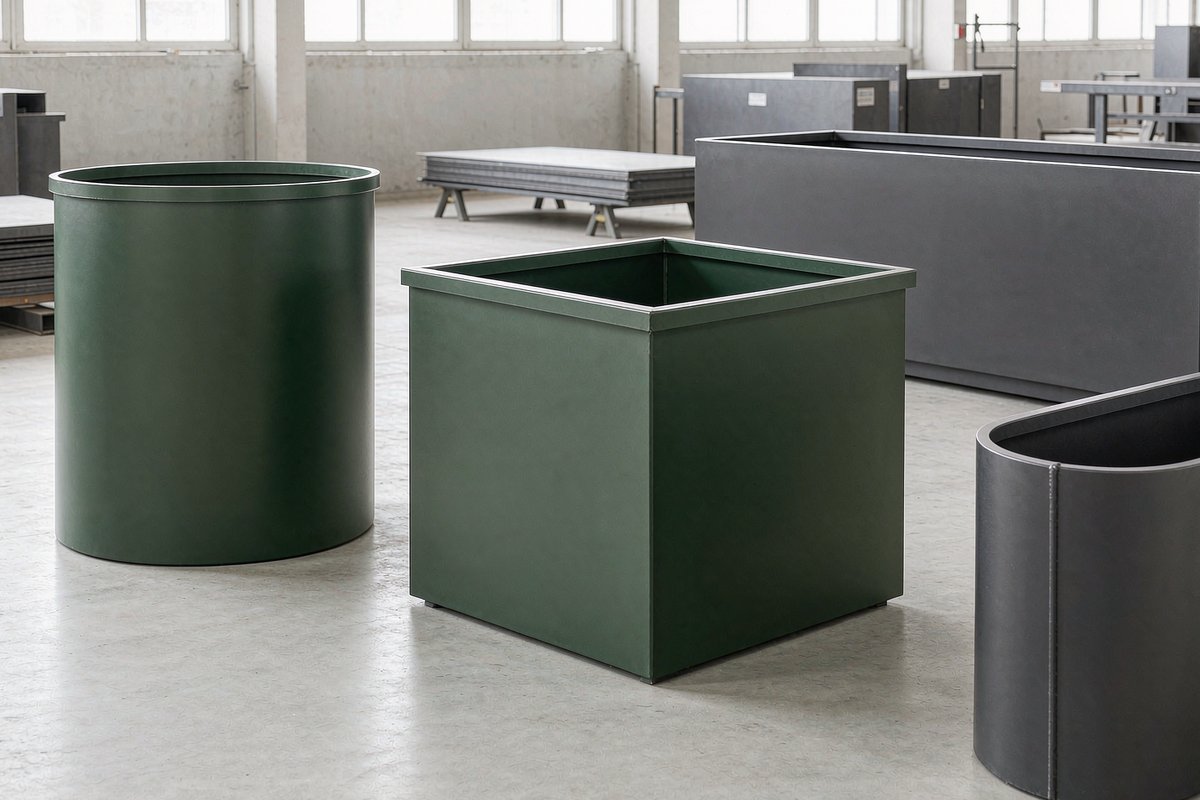
A custom planter order starts with your landscape drawing, not a catalogue page. Send a plan view showing the footprint, the soil depth the planting needs and the finish direction, and the body is built to those dimensions in powder-coated steel, marine-grade aluminium or GFRC — with drainage, liner and logo detail resolved before the first unit is formed. Below: which changes are routine, which re-tool the line, and what a custom run means for minimum quantity.
Quick answer: Dimensions, format, colour and branding are all open on a commercial outdoor planter build. Rectangular and round steel or aluminium bodies are cut and folded from sheet, so a new size is a drawing exercise; a GFRC body is mould-made, so a new shape carries a mould. Catalogue models carry a per-model MOQ from 5 pcs, while a custom run starts at 50 pcs per model because every new size goes through drawing, fixture and first-article sign-off first.
The Four Layers of "Custom"
Buyers use one word for four different requests, and they do not cost the same. The table below separates them, because the layer you are actually asking for decides the minimum run and the drawing work.
| Customisation layer | What changes | What it does to tooling | Minimum run (pcs) |
|---|---|---|---|
| Dimensions and proportions | Footprint, overall height, wall gauge, rib pitch | New flat patterns and fold sequence; existing press radii reused where unchanged | 50 per model (custom run) |
| Format and assembly | Round, square, street rectangle, trough, linked modular runs | New module joint or corner unit; cut from standard modules | 50 per model, or quoted as a linked-module package |
| Finish and colour | Any RAL powder coat, two-tone split, metallic, granite-texture GFRC | No new tooling; colour sample and batch matching apply | Same as the body run |
| Detail and branding | Laser-cut logo, cast plate, seating rim, LED preparation, castors, liner | Drawing revision plus first-article sign-off | Same as the body run |
The practical reading: a change of finish or a logo still buys a catalogue model. A change of footprint buys a custom run, and the 50 pcs applies to that model, not your total order.
Choosing the Body Material for a Custom Size
The material decides how a non-standard size behaves, and each one has a different failure mode when the size is pushed.
| Body material | How a custom size is produced | Where it is the right call | What to watch on a custom size |
|---|---|---|---|
| Powder-coated steel | Cut and folded from sheet, welded, folded edge returned | Street, plaza, promenade — clean edges and consistent colour | Tall, narrow bodies need an internal stiffener so the wall does not bow under fill |
| Marine-grade aluminium | Same fabrication logic at lower unit weight | Rooftops, podium decks and coastal sites where load or salt air decides | Isolate dissimilar metals at fixings and at the anchor plate |
| GFRC concrete composite | Cast in a mould built to the drawing | Thermal mass, a masonry look, or where a heavy body is wanted for stability | A new shape means a new mould, so the economics improve with identical repeat units |
If your specification names weathering steel, note where we stand: planter bodies are supplied in powder-coated steel, marine-grade aluminium or GFRC, and the closest stable-patina equivalent is a dark bronze or graphite powder coat. The GFRC planter specification guide covers mould economics and surface finish.
From Landscape Drawing to Fabricated Body
A custom planter is not a scaled-up catalogue unit. The sequence that keeps it buildable runs in this order:
- Read the plan view, not the elevation. The footprint on plan fixes the body; the elevation only confirms height and any rim detail.
- Set the module grid before the outline. Long runs are split into modules that can be handled, shipped and replaced individually. The Coastline modular planter is a 1200 × 500 × 550 mm module for exactly this reason — a 10 m run is a count of modules plus corners, not one welded body.
- Fix the corner and end condition. Corners are separate units so a run can turn; a quote that ignores them comes back short.
- Return the folded edge. A folded top edge is what stops a thin wall reading as a bucket, and what lets a seating rim be added later.
- Resolve drainage and liner together. Drain holes are standard; an internal liner and water-retention layer are what make a planter usable on a podium deck or atrium floor. Decide at drawing stage — it changes the base detail.
- Agree tolerance and joint gap on the drawing. On a linked run the joint gap is a design decision; leave it to the shop floor and the modules will not line up on site.
Soil Depth Is the Constraint, Not Soil Volume
Most custom planter briefs arrive as a litre figure. The litre figure is an output, not an input, and it is easier to work the other way:
Effective soil depth = overall height − drainage layer − rim freeboard. Then soil volume = footprint area × effective depth × 0.85 settlement factor.
A 150 mm drainage layer is what the range is detailed around, so overall height is never the planting depth. Volume figures for each catalogue diameter are published as planning values, treated as ±10%, on the planter volume table — and any volume for a non-standard custom footprint is calculated from your drawing and confirmed in writing, rather than assumed from the nearest catalogue size. Plant selection drives the depth: seasonal colour and grasses need far less than specimen shrubs, and a small tree needs a body the module grid may not want to carry.
Minimum Quantity, First Article and Terms
Two tracks run in parallel, and confusing them is the usual reason a custom planter quotation stalls:
- Catalogue models: per-model MOQ from 5 pcs, with 20 pcs on most models. The figure is printed on each product page — see the Terrace ribbed trough planter for a typical entry.
- Custom runs: from 50 pcs per model. The run pays for drawing, fixture and a first article, which is why a one-off bespoke planter is quoted as a project item rather than as a catalogue order.
- Mixed models share a container. Forty planters, a dozen benches and twenty bins is one order against one set of minimums, and the loading plan is issued with the quotation.
- Lead time is quoted per package, not published as a house number, because it moves with mould or fixture work, finish and load sequence. The project schedule guide shows how to work backwards from an installation date.
Where Custom Planter Orders Go Wrong
Five failures account for most of the rework we see on bespoke planter packages:
- A drawing with no drain direction. Water goes somewhere, and on paving that is a placement decision, not a factory one.
- Planting specified before soil depth is fixed. The species list then has to be cut back after the body is drawn.
- Logo artwork arriving after the laser program is cut. Branding is cheap at drawing stage, a new program at production stage.
- No liner on an indoor or rooftop job, or a module count without corners and closers — turning units are the line item most often missing from a take-off.
How to Specify — What to Send Us
Send these and the first response is a sized proposal rather than a list of questions:
- Plan view (PDF or DWG) with the footprint, and a datum line for alignment.
- Overall height and the soil depth the planting needs.
- Planting type and whether irrigation is manual or automated.
- Material direction: powder-coated steel, marine-grade aluminium or GFRC.
- RAL reference or a two-tone split, plus any paving or façade colour to sit against.
- Logo artwork as vector, and where it sits on the body.
- Site context: indoor, rooftop, coastal or street — it decides liner, castors and fixing detail.
- Quantities by model, plus the total package if other furniture is on the same order.
- Delivery sequence and the installation date you are working back from.
If the landscape drawings are still moving, send them anyway — the size chart for the standard range often answers the footprint question without a custom run, and the full planter range shows which formats already exist before a new drawing is issued.
Ready to start a custom planter package? Send the drawing set through the contact page and our engineers will return a module layout, body material recommendation and quantity breakdown against it.