
2026-11-15
Litter Bin Price Per Unit Wholesale: A Buyer's Cost Breakdown
What a litter bin price per unit wholesale includes: quote anatomy, container cube, quantity tiers and how to normalise three supplier offers fairly.
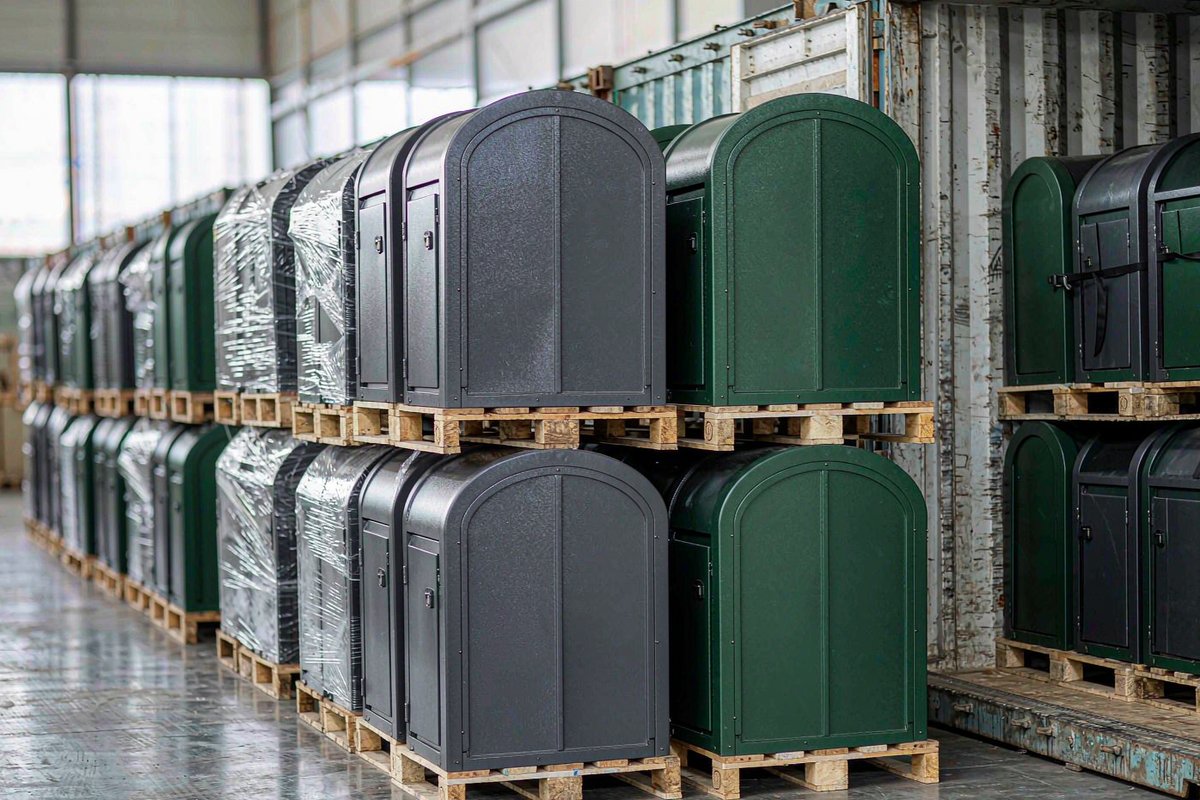
A litter bin price per unit wholesale is not one number. It is a bare body, a liner, door hardware, a finish system and a share of the shipping space the bin occupies — quoted at one quantity tier, in one packing configuration, on one Incoterm. Two factories can price the same-looking model at the same tier and still land far apart on delivered cost, because one of them is pricing the bin and the other is quietly pricing the space it fills. This breakdown walks through what sits inside the unit price, what usually sits outside it, and how to put three offers on a comparable footing before you rank them.
Quick answer: a per-unit wholesale quote for litter bins is only meaningful once it states the quantity tier, the finish system, whether the liner and fixing kit are included, the packing configuration and the Incoterm. A figure missing any of those is a placeholder, not a price.
You Are Buying Container Space as Much as Steel
Litter bins are hollow. A body that weighs a fraction of a park bench can occupy more of a container than the bench does, and sea freight is charged on volume long before weight becomes the limiting factor. That single fact reshapes how a wholesale price per unit should be read: the cheapest-looking bin is often the one that wastes the most cube, and the "expensive" quote is sometimes the one whose body packs efficiently.
The practical consequence: ask every supplier how many units of your model load into one 40 ft high-cube container. Divide the usable cube by that number and you get the container space each bin consumes. Now every offer — any model, any tier, any Incoterm — can be converted into the same unit, and the comparison stops being a guess. The OEM container packing guide covers the loading-plan documents behind that arithmetic in detail.
What Sits Inside a Bin Quote — and What Usually Sits Outside
A litter bin is a small assembly line of its own. The table below is the anatomy of a per-unit quote, with the lines that most often migrate out of the price and reappear later as extras.
| Quote line | What it covers | Commonly excluded from the headline figure | What to confirm in writing |
|---|---|---|---|
| Body and lid | Shell, top cap or hood, welds, drain provision | Hood or canopy on models quoted open-top | Which aperture style the price refers to |
| Inner liner | Removable galvanized or rigid-plastic liner with bag retention | Liner quoted as a separate line; bag-only substitution | Liner included, material, and whether it is rigid or folded |
| Door hardware | Hinged service door, cam lock, pinned hinges | Lock type upgrade, keyed-alike sets | Lock grade and whether keys are keyed-alike per order |
| Aperture inserts | Throw-in opening, ashtray module, split recycling openings | Icon panels and colour-coded aperture plates | Which inserts are inside the price at which tier |
| Finish system | Outdoor-grade powder coat over steel | Hot-dip galvanizing beneath the coat; 304 stainless upgrade | The exact system — see the coating sections |
| Fixing kit | Base plates or embedded-leg option, fasteners | Anchors and setting template billed with installation | Whether anchors are inside the unit price |
| Branding | Standard finish and plain panels | Laser-cut logos, cast badges, RAL-matched two-tone bodies | Custom branding quoted per custom runs |
| Packing and freight | Export carton or pallet, container loading | Freight itself, which follows the Incoterm | Packed dimensions and units per container for your model mix |
Two rows cause most of the disputes. The liner row, because a "bag-only" substitution looks cheaper until the first crew complains; and the finish row, because powder-coated steel and galvanized-plus-powder are different products with different service lives — the difference is set out in the specifications hub.
Normalising Three Offers: Work From the Container Backwards
Suppliers quote in whatever format their price list uses. Before ranking anything, convert every reply to the same two numbers: cost per unit at your real quantity, and units per 40 ft high-cube for your model mix. The second number is where bin quotes hide their real difference.
| Container | Nominal internal volume (m³) | Planning cube at 90% fill (m³) | Units at 0.30 m³ per bin | Units at 0.45 m³ per bin | Units at 0.60 m³ per bin |
|---|---|---|---|---|---|
| 20 ft general purpose | 33 | 29.7 | 99 | 66 | 49 |
| 40 ft general purpose | 67 | 60.3 | 201 | 134 | 100 |
| 40 ft high cube | 76 | 68.4 | 228 | 152 | 114 |
The three per-bin cube columns are illustrative planning values, not catalogue data — substitute the figure you derive from each supplier's loading plan. The table shows why the loading plan matters more than the unit price: the same container can carry twice as many slim-bodied units as wide double-door ones, so a supplier whose body nests tighter can be dearer per unit and cheaper per project. Packed dimensions per model are confirmed with the quotation; we do not publish them as generic figures.
One more normalisation trap: mixing models. If a project takes three models, the container average — not any single model's cube — decides how many units a shipment carries. Ask for the container plan for your exact mix, not a per-model ideal case.
Where the Money Actually Moves
For a given tier, five decisions move a bin's unit price more than any negotiation does.
Body format. Solid welded bodies, perforated shells and hooded tops are different fabrication jobs. A perforated body such as the Lakeside Perforated Litter Bin trades sheet cost for laser-cutting and folding time; a hooded body such as the Fairway Slat Hood Bin adds a formed top and a second aperture line. Neither is "more expensive" in the abstract — they price differently per unit of capacity they hold.
Liner system. A rigid galvanized or rigid-plastic liner costs more than a bag-only interior, and it is the difference between a bin a crew services in seconds and one the crew wrestles. On a per-unit quote, confirm the liner is inside the price rather than assuming it.
Finish system. Powder coat only, hot-dip galvanized beneath the powder, or a stainless upgrade — each is a different quote. The duplex system costs more per unit and repays it in maintenance cycles on exposed sites.
Slim versus wide bodies. A narrow 480 mm body such as the Timberline Wood-Slat Litter Bin uses less material and packs more units per container than a wide-format model such as the Steelwood Single Litter Bin. Where the site allows it, the slim body often wins on delivered cost even at a higher unit price — which is exactly why the container plan belongs in the comparison. Both formats sit in the outdoor trash bin range, each with its own footprint and service behaviour.
Wood and weathering-steel options. Timber-clad bodies should specify documented, traceable supply chains in writing, and the weathering-steel option in the range is limited to the Corten Curve Hood Bin rather than a full-line finish.
Quantity Tiers and the Tier-Boundary Trap
Wholesale pricing steps down at fixed quantities rather than sliding continuously. Per-model tiers are printed on each product page, and per-model minimums start from 5 pcs on selected builds, with most models at higher minimums and custom geometry quoted per run. Three practical rules follow from that structure.
First, quote at one tier and compare at that tier. A tier-3 price offered against a competitor's tier-1 price is not a discount, it is a different order. Second, watch the boundary: if a project lands just under a tier break, the marginal cost of lifting the last few units into the better tier is often smaller than the saving per unit — ask for both versions of the quote. Third, mixed containers inherit the weakest tier: if only one model reaches the higher quantity, confirm whether the tier applies per model or across the order line.
Terms sit on top of all of this. Our quotations are typically FOB or CIF with a 30% deposit against order confirmation and the balance against the bill of lading. Duties, import VAT and destination charges sit outside a factory quote, so land them before comparing — a CIF figure and an FOB figure differ by more than most unit-price discounts do. Liner and body volumes, where a project needs them for waste planning, are pending factory confirmation and are issued against the model specification rather than converted from outer dimensions; the capacity planning method explains how to size from usable liner volume instead.
What to Send Us
The fastest way to a comparable per-unit price is a complete enquiry. Each item below removes one round of questions.
- Model, or the closest catalogue match, plus the quantity per model
- Site type — park, streetscape, campus, transit stop — and exposure
- Aperture style: open throw-in, hood, canopy, or split recycling openings
- Liner requirement: rigid liner included or bag-only, and emptying frequency
- Finish system: powder coat, galvanized-plus-powder, stainless, or a RAL reference
- Fixing substrate: paving, slab or soil, and whether anchors are inside the price
- Destination port and preferred Incoterm, for the freight leg of the comparison
- Any branding: logos, icon panels, two-tone bodies, city artwork
Send the list and we will return a quotation that states the tier, the packing configuration and the units per container for your mix — the three numbers that make a per-unit bin price comparable. If you are still selecting bodies, the trash bin category page links every model to its specification sheet, and the litter bin size chart puts the footprints side by side. For a formal enquiry, go straight to contact.