
2026-11-04
Outdoor Planter Supplier China: Material, Load and Drainage Checks
How to vet an outdoor planter supplier in China: material routes, body stiffness, drainage path, load schedule, lifting points, minimums and terms.
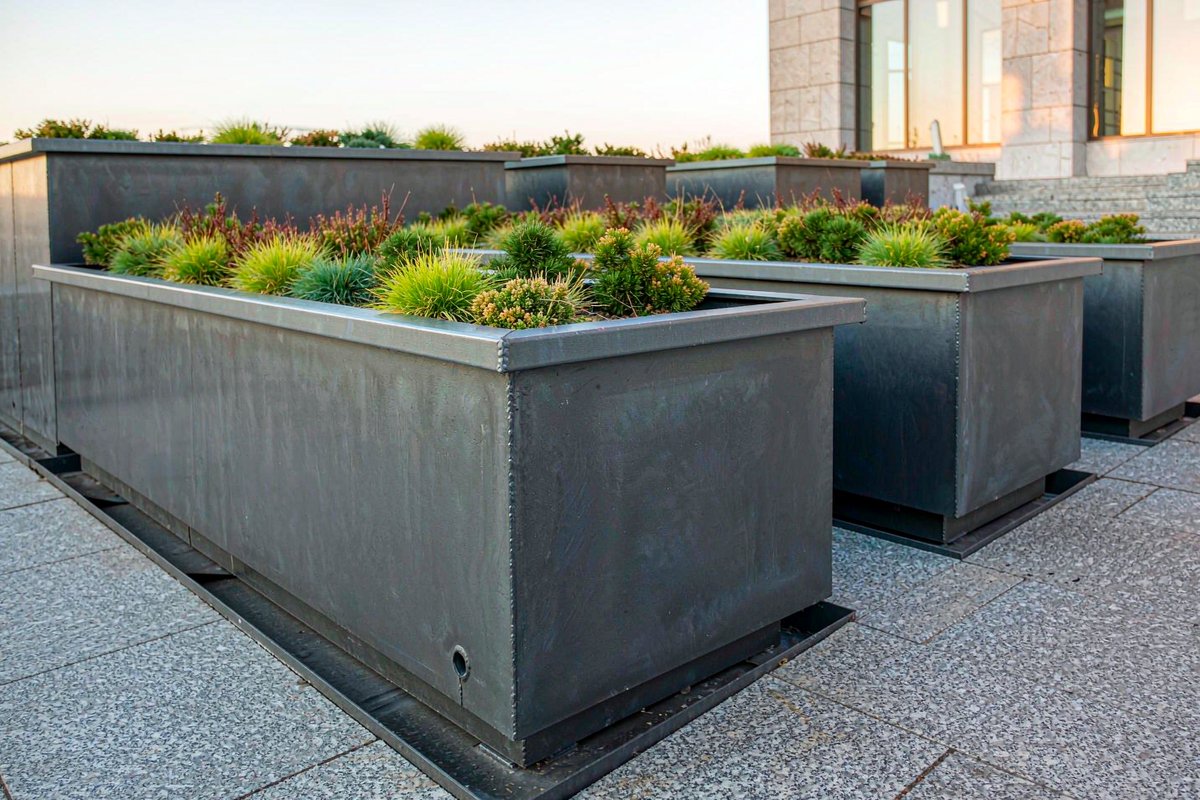
Vetting an outdoor planter supplier in China comes down to three questions you can ask before price enters the conversation: what the body is made of and how thick it is, where the water goes when it rains, and what the unit weighs once it is planted. A supplier who answers all three in writing, with drawings and a load schedule, is worth quoting. The rest are resellers of a photograph.
Three supplier types, three different risks
The phrase "planter supplier" covers three very different businesses, and the distinction decides how much of your specification survives contact with the factory.
Export trading companies hold no plant. They are efficient at paperwork, consolidation and freight, and useful when an order mixes planters with bins and benches. What they cannot do is change a gauge, adjust a fold or tighten a weld — technical questions are relayed to a factory you never speak to and come back paraphrased.
Sheet-metal fabricators cut, fold, weld and coat in-house. This is where body thickness, corner detail and drainage geometry are actually decided, and where a shop drawing is a production document rather than a sales illustration.
Project houses working to drawings sit between the two: they take the landscape architect's plan, produce shop drawings, run a sample, and manage first-article inspection before the line starts. Custom planter programmes belong here.
Ask each bidder: who welds the body, and which plant coats it? A supplier who names a process — laser cut, press-braked, jig-welded, zinc primed, powder cured — is describing their own floor. A supplier who answers "our partner factory" has told you where the risk sits.
Material routes, and what each one changes
Three body materials cover almost every commercial planter brief, decided by what the project is buying: colour consistency, weight or mass. Our commercial planter range is built in these three, and the differences below are the ones that surface in a quotation.
| Body route | Construction | Relative shell weight | Edge and repair behaviour | Where it wins |
|---|---|---|---|---|
| Powder-coated steel | Folded and welded sheet, zinc-rich primer, UV-stable polyester powder | Moderate | Crisp folded edge; chips spot-repairable on site | Streetscapes, plazas, retail frontage — any scheme that needs a RAL match across furniture families |
| Marine-grade aluminium | Welded aluminium sheet, powder-coated | Lightest of the three | Softer edge; dents rather than chips | Roof terraces, podiums, balconies and any deck with a tight load allowance |
| GFRC composite | Glass-fibre reinforced concrete shell, moulded | Heaviest of the three | Thick masonry edge; repairs are cosmetic patching | Atria, hospitality, heritage contexts where thermal mass and a stone look matter |
Two honest notes. First, we do not manufacture planter bodies in weathering (corten) steel: patina runoff stains light paving and the section needs a corrosion allowance that adds weight for no structural gain. If your drawings call for corten, a dark bronze or graphite powder coat reads as a stable patina and arrives consistent unit to unit. Second, an aluminium and a steel planter of the same drawing are not interchangeable on a load schedule — the difference is the number your structural engineer needs.
Four checks that separate fabricators from resellers
Body stiffness under fill. A planter is a retaining wall with four sides. Wet substrate pushes outward continuously, and a light gauge body with no internal stiffening bows along its long face within a season — the paint line cracks first, then the panel drums. Ask for the body gauge in millimetres, the fold depth, and whether internal ribs are welded on troughs longer than about a metre. Our ribbed trough planter is a working example: the rib profile is a stiffness decision before it is a visual one.
The water path, drawn. Drainage holes are the easy part; the question is where the water lands. On a paved plaza it can discharge to the surface. On a podium, a roof deck or an indoor atrium it cannot, so the planter needs an internal liner, a retention layer and a sealed base — the arrangement described in our planter drainage guide. Ask for a section drawing showing the drain, the overflow level and the liner termination. A supplier who sends a photo instead of a section has not yet engineered the product.
Lifting and handling. A planted planter is not moved by two people. Specify cast-in lifting lugs or bolt-on eyes, note the crane or telehandler access on site, and confirm the empty weight in writing so the rigging plan can be built. Where units are repositioned seasonally — hotel lobbies, event plazas — a castor plate is a specification item, as on our mobile lobby planter, not an accessory.
Base detail and floor protection. Direct contact between a steel base and a membrane, a timber deck or a polished floor is a wear point and a water trap. Adjustable feet, a continuous plinth or a sacrificial pad belong in the drawing. On exposed decks, the base fixing also has to resist wind uplift on an empty unit — a load case settled with the engineer of record, not by the supplier alone.
Build the load schedule before you ask for a price
Planters are one of the few furniture items where the delivered weight can govern the structure. A short load schedule, circulated with the RFQ, saves a redesign later.
| Input | Unit | Who supplies it | Why the quote depends on it |
|---|---|---|---|
| Overall height and plan dimensions | mm | Your drawing | Sets shell size, panel count and packing footprint |
| Drainage layer depth | mm | Specified by you, confirmed by factory | Subtracted from overall height before soil volume is calculated |
| Effective soil volume | L or m³ | Calculated, then confirmed in writing | Drives saturated weight and planting viability |
| Substrate bulk density | kg/m³ | Your landscape engineer | Converts volume into load; varies widely by mix |
| Empty unit weight | kg | Factory, in writing | Rigging plan, crane selection, manual handling limits |
| Saturated unit weight | kg | Derived and confirmed by factory | Podium and roof loading, slab point loads |
| Fixing or ballast requirement | kN or fixing schedule | Engineer of record | Wind uplift and slip resistance at the base |
The volume is arithmetic, not guesswork: subtract the drainage layer from overall height, apply the plan area, then a settlement factor for the substrate. The formula and a worked table of catalogue diameters sit on our planter volume page; treat those figures as planning values and have the factory confirm the final number against the internal geometry of your unit. Sizes in millimetres and inches are collected in our planter size chart.
Minimums, samples and terms
Catalogue planters carry a per-model minimum, from 5 pcs on selected builds and typically around 20 pcs — the figure is printed on each product page rather than issued as a house rule. Custom runs start at 50 pcs per model, because a new mould or fold goes through drawing, fixture and first-article inspection before the line runs. Mixed models share one container, so planters, benches and bins can travel as a single order against one set of minimums.
A catalogue model can usually be supplied as a single pre-production unit; a custom body needs an approved shop drawing first, and a moulded GFRC section needs a tooling decision before anything is cast. Terms are typically FOB or CIF with a 30% deposit and the balance against documents; whether the sample charge is credited against the bulk order, and the warranty position on coating and body, are points to settle in writing at quotation stage.
How to specify: what to send us
The fastest, most accurate quotation comes from a complete brief. Send:
- Plan view or landscape drawing with the planter positions marked
- Overall height and plan dimensions, in millimetres
- Body material preference, or the constraint driving it — load allowance, colour match, masonry look
- RAL colour or a reference image, plus gloss level
- Planting type and expected substrate, so the soil volume can be sized
- Placement: plaza, podium, roof deck, indoor atrium, or coastal exposure
- Drainage route: surface discharge, or liner and retention required
- Lifting and handling constraints on site — crane, telehandler, lift dimensions
- Quantities by model, and the required delivery window
Send those nine lines through our contact page and we will return a costed proposal with the material route, per-model minimums and a shop drawing scope stated in writing. If the brief is still open, the planter category page lists every model with dimensions and finish, and our GFRC specification guide covers the composite route in more depth.