
2026-11-14
Park Bench Supplier China: Auditing the Bench Spec Sheet
Sourcing a park bench supplier in China? Audit the spec sheet: frame drawing, slat fixing, coating, fixing kit and packing, before you rank the quotes.
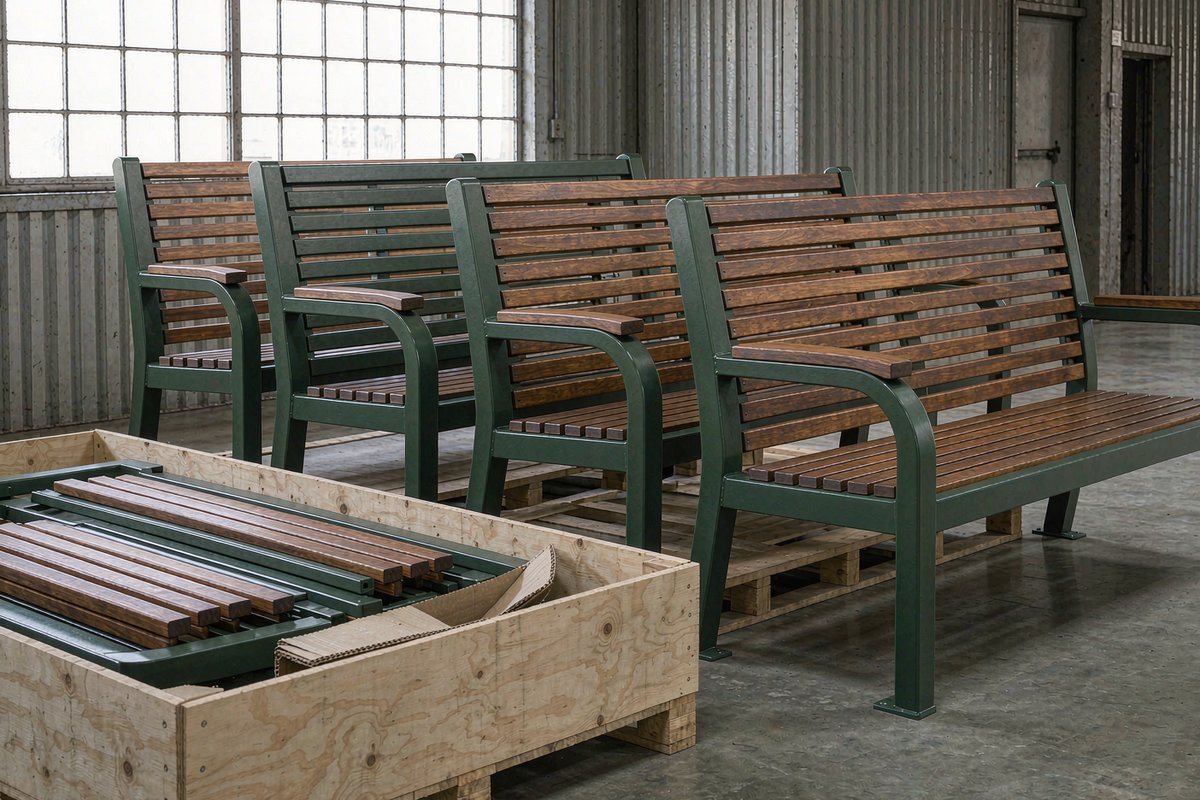
When you evaluate a park bench supplier in China, the catalogue tells you almost nothing and the spec sheet tells you almost everything. A factory that manufactures its own benches can produce five documents on request: a dimensioned frame drawing, a slat schedule, a written coating build-up, a fixing-kit detail and an export packing list. A supplier who cannot produce them is reselling, and every line the sheet leaves vague eventually reappears as a variation on your invoice.
Quick answer: before ranking any park bench supplier in China, ask each one for the same five documents and read them line by line. Price the supplier whose spec sheet survives the audit — not the one whose photograph looks closest to your reference image.
The Five Documents to Demand
These five lines are where a real bench manufacturer and a trading outfit separate, because the first four come from the factory's own engineering file and the fifth from its export process. Request them all, from every candidate, in the same format, or the comparison collapses before it starts.
| Document | A complete entry states | Red flag |
|---|---|---|
| Frame drawing | Section profile and wall thickness, leg centres, seat and back geometry, weld locations | "Heavy-duty steel frame" with no section data anywhere on the sheet |
| Slat schedule | Slat material by name, count and profile, edge treatment, fixing method per slat | A catalogue photograph standing in for a schedule |
| Coating build-up | Pretreatment, galvanizing or primer layer, powder topcoat, whether internal faces are coated, RAL reference | "Powder-coated" with no layer detail behind it |
| Fixing-kit detail | Base plates or embedded legs, anchor type, setting template, substrate the design assumes | "Anchors available" added as an afterthought line |
| Export packing list | Crate or carton dimensions, nesting scheme, units per container for your model mix | "Foam and carton" with no crate plan |
Why these five? They are exactly the lines a reseller cannot answer without calling the factory — and the delay, or a reply that arrives reformatted and contradictory, is itself your answer. The coating and stainless sections of the specifications hub show what a complete finish description looks like, so you can hold every reply against a worked example rather than a feeling.
Reading the Slat Schedule Like a Buyer
The slat schedule is the line most often fudged, because slats carry both the look of the bench and most of its lifetime cost. Three slat families circulate in the export market, and each one fails a different audit if the entry is incomplete.
| Slat material | The schedule must state | Watch for |
|---|---|---|
| Steel bar or plate slats | Profile, thickness on the drawing, edge radiusing, individual fixing per slat | Unnamed "steel" that could be anything from the offcut bin |
| WPC slats | Profile, colour stability approach, fixing method, replacement per slat | "Composite" used as a catch-all for several different materials |
| Hardwood slats | Species named in writing, documented, traceable supply chains, fixing method per slat | A generic "hardwood" that resolves into whatever is in stock after the deposit |
Two rules make the schedule enforceable. First, species and profile go into the purchase order, not just the quotation — a sheet that names them only in the offer can be changed silently between offer and delivery. Second, confirm that any single slat can be replaced without dismantling the bench, and ask how replacement slats are sourced after installation; here they are quoted per project rather than held as a stock line, and a supplier who promises a permanent spare-parts catalogue for a catalogue bench is promising something they have not checked with their own factory.
Frame Questions That Separate Maker From Trader
Beyond the drawing itself, four questions expose who actually controls production. Ask who cuts and bends the frame sections, and whether the welding happens in-house or at a subcontractor. Ask whether a first-article sample against the drawing is offered before the run — a factory with its own jigs says yes quickly, because the jig already exists. Ask what happens when a section size changes between your order and the next batch, and whether the drawing revision is versioned and dated. And ask which models are tooled and which would be fabricated to order; a supplier who claims everything is "standard stock" for a range that includes curved and cast-leg builds is describing a wish, not a workshop.
If the answer to the fourth question is that only catalogue builds are tooled, that is normal and workable — the park bench range shows exactly which builds are already in production, including the Fairway park bench with its timber slats, the all-steel steel slat bench for high-vandal sites, and the hardwood cast-leg bench where the frame is cast rather than fabricated. Geometry outside that list moves to a custom run, and the drawing-to-container path is set out in the custom park bench guide.
Terms to Pin Beside the Audit
A spec sheet that survives the audit still needs commercial terms pinned down in writing, because the same technical file can be quoted on very different order structures.
| Term | Structure to confirm in writing | Why it moves |
|---|---|---|
| Order route and minimum | Catalogue models quoted per model — most at 20 pcs, selected builds from 5 pcs; custom geometry from 50 pcs per model | Setup costs amortise differently on each route |
| Payment split | 30% deposit with the balance against shipping documents | Cash-flow risk shifts with the split |
| Delivery term | FOB and CIF quoted side by side, same destination port | Freight and insurance hide scope differences |
| Quote validity | A stated validity window, named currency | Steel prices move; undated offers expire quietly |
| Packing scope | Export crating versus blanket wrap, stated per model | Bulky goods are charged by volume, not weight |
The routes and their minimums are broken down further in the park bench MOQ guide. Once the terms are pinned, the comparison of actual figures is a separate exercise — the per-unit cost model walks through normalising competing quotes onto identical scope.
Where the Audit Most Often Fails
- The coating line stays silent. Powder-only quoted against galvanized-plus-powder is a different product at a different level; the failure shows up as the first scratch opening bare metal.
- Hardwood stays unnamed. The word "hardwood" in a quotation is a placeholder; the species, the documentation of the supply chain and the fixing method all belong in the purchase order.
- The fixing kit arrives later. Base plates, anchors and templates quoted as a post-award variation are the classic increase, and the substrate the design assumed was never stated.
- The seat count was counted from a photograph. Length, armrests and layout change how many people a bench holds; the count belongs on the model's own drawing, which is one more reason the frame drawing leads the document list.
How to Specify — What to Send Us
Send these eight items and the reply is a costed proposal against your own specification instead of a page of questions:
- Model, drawing or reference image, with quantity per model — and the total package if bins or planters ship in the same container.
- Bench length, seat depth, and backrest or backless; catalogue builds such as the plaza backless bench can be quoted directly.
- Slat material, named precisely: steel, WPC, or hardwood with any species requirement written out.
- Frame and finish: powder-coated galvanized steel, 304 stainless, or aluminium, with the RAL reference.
- Fixing method and substrate: surface base plates, embedded legs, or a mix across the site.
- Delivery term and destination port, so FOB and CIF can be shown side by side.
- Export crating requirement, and any crane or tail-lift constraint at the receiving site.
- The installation date you are working back from, so the order route and shipping window are realistic.
Sizing questions can be settled before the quotation — the park bench dimensions in mm, inches and feet in the specifications hub cover seat height, depth and lengths in both unit systems, and the full park bench category shows what is already tooled.
Send the specification through the contact page with the five documents you expect back, and the reply will be a spec sheet built to pass your own audit: frame drawing, slat schedule, coating build-up, fixing-kit detail and export packing plan, with FOB and CIF quoted side by side at your quantity.