
2026-11-03
Stainless Steel vs Powder Coated Trash Bins: A Buyer's Comparison
Stainless steel and powder-coated trash bins compared: corrosion, coastal sites, dents, maintenance and cost tier, plus a specifying checklist for buyers.
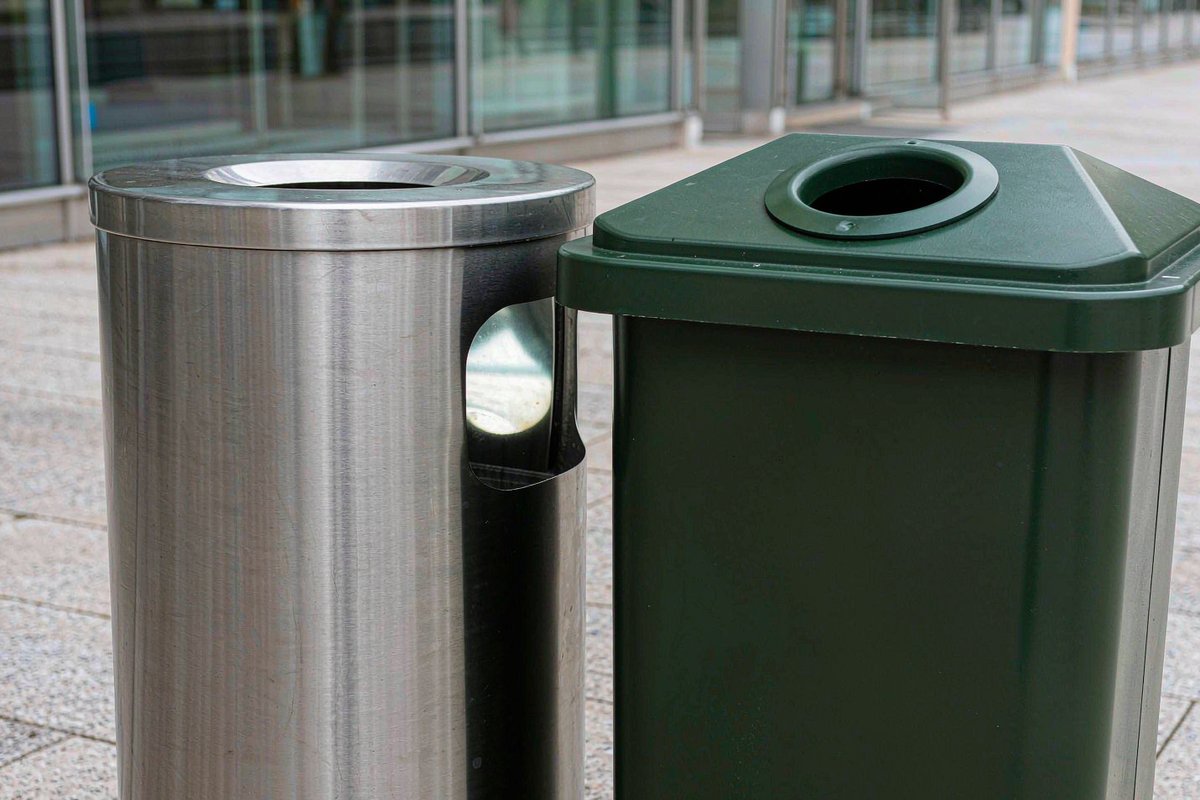
For most inland public spaces, a properly specified powder-coated steel bin is the more practical purchase: it carries any RAL colour in the streetscape palette, holds its finish for years with simple cleaning, and a damaged panel can be repaired and resprayed instead of replaced. Stainless steel earns its premium where salt, hygiene or fingerprints drive the specification — coastal promenades, transit interchanges, covered podium lobbies. This guide compares the two materials the way a buyer should: by site environment, cleaning regime and service life, not by which surface photographs better.
The two materials, defined precisely
A powder-coated trash bin is a carbon steel body — usually with a zinc-rich primer or a hot-dip galvanized layer underneath — finished with an electrostatically applied polyester or PVDF-type powder that is baked into a continuous skin. The coating is the primary corrosion barrier; the zinc layer underneath is the backup that protects any spot where the film is breached. Our overview of hot-dip galvanizing for outdoor furniture explains how that underlayer works.
A stainless steel trash bin resists corrosion through the alloy itself, not through a coating. Grade 304 is the general-purpose choice; grade 316 adds molybdenum for chloride environments. If a supplier quotes "stainless" without a grade, that is the first question to ask — our guide to stainless steel grades for outdoor furniture covers the differences buyers care about.
Side-by-side comparison
| Factor | Powder-coated steel | Stainless steel (304/316) |
|---|---|---|
| Corrosion barrier | Coating film + zinc underlayer | Alloy through the full body thickness |
| Inland durability | High with intact coating; touch-up possible | High; no coating to maintain |
| Coastal exposure | Needs verified coating spec; sheltered placement | 316 grade holds up near salt spray |
| Surface damage | Chip exposes steel; repair by respray | Scratches blend into brushed grain; dents remain visible |
| Cleaning regime | Mild detergent, soft cloth; avoid abrasives | With-grain wiping; specific cleaners to avoid tea-staining |
| Colour range | Any RAL, textures and gloss levels | Natural metal tones only |
| Cost tier | Mid | Premium |
| Fingerprint visibility | Low on matte/mid-gloss finishes | High on bright brushed faces |
Matching the material to the site
The decision is mostly environmental, and it can be made in a minute on site. The distance bands below are indicative planning guidance for early scoping, not a factory-verified limit — confirm the final coating or grade specification with the manufacturer against your actual site.
| Site environment | Distance to breaking surf (m) | Recommended approach |
|---|---|---|
| Inland parks, campuses, residential estates | > 5,000 | Powder-coated steel, standard polyester system |
| Urban cores, business districts, podium decks | > 5,000 | Powder-coated steel; stainless-look finish where a metal tone is wanted |
| Suburban transit stops, roadside verges | 500 – 5,000 | Powder-coated steel with an enhanced zinc underlayer; request the coating spec in writing |
| Coastal promenade, beachfront, marina edge | < 500 | Discuss 316-grade stainless, or keep coated bins in sheltered pockets with a rinse-down regime |
Most real schemes mix the two: coated bins across the main body of the site, one metal-finish feature where the architecture asks for it. Browse how the builds, hoods and doors are configured in our outdoor trash bins category before you shortlist.
What powder coat does better
Three practical advantages explain why powder-coated steel dominates most public-realm bin ranges, including ours.
Colour and identity. A streetscape programme lives and dies by palette discipline. Powder coat delivers any RAL across bins, benches, planters and bike racks so the whole furniture family matches. Stainless cannot be colour-matched.
Repair economics. When a coated panel gets scratched by a maintenance tool or scorched at an emplacement, the fix is a powder-coating touch-up and respray — a maintenance task, not a spare-part order. A dented stainless face usually stays dented.
Cost per unit at quantity. For a 60-bin municipal rollout, the budget difference between coated steel and stainless buys the difference between a basic liner programme and a full servicing kit. When you are comparing quotes from an outdoor trash bin supplier in China, ask each bidder to quote both material routes so the delta is visible on your terms.
What stainless does better
Salt air. Near breaking surf, any coating is a consumable: it will chalk and breach faster, and every breach becomes a corrosion site on steel underneath. Through-body alloy resistance does not depend on a film.
Hygiene-sensitive interiors. Transit hubs, hospitals and food precincts clean hard and often, sometimes with agents that attack coatings. Stainless tolerates that regime.
Perceived quality. In covered lobbies and premium podiums, brushed steel reads as architectural metalwork rather than street furniture — which is why even our catalogue offers a stainless-look architectural bin finished in metallic powder coat rather than a painted colour.
Where weathering steel fits
A third option sits outside this comparison: weathering (corten) steel, which forms its own protective oxide layer and never needs repainting. It suits feature locations on dark or warm-toned paving — with the caveat that run-off can stain pale surfaces during the patina period. The corten curve hood bin in our range is a weathering-steel hood over a coated drum, so the touch surfaces stay maintainable.
What our range offers
Every catalogue litter bin we manufacture — from the perforated lakeside model with its rain hood and locking door, to the gloss KYNAR fluted bin for evening plazas — is built on powder-coated steel, because that is where the durability-per-budget equation lands for most public programmes. The range, minimums per model and coating options are all listed under our outdoor trash bins category.
If your site genuinely calls for full stainless construction — a beachfront scheme, a 316 spec written by a marine consultant — talk to us through the same channel as a custom OEM run: alternative body materials are quoted against drawings and subject to factory confirmation. Per-model minimums are printed on each product page, starting from 5 pcs on selected builds, and coating systems are documented on our specifications hub, including the stainless finish notes.
How to specify: what to send us
Whether you land on coated steel or stainless, the fastest quotations come from a complete brief. Send:
- Site location and macro environment (city, climate zone, any coastline within a few kilometres)
- Indoor, covered or fully exposed placement
- The cleaning regime and chemicals your maintenance team uses
- Target colour: RAL number, gloss level or a brushed-metal requirement
- Aperture type (open, hooded, chute) and liner servicing preference
- Estimated annual quantity and first-delivery date
- Mounting: surface-mount base plates, in-ground or freestanding
- Any architect drawings or a reference product you are matching
With those eight lines, a factory-direct quotation comes back with the material route, coating system and per-model minimums stated in writing — the three items that decide whether the bin you buy is the bin that survives your site. Send your project details through our contact page and we will respond with a costed proposal.