
2026-11-16
Outdoor Planter Lead Time: What Actually Moves Your Delivery Date
Planter lead time is mostly decided before production starts. See the six decisions that move your delivery date, and what to lock before you sign.
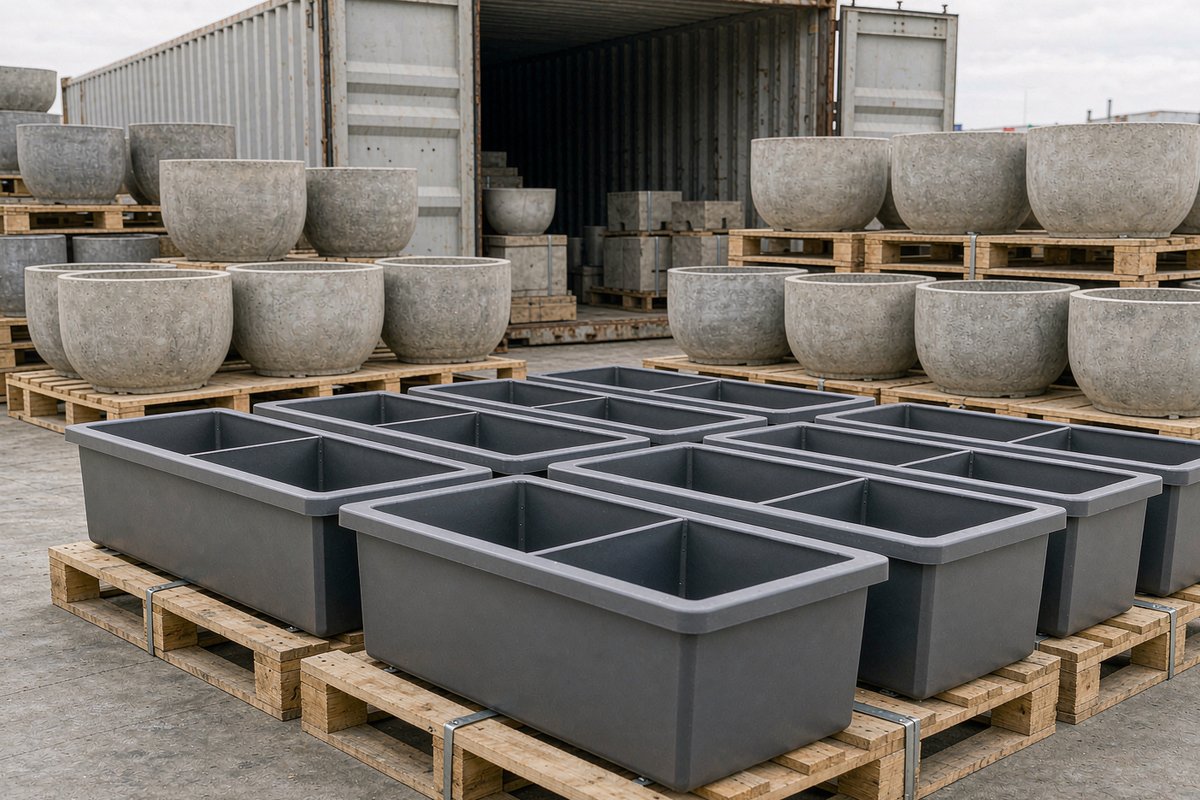
An outdoor planter lead time is rarely a factory problem. Fabrication is usually the shortest segment of the calendar; the weeks around it — specification rounds, coating decisions, approval loops and freight booking — are where delivery dates quietly slip. Buyers who fix six decisions up front routinely ship on the original schedule, while buyers who treat those choices as open questions watch a production run finish and still wait. This article walks through where the time actually goes on a commercial planter order, and what to lock before you sign anything.
Quick answer: the biggest lever on planter lead time is decision discipline before production starts — material route, geometry, finish, drainage and irrigation, approval rounds and freight booking. A catalogue model with a frozen spec ships far sooner than a semi-custom one with a moving spec.
Where the Calendar Actually Goes
A planter order moves through six stages: specification freeze, drawing confirmation, material procurement, fabrication, coating and packing, then freight booking. The first two and the last one are almost entirely controlled by the buyer side, which is good news — they are the cheapest stages to shorten. The project schedule guide breaks the whole PO-to-install span into stages with planning durations; this article stays on the six decisions that bend the curve on a planter line specifically.
Two features of the planters category make this sharper than on benches or bins. First, the material route splits into genuinely different production systems — powder-coated steel and marine aluminium run a cut-bend-weld-coat sequence, while GFRC composite bodies involve moulding and a cure window before demoulding — so the same quantity ordered in two materials does not sit in the same queue. Second, planter interiors matter: drainage layers, liners and drip-line connections are built in after the shell work, so late changes there do not just add fitting time, they push the packing date.
The Six Decisions That Move Your Delivery Date
| Decision | How it moves the schedule | What to lock early |
|---|---|---|
| Material route (steel / aluminium / GFRC) | Different production systems run on different queues; switching route mid-project restarts procurement | Name the material at RFQ, not after the first drawing |
| Geometry (catalogue vs custom shell) | Catalogue shapes run from existing jigs and moulds; new geometry needs tooling and first-article approval | Choose catalogue modules wherever the layout allows |
| Finish (stock RAL vs non-stock colour) | Non-stock colours join the coating queue later and may need panel verification | State the RAL code in writing with the order |
| Drainage and irrigation build-in | Internal fittings are assembled after coating; late additions reopen finished work | Decide drip-line readiness and liner type before drawing release |
| Approval rounds | Each drawing revision restarts the clock at the drawing stage, not at production | Nominate one approver with a review deadline |
| Freight booking | Booking after packing completion stacks vessel wait onto production wait | Hand the forwarder a packing plan before fabrication ends |
None of these rows is exotic — that is the point. Almost every delayed planter shipment we see traces back to one of them being left open into the production window.
Catalogue Runs vs Custom Geometry
Geometry is the decision with the widest spread. Modular systems such as the Coastline Modular Planter — marine-grade aluminium modules of 1200 × 500 × 550 mm that join at 120° — let you build serpentine promenade layouts entirely from existing jigs, which keeps the run on the fastest path through the shop. The same logic applies to straight troughs: the Terrace Ribbed Trough Planter is a standard steel shell at 1500 × 420 × 600 mm with an optional irrigation connection specified at order stage.
Custom shells are a legitimate choice — statement pieces for atria and plazas often justify their own tooling — but they change the calendar, not just the price. A new profile means rolling or forming dies, a first-article check, and a coating trial on the new surface before the batch runs. The fastest schedules on the outdoor planters category page belong to models built from existing tooling, so treat custom geometry as a deliberate trade against time. When a project needs both, the usual answer is to split the order: catalogue modules for the baseline runs, custom pieces for the signature positions. The custom planter OEM guide covers the tooling and approval sequence in detail; custom runs carry their own minimum quantity per model, while catalogue builds start from lower per-model minimums — from 5 pcs on selected builds, with most catalogue models at 20 pcs.
For reference, four catalogue models span the range from fast-tracking street runs to statement pieces:
| Model | Body material | Footprint (mm) | Height (mm) | First MOQ band (pcs) |
|---|---|---|---|---|
| Coastline Modular Planter | Marine-grade aluminium, powder-coated | 1200 × 500 | 550 | 20 |
| Terrace Ribbed Trough Planter | Steel, powder-coated | 1500 × 420 | 600 | 20 |
| Lumen Street Planter | GFRC concrete composite | 1100 × 450 | 550 | 20 |
| Grand Atrium Round Planter | Steel drum with gold rail collar | 1000 dia | 1000 | 10 |
The MOQ column matters for scheduling as well as for ordering: quantities that stay within a single model's tier are simpler to sequence, while mixed-model projects inherit the longest production path among the models involved.
Soil Volume and Drainage Belong in the Same Conversation
Soil volume is usually discussed as a planting question, but it is a scheduling question too. Liner selection, drainage layer thickness and irrigation fittings all depend on the internal geometry, and they are sourced or fabricated on their own timeline. The calculation method — with the drainage allowance and settlement factor — is set out in the specifications centre; the exact per-model usable volumes remain pending factory confirmation, so plan the liner route by calculation rather than by assumption, and confirm the chosen configuration in writing before drawings are released.
The same applies to wind loading on exposed sites. Troughs on decks and round planters on promenades sit in different exposure bands, and fixing or ballast requirements can affect the base detail — which, like the drainage build-in, is cheapest to settle before coating, not after.
How to Compress the Schedule Without Compressing the Product
- Freeze material route, finish code and drainage configuration at RFQ stage, and treat later changes as formal revisions with a date cost.
- Nominate a single approver for drawings and a first-article sample, with a review window stated in the order.
- For phased sites, ship the catalogue-model phases first and let the custom pieces follow on their own tooling timeline.
- Book freight against a projected packing date rather than a confirmed one; re-booking late is the most expensive week you can buy.
- If the destination climate is coastal or frost-exposed, say so at RFQ — material and coating selection on the planter category page differ by exposure, and choosing the right route first time avoids a late re-specification.
- Compare shortlisted factories on schedule transparency, not just on price; the planter supplier vetting checklist lists the evidence to request.
What to Send Us
To quote and schedule a planter order accurately, send:
- Site type and city, so climate and exposure can drive material selection.
- Quantity per model, split by catalogue and custom if the project mixes both.
- Preferred models from the catalogue, or drawings/CAD files for custom shells.
- Finish requirement as an explicit RAL code or reference.
- Drainage and irrigation requirements, including drip-line readiness.
- Substrate and fixing situation — deck, slab, soil bed — for the base detail.
- Target on-site date and preferred Incoterm.
- Any phasing constraints, so the sequence can be planned around them.
Send these with the layout quantities from the planter sizing method and the dimensions from the planter size chart, and a quotation will come back with a production and packing schedule attached rather than a bare figure. If you are planning a planting-led scheme and want the schedule reviewed against your site dates, contact us with the list above — the earlier the six decisions arrive, the earlier the container does.